The Level 7 aesthetics exam isn’t just a test of how well you can memorise a textbook; it’s a rigorous assessment of your ability to think and act like a clinical leader. Many practitioners feel a genuine sense of dread when faced with the level 7 aesthetics exam difficulty, often worrying that the academic written components or the high stakes environment of the OSCEs might be insurmountable. It’s completely natural to feel overwhelmed by the sheer volume of facial anatomy or the depth of critical analysis required for a master’s level qualification.
We understand these concerns because we see them every day. We’re here to reassure you that while the standards are high, this qualification is entirely achievable with the right framework and support. This guide breaks down the academic and practical challenges of the Level 7 Aesthetics Diploma, offering expert insights into the format of SAQs and clinical assessments. You’ll gain a clear study strategy to manage the workload and the confidence to prove your clinical “why” through evidence based practice, ensuring you’re fully prepared for the regulatory environment of 2026.
Key Takeaways for Mastering Your Level 7 Exam
- Move beyond basic injection techniques to master the postgraduate level critical thinking required by Ofqual regulated standards.
- Navigate the level 7 aesthetics exam difficulty with a clear breakdown of referenced SAQs and the structured clinical environment of OSCEs.
- Prepare for your practical assessments by understanding how to document 40 clinical cases with the precision expected of a master’s level practitioner.
- Build a sustainable study routine using our “Write as You Go” method and clinical literature banks to stay ahead of your academic deadlines.
- Understand why local mentorship and hands-on support are essential investments in your confidence and long term career safety.
What Is the Level 7 Aesthetics Exam Difficulty? Understanding the Standard
The level 7 aesthetics exam difficulty is often the first topic practitioners raise when they look toward the future of their career. It is a valid concern. This qualification isn’t a simple attendance certificate or a quick weekend workshop. It is a postgraduate-level qualification regulated by Ofqual, specifically designed to bridge the gap between technical skill and clinical mastery. As the standards for Aesthetic medicine continue to rise, this distinction becomes your most valuable asset for professional safety and patient trust.
The Ofqual Framework: What Level 7 Really Means
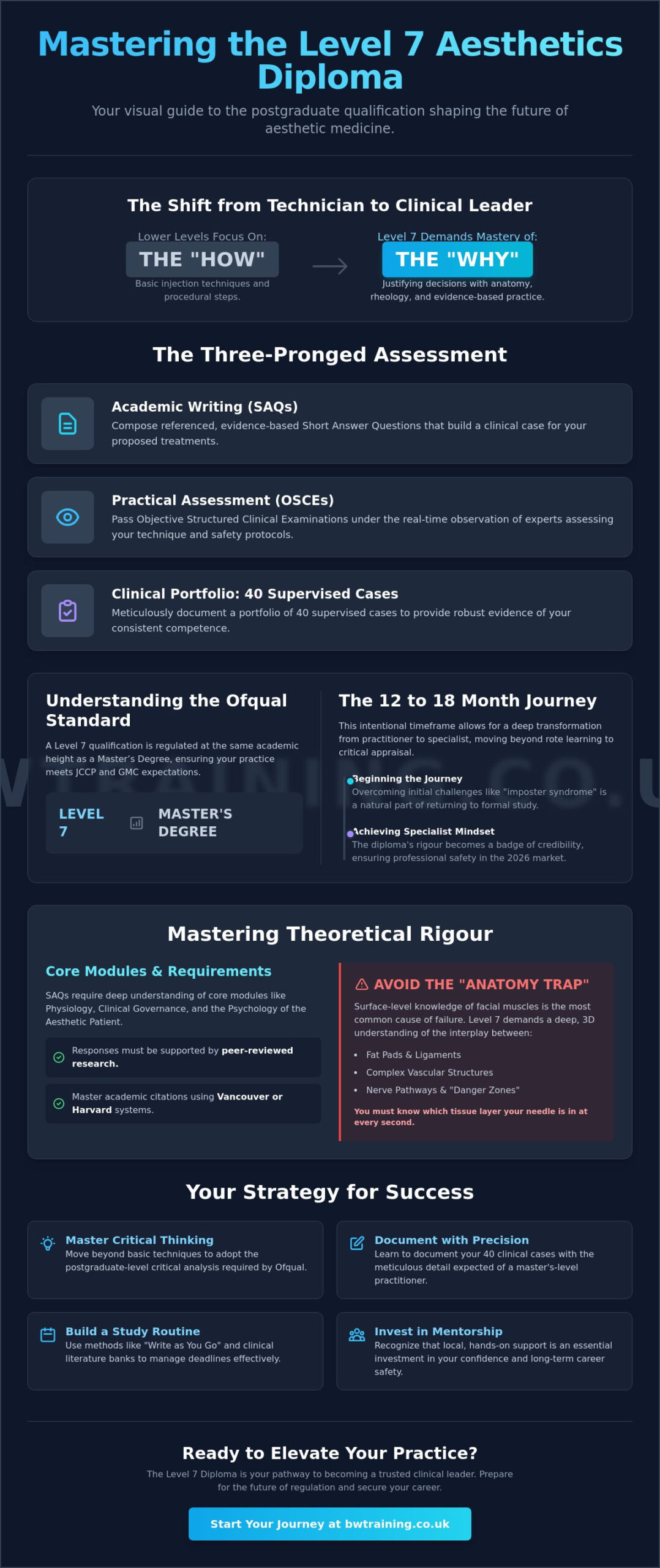
The Regulated Qualifications Framework (RQF) places Level 7 at the same academic height as a Master’s degree or the final year of a medical program. While lower levels focus on the “how” of aesthetics, Level 7 demands you master the clinical “why.” You aren’t just learning where to place a needle; you’re learning to justify that decision through a deep understanding of facial anatomy, rheology, and psychological screening. This standard aligns with JCCP and GMC expectations, ensuring your practice stands up to the most rigorous scrutiny.
To achieve this, you’ll need to conquer a three-pronged challenge:
- Academic Writing: Completing Short Answer Questions (SAQs) that require referenced, evidence-based arguments.
- Practical OSCEs: Passing Objective Structured Clinical Examinations where experts observe your technique and safety protocols in real time.
- Clinical Portfolio: Documenting 40 supervised cases with meticulous precision to prove consistent competence.
The Emotional Journey: From Practitioner to Specialist
Many students face a wave of imposter syndrome when they return to formal study. We understand this feeling. It’s common to worry that you’ve been out of the academic loop for too long to handle the level 7 aesthetics exam difficulty. Most practitioners spend 12 to 18 months completing the diploma on a part-time basis. This timeframe is intentional. It gives you the space to shift from rote learning to the critical appraisal of clinical literature. You aren’t just memorising facts; you’re developing the mindset of a specialist.
In the 2026 market, the rigour of this exam serves as a badge of credibility. It proves you’ve made a genuine investment in your patients’ safety and your own professional growth. The difficulty isn’t a barrier to entry; it’s the very thing that secures your position as a trusted, high-level practitioner in a competitive industry. By embracing the challenge, you move from being an injector to being a clinical leader.
Theoretical Rigour: Navigating Short Answer Questions (SAQs)
The academic component is where many practitioners first feel the weight of the level 7 aesthetics exam difficulty. Unlike foundation courses that often rely on multiple-choice questions, this diploma requires Short Answer Questions (SAQs) that demand evidence-based, referenced responses. These qualifications are formalised on the official Register of Regulated Qualifications, confirming their status as master’s-level assessments. You aren’t just answering a question; you’re building a clinical case for every treatment you propose.
You’ll cover core modules including Physiology, Clinical Governance, and the Psychology of the Aesthetic Patient. Each answer must be supported by academic citations using either the Vancouver or Harvard system. This isn’t just about following a style guide. It’s about proving that your clinical decisions are rooted in the latest peer-reviewed research rather than social media trends. Mastery of these theoretical foundations ensures you can justify your practice to peers, insurers, and patients alike.
Mastering Facial Anatomy for Level 7
Surface-level knowledge of facial muscles is the most common cause of failure, a phenomenon we call the “Anatomy Trap.” At Level 7, you must look deeper. You’re expected to describe the precise interplay between fat pads, complex vascular structures, and nerve pathways. Understanding “danger zones” isn’t just about avoiding them; it’s about knowing exactly which layer of tissue your needle is in at every second. A practical tip for your study: Draw out the facial layers on paper. Visualising the 3D complexity helps you move beyond 2D diagrams and prepares you for safe, real-world application.
Critical Appraisal: The Key to Passing SAQs
Passing requires more than just quoting a study; you must critique it. This involves looking at sample sizes, potential biases, and how the findings apply to your specific patient demographic. You’ll also explore the ethics of aesthetics, specifically how to identify signs of body dysmorphia and manage patient expectations with integrity. The Level 7 academic voice is a professional tone that constantly questions and validates every clinical claim through the lens of patient safety and evidence.
Transitioning into this academic mindset takes time and practice. If you feel overwhelmed by the referencing or the depth of the anatomy, our Level 7 Diploma in Aesthetics Practice provides the structured mentorship needed to navigate these requirements. We focus on turning complex theory into manageable, practical knowledge. This approach helps lower the perceived level 7 aesthetics exam difficulty by giving you a clear, step by step roadmap to success.
Practical Assessment Difficulty: The OSCE and Clinical Portfolio
Practical skill is the heartbeat of your career. While the academic writing tests your logic, the Objective Structured Clinical Examination (OSCE) tests your composure and clinical safety. This assessment is the “gold standard” for testing medical competency because it removes subjectivity. Your assessor isn’t just looking at the final aesthetic result; they’re scrutinising your entire process. They want to see a practitioner who is methodical, safe, and entirely in control of the clinical environment.
The level 7 aesthetics exam difficulty is most visible during these practical assessments. Common pitfalls often have nothing to do with the injection itself. Instead, students frequently fail due to lapses in aseptic non-touch technique (ANTT), poor consultation methods, or a lack of immediate emergency protocol knowledge. The assessor’s role is to ensure that if a complication occurs in your own clinic, you have the presence of mind to manage it without hesitation. Safety is the only metric that truly matters on exam day.
The 40-Case Portfolio: Consistency Over Speed
Consistency is the mantra for your clinical portfolio. You’ll need to document 40 cases in total, consisting of 10 observed and 10 supervised treatments for both Botulinum Toxin and Dermal Fillers. This isn’t just a logbook; it’s a collection of evidence. Each entry requires a reflective practice component where you analyse your clinical decisions and patient outcomes. This rigorous process starts with a solid grasp of foundation dermal fillers, as these early cases form the bedrock of your clinical evidence. Taking the time to document every detail ensures your portfolio reflects the high standards of a Level 7 practitioner.
Managing OSCE Nerves
The exam day environment is professional, clinical, and strictly timed. You might face simulated scenarios with actors or real patient treatments under direct observation. It’s natural to feel anxious, but the “vibe” of the assessment is designed to mirror a high end clinical setting. The key to success is demonstrating “Complications Management” under pressure. When an assessor asks how you’d handle a vascular occlusion, they don’t expect you to be fearless. They expect you to be systematic. By following a clear, rehearsed protocol, you prove that you’re ready for the responsibilities of independent practice. Preparation is the best antidote to exam day nerves.
A Study Strategy to Conquer the Level 7 Aesthetics Exam
Success in this qualification depends on how you manage your time and resources. You can’t cram for a Level 7 diploma; it requires a structured approach that turns study into a daily habit. Creating a “Literature Bank” is an excellent first step. Organise your clinical papers by specific topics, such as rheology, vascular anatomy, or complications management. This isn’t just an exam prep task; it’s the foundation of a professional reference library you’ll use throughout your career.
The “Write as You Go” method is another essential tactic. Many students underestimate the level 7 aesthetics exam difficulty because they leave the 30+ SAQs until the final months of their course. This creates a mountain of work that can feel insurmountable. By tackling one or two questions each week, you maintain academic momentum and give yourself the space to refine your arguments based on new things you learn during your clinical days.
Don’t study in isolation. Joining peer review groups with fellow aesthetic nurse training candidates allows you to debate clinical papers and share practical insights. These discussions often highlight nuances in patient safety that you might miss when reading alone. You can also utilise Mock OSCEs by “performing” your consultations in front of a mirror or a colleague. It might feel awkward at first, but it builds the muscle memory and verbal fluency needed for the real assessment day.
Academic Writing for Clinicians
Mastering the academic requirements involves a clear three-step process. First, you must understand question command verbs. To “Critically Analyse” means you need to weigh evidence and identify limitations, whereas to “Describe” only requires a detailed account. Second, build your bibliography from day one. Tracking your sources as you find them prevents a stressful search for citations later. Finally, seek feedback on early drafts to calibrate your writing to the expected master’s level before submitting your final portfolio.
Anatomy Visualisation Techniques
Textbooks are a starting point, but 3D anatomy apps allow you to rotate structures and see how layers interact in real time. We recommend the “Injection Mapping” exercise; this involves physically connecting needle depth and angles to specific anatomical layers on a model or diagram. Successful Level 7 candidates often spend 60% of their study time on anatomy and complications management rather than injection technique alone. This focus ensures you’re prepared for the clinical reality of the level 7 aesthetics exam difficulty.
If you’re ready to start your journey with a team that prioritises your clinical safety and academic success, view our aesthetics training programmes today.
How Mentorship in West London Reduces Exam Stress
Isolation is often the biggest hurdle when preparing for a postgraduate qualification. While “distance only” learning might seem convenient, it frequently leaves practitioners feeling unsupported when they encounter the more complex aspects of the curriculum. When you’re facing the level 7 aesthetics exam difficulty, having a physical space to ask questions and refine your technique makes a significant difference. Local support in Hounslow, Whitton, and Richmond provides a genuine safety net. It transforms a daunting academic task into a manageable journey shared with experts who know your name and your clinical goals.
At Beautiful World Training Academy, we prioritise small class sizes to ensure every student receives personalised attention. This focus allows our tutors to help you build a high-quality portfolio that stands up to the most rigorous external moderation. You aren’t just following a syllabus; you’re learning from practitioners who deeply understand the 2026 UK regulatory landscape. This real-world expertise ensures that the evidence you collect for your cases is both clinically sound and academically robust, reducing the pressure of the final submission.
The Value of In-Person Clinical Supervision
Face-to-face feedback in our West London clinics is designed to accelerate your OSCE readiness. There is no substitute for a mentor watching your hand placement, your needle angle, and your patient interaction in real time. This immediate correction prevents bad habits from forming and builds the calm confidence you need for exam day. Training close to home in Twickenham or Ealing also helps you maintain a healthy study-life balance, ensuring you don’t burn out before your assessments. For more details on local career paths and requirements, you can explore our level 7 aesthetics guide.
Your Success is Our Investment
We view the Level 7 Diploma as a partnership between our academy and you. Our approach moves away from dry, tedious seminars toward participatory and practical learning. We act as your dependable guides, prioritising your state of mind and your self-assurance just as much as your technical ability. When you feel supported, the level 7 aesthetics exam difficulty becomes a challenge you’re eager to meet rather than a source of anxiety. We’re here to ensure you finish your qualification feeling empowered, compliant, and ready to lead in the aesthetics industry.
If you’re ready to take the next step in your professional development with a team that cares about your safety and success, Enrol in our Level 7 Diploma at our Hounslow Academy today.
Secure Your Clinical Future in Aesthetics
Mastering the Level 7 diploma is a significant milestone that separates technical injectors from clinical leaders. While the level 7 aesthetics exam difficulty is designed to be rigorous, it’s also your most powerful tool for building patient trust and professional resilience. By focusing on evidence-based SAQs, maintaining a consistent clinical portfolio, and embracing hands-on mentorship, you turn these academic challenges into a foundation for a safe, successful career.
We’ve been an accredited Level 7 training provider since 2014, and our specialist centers in Hounslow and Whitton are built to provide the small-group clinical mentorship you need to thrive. We don’t just help you pass; we invest in your confidence and your long-term safety as a practitioner. You don’t have to navigate these standards alone. Our team is ready to partner with you to ensure you meet the 2026 regulatory requirements with poise and professional pride.
View our Level 7 Diploma in Aesthetics Practice details and take the first step toward clinical excellence. Your journey to specialist status starts with the right support, and we’re here to help you every step of the way.
Frequently Asked Questions
Is the Level 7 aesthetics exam multiple choice?
No, the Level 7 aesthetics exam isn’t multiple choice. It consists of Short Answer Questions (SAQs) that require referenced, evidence based responses and Objective Structured Clinical Examinations (OSCEs). This format ensures you can demonstrate a postgraduate level of critical thinking rather than just basic recall. You’ll need to justify every clinical decision using peer reviewed literature to prove your competency.
What happens if I fail one of the Level 7 SAQs?
If you don’t pass an SAQ on your first attempt, you’re typically given constructive feedback and an opportunity to resubmit. This is a standard part of the learning process for a master’s level qualification. Your tutors will help you identify where your analysis or referencing needs improvement. It’s about ensuring you meet the required standard of clinical safety and academic rigour before you move forward.
How much time per week should I dedicate to Level 7 study?
Most practitioners find that dedicating five to ten hours per week allows them to manage the level 7 aesthetics exam difficulty without burning out. This time includes reading clinical papers, drafting your SAQs, and documenting your 40 clinical cases. Spreading the workload over 12 to 18 months ensures you have enough time for reflective practice, which is essential for passing the academic components.
Do I need to be a doctor or nurse to pass the Level 7 exam?
You don’t necessarily need to be a doctor or nurse, but you must hold a relevant entry qualification such as a Level 3 or 4 in Beauty Therapy or a medical degree. The exam is designed to test your clinical competence and safety regardless of your professional background. While a medical foundation helps with anatomy, our structured mentorship ensures all students can meet the required postgraduate standards.
What is the pass mark for the Level 7 Diploma in Aesthetics?
The Level 7 Diploma is competency based, meaning you must pass every module and assessment to achieve the qualification. There isn’t a traditional percentage pass mark; you’re assessed as either competent or not yet competent. This strict approach ensures that every practitioner who qualifies has met the exact safety and academic standards required by Ofqual and the JCCP.
Can I fast-track the Level 7 if I am an experienced injector?
Yes, experienced practitioners can often access a fast track route through Recognition of Prior Learning (RPL). This allows you to use your existing clinical experience to meet some of the practical portfolio requirements. However, you’ll still need to complete the academic written components and the final OSCEs to ensure your theoretical knowledge matches the high standards of the 2026 regulatory environment.
How difficult is the anatomy section compared to medical school?
The anatomy section is as rigorous as a medical school final year but focuses specifically on the head, neck, and facial layers. You’ll need to understand the 3D relationships between fat pads, vessels, and nerves with extreme precision. While the scope is narrower than a full medical degree, the depth required for safe injectable practice is significant and requires dedicated study.
Will the Level 7 exam difficulty increase with new 2026 regulations?
The level 7 aesthetics exam difficulty remains consistent with Ofqual standards, but the 2026 regulatory environment places a sharper focus on clinical governance and patient safety. New licensing schemes mean your ability to prove your compliance through a regulated qualification is more important than ever. The exam is designed to future proof your career by ensuring you meet the highest possible standards for independent practice.