The most devastating outcomes in skin resurfacing rarely stem from a shaky hand during application; they almost always start with a failure to assess the person behind the skin. We know the weight of responsibility you carry every time you open a bottle of high-potency acid. The fear of causing permanent scarring or hyperpigmentation is a natural response for any practitioner who values safety, especially with the UK’s new licensing regulations categorising medium and deep peels as higher-risk procedures. By identifying the common mistakes in chemical peels before the treatment even begins, you can transform that clinical anxiety into the steady, calm confidence of a true expert.
This guide is designed to help you master the art of chemical peeling by focusing on safety as a result of selection, not just technique. We’ll show you how to navigate different Fitzpatrick types with total certainty and manage adverse reactions before they become permanent complications. You’ll gain a clear understanding of the latest regulatory standards and the technical mastery needed to deliver exceptional results for every client. It’s time to move beyond the fear of the “what if” and step into a professional practice rooted in preparedness and skill.
Key Takeaways
- Learn why the consultation phase is your most powerful tool for preventing hyperpigmentation and identifying high-risk contraindications.
- Master technical precision to avoid common mistakes in chemical peels, such as inconsistent layering or acid pooling in delicate skin folds.
- Gain the confidence to manage post-treatment recovery by educating clients on essential SPF protection and safe skin handling.
- Understand how to align your practice with the latest UK licensing regulations through accredited, hands-on training.
- Distinguish between superficial and deep peels to ensure you always operate safely within your professional scope of practice.
Understanding the Risks: Why Professional Chemical Peels Can Go Wrong
A professional chemical peel is, at its core, a controlled injury to the skin. We use specific acids to intentionally damage the epidermis or dermis, triggering the body’s natural wound-healing response. While this sounds clinical, it’s the foundation of effective resurfacing. The goal is to stimulate collagen and clear hyperpigmentation without crossing the line into permanent damage. When this control is lost, the results can be devastating for both the client and the practitioner.
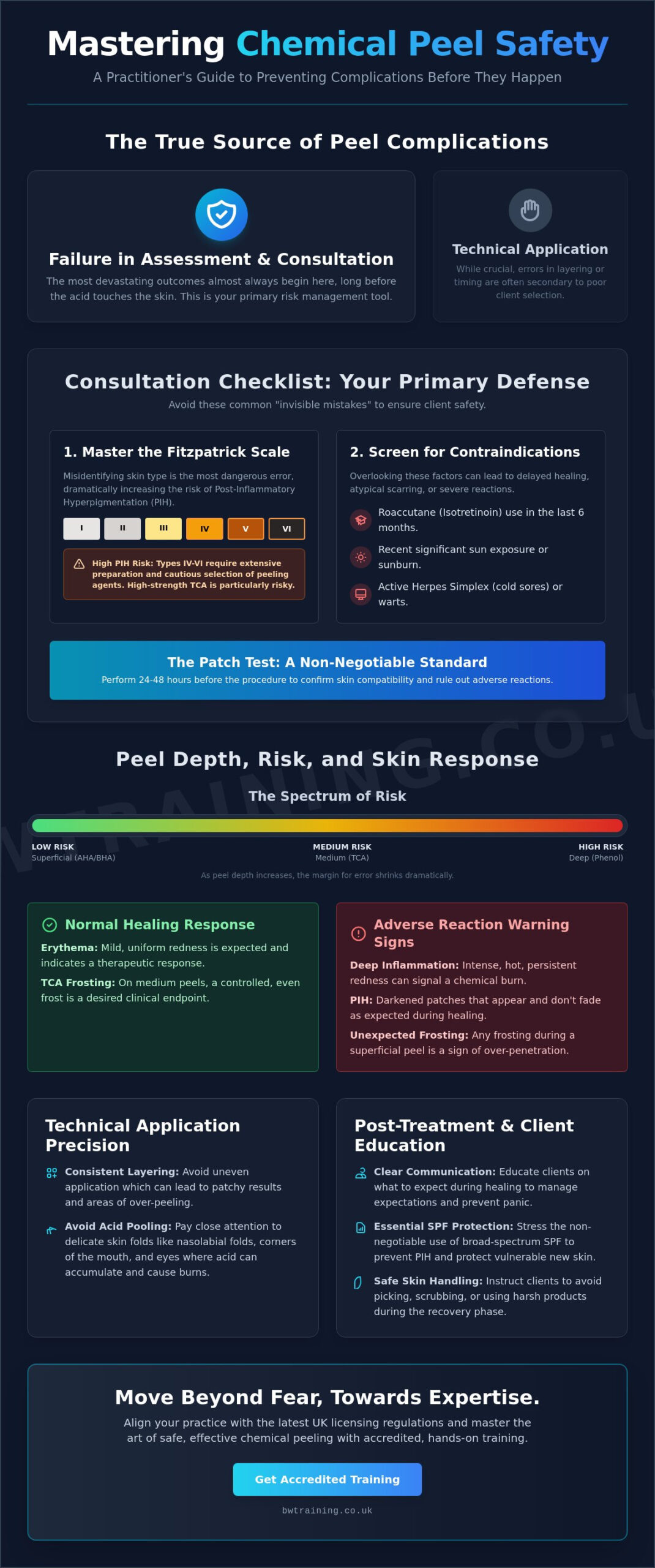
The spectrum of risk varies significantly across different treatments. Superficial peels using Alpha Hydroxy Acids (AHAs) or Beta Hydroxy Acids (BHAs) carry a lower risk profile compared to medium or deep peels involving Trichloroacetic Acid (TCA) or Phenol. For a comprehensive overview of chemical peels and their depth categories, practitioners must understand that as the depth increases, the margin for error shrinks. Many common mistakes in chemical peels occur because a practitioner prioritises the “wow” result over the client’s skin barrier integrity.
Adopting a safety-first mindset is non-negotiable for modern aesthetic practitioners. Professional training is the only way to mitigate the risk of permanent skin damage. It provides the technical foundation to recognise when a skin’s reaction has shifted from therapeutic to traumatic. We don’t just teach you how to apply a product; we teach you how to read the skin’s response in real-time. This level of expertise ensures that you’re prepared for the complexities of different skin types and conditions.
The Science of Controlled Skin Resurfacing
Acids work by disrupting the cellular bonds, known as desmosomes, that hold dead skin cells together. This process triggers rapid regeneration. However, the depth of this disruption depends entirely on the pH and concentration of the acid. A lower pH means a more aggressive peel. When a practitioner doesn’t respect these variables, the peeling becomes uncontrolled. This lack of control is often the root cause of the complications we see in clinical settings.
Common Adverse Reactions vs. Normal Healing
Distinguishing between a healthy response and a complication is a critical skill. You must be able to spot the difference before the client leaves your chair.
- Erythema: Mild redness is expected. Deep, persistent inflammation that feels hot to the touch can signal an early-stage chemical burn.
- PIH: Post-Inflammatory Hyperpigmentation is a major concern, especially for darker skin tones. Early signs include darkened patches that don’t fade as the skin heals.
- Frosting: In TCA peels, frosting is often a desired clinical endpoint. In superficial peels, however, sudden frosting is a warning sign that the acid has penetrated too deeply.
Consultation Failures: The Invisible Mistakes Before the Peel Starts
Many common mistakes in chemical peels happen before the bottle is even opened. A thorough consultation isn’t just an administrative task; it’s your primary risk management tool. Rushing this stage is a frequent error that leads to the complications we discussed in the previous section. When we fail to screen properly, we aren’t just risking a poor result; we’re risking the client’s long-term skin health.
The Critical Role of the Fitzpatrick Scale
Misidentifying a client’s Fitzpatrick skin type is arguably the most dangerous error a practitioner can make. Skin typing is the foundation of peel safety because it determines how the melanocytes will react to trauma. For those with Fitzpatrick types IV through VI, the risk of Post-Inflammatory Hyperpigmentation (PIH) is exceptionally high. Using high-strength TCA on darker skin without extensive preparation can lead to permanent discolouration. Clinical resources like this study on Chemical Peels for Skin Resurfacing highlight that patient selection and preparation are just as vital as the peeling agent itself.
We must also be vigilant about medical contraindications. Treating a client who has used Roaccutane in the last six months can lead to delayed healing and atypical scarring. Similarly, an active herpes simplex outbreak or recent sun exposure are absolute contraindications. A patch test performed 24 to 48 hours before the procedure is a non-negotiable standard of care. It’s your final check to ensure the client’s skin won’t react unexpectedly to the specific formulation you’ve chosen.
Pre-Treatment Priming: The Forgotten Step
Many practitioners fail by allowing “lunchtime peels” on day one without prior skin conditioning. Skipping a two-week home-care preparation period often results in uneven acid penetration and patchy results. For higher-risk clients, using Tyrosinase inhibitors before the treatment is essential to suppress melanin production and prevent rebound pigmentation. This priming phase ensures the skin is healthy and resilient enough to handle the controlled injury. It also serves as a test of the client’s commitment to aftercare.
Finally, don’t fall into the trap of over-promising results. A superficial-grade acid will never fully erase deep ice-pick scarring. Being honest about what an AHA or BHA peel can achieve builds trust and protects your professional reputation. If you want to refine these assessment skills and gain total confidence in client selection, our Chemical Peel Training provides the hands-on experience needed to master these critical early steps.
Technical Application Errors: Precision, Layering, and Timing
Technical mastery is what separates a professional practitioner from a hobbyist. Even with a perfect consultation, a sloppy application can lead to the very chemical peel risks and side effects we aim to avoid. Precision isn’t just about where you put the acid; it’s about how much you use and how you manage its movement on the face. One of the most common mistakes in chemical peels is inconsistent application, particularly allowing the liquid to “pool” in skin folds or the corners of the mouth. This concentrated accumulation leads to localized burns and uneven healing.
We also see the “More is Better” fallacy frequently in clinical settings. Practitioners often feel pressured to deliver dramatic results and respond by adding too many layers too quickly. This aggressive approach doesn’t give the skin’s biological response time to catch up with the chemical stimulus. It’s far safer to build results over a series of treatments than to risk a deep, accidental injury by over-layering in a single session.
Degreasing and Preparation Protocols
Uniform acid penetration is impossible if the skin hasn’t been properly prepared. Sebum acts as a natural barrier; if it isn’t completely removed, the acid will only penetrate the “dry” patches, leading to a mottled, patchy result. Using the wrong prep solution is a subtle but serious error. Some cleansers can shift the skin’s pH so significantly that they neutralize or amplify the peel’s strength unexpectedly. We always recommend protecting vulnerable areas like the nostrils, the vermilion border of the lips, and the outer canthus of the eyes with a thick occlusive barrier before you begin. This simple step prevents the acid from migrating into sensitive tissues where it doesn’t belong.
Mastering the End-Point and Neutralisation
Knowing exactly when to stop is the hallmark of an expert. You must distinguish between self-neutralizing peels, like Salicylic acid, and those that require a base to stop the reaction, such as Glycolic acid. Misidentifying the “end-point” is a critical failure. You’re looking for specific visual cues: mild erythema, or in deeper peels, the white protein denaturation known as frosting. Don’t confuse this with simple blanching, which is a sign of vascular constriction. While your protocol might suggest a specific duration, timing is secondary to the skin’s physical response. Always trust what the tissue is telling you over what the stopwatch says. Being ready to neutralize at the first sign of an adverse reaction is your best defense against long-term complications.
Post-Treatment Pitfalls: Managing Recovery and Client Expectations
Your technical work might be flawless, but the final result rests in your client’s hands once they leave your clinic. We often see practitioners focus so heavily on the application that they rush the aftercare briefing. This is a critical error. Inadequate education is one of the most common mistakes in chemical peels, as it leaves the client unprepared for the biological reality of skin shedding. If a client doesn’t understand the “why” behind your instructions, they’re far more likely to deviate from the plan, leading to preventable complications like scarring or infection.
We also have to manage the timeline of active skincare. Many clients are eager to return to their high-performance routines, applying retinoids or Vitamin C far too early. These actives can be incredibly irritating on a compromised skin barrier. Similarly, skipping the follow-up appointment is a missed opportunity for professional oversight. That 7 to 10-day window is your chance to catch early signs of Post-Inflammatory Hyperpigmentation (PIH) and adjust the recovery protocol before any damage becomes permanent.
The “No-Pick” Policy
When skin begins to flake, the temptation to peel it off is immense. You must explain to your clients that the peeling skin acts as a biological dressing. It protects the vulnerable, new tissue underneath while it matures. If they pick or pull at a “scab” or a dry patch, they’re essentially ripping away a protective layer before the skin is ready. This is a direct route to permanent scarring. We recommend managing client anxiety during the “ugly” phase by prescribing heavy, bland moisturisers rather than physical exfoliants. Keeping the skin hydrated helps the flakes lay flat, making the process less noticeable and reducing the urge to pick.
Long-term Maintenance and Sun Safety
Sun safety isn’t just a suggestion; it’s a non-negotiable requirement for success. A single day of unprotected sun exposure can ruin a six-week treatment plan by triggering aggressive rebound pigmentation. We always prescribe a post-procedure kit that includes a gentle, non-foaming cleanser and a high-quality SPF 50. Clients should only return to active ingredients like Retinol or AHAs once the skin barrier has fully repaired, typically 10 to 14 days post-peel. Building these comprehensive aftercare plans is a skill we refine in our NVQ Level 3 Beauty Therapy training, where we link clinical success to patient compliance.
If you’re ready to master the full lifecycle of a chemical peel treatment, from the first consultation to the final follow-up, our Chemical Peel Training will give you the practical tools and confidence you need to guide your clients safely through every stage of the process.
Mastering the Art: Accredited Chemical Peel Training in London
The transition from a cautious practitioner to a confident expert requires more than just reading manuals. While we’ve detailed the common mistakes in chemical peels throughout this guide, the most effective way to eliminate these risks is through structured, accredited education. Many practitioners mistakenly believe that brand-led workshops or self-teaching are sufficient. However, these often lack the physiological depth required for professional insurance. Without a regulated qualification, you may find yourself unprotected if a complication occurs, especially as the UK moves toward the new 2026 licensing requirements for non-surgical cosmetic procedures.
Investing in your education is an investment in your clients’ safety and your own professional security. We view training as a partnership. At Beautiful World Training Academy, we don’t just teach you how to apply a product; we provide the clinical foundation to assess skin health and manage the entire treatment lifecycle. This mastery acts as a vital stepping stone for those looking to progress into advanced clinical work, such as a Level 7 Aesthetics diploma.
What to Expect from Our Chemical Peel Course
Our curriculum is designed to be practical, participatory, and deeply supportive. We bridge the gap between abstract theory and real-world application. You’ll move through a logical progression of learning that ensures you never feel rushed or overwhelmed.
- Comprehensive Theory: Deep dives into skin anatomy, the chemistry of pH levels, and how to select the right acid for every Fitzpatrick type.
- Live Model Practice: Perform treatments under the direct supervision of expert tutors at our Hounslow centre to perfect your technique and timing.
- Post-Course Support: Gain access to ongoing guidance to help you build a safe, compliant, and thriving aesthetics practice.
Building a Career in Advanced Aesthetics
Mastering skin resurfacing is often the gateway to a broader career in aesthetic medicine. A practitioner who understands the nuances of chemical peeling is better equipped to handle the complexities of skin preparation for other treatments. These skills perfectly complement our Botox courses and dermal filler training, allowing you to offer holistic rejuvenation plans. In an industry that is rapidly professionalising, holding accredited vocational qualifications is what sets you apart as a steady, reliable expert.
Your journey toward total clinical confidence starts with the right mentor. Don’t leave your reputation to chance by repeating the common mistakes in chemical peels that stem from inadequate training. Enrol in our Chemical Peel Training today and take the first step toward professional mastery.
Elevate Your Clinical Practice with Confidence
Mastering skin resurfacing is a journey that begins with rigorous patient selection and ends with meticulous aftercare. We’ve explored how identifying the correct Fitzpatrick type and screening for medical contraindications forms the bedrock of a safe treatment. Technical precision during application ensures uniform results, while clear communication helps your clients navigate the recovery phase without anxiety. By proactively addressing the common mistakes in chemical peels, you transform a high-risk procedure into a predictable, high-reward service.
True expertise comes from hands-on guidance and accredited recognition. At Beautiful World Training Academy, our VTCT and CPD accredited courses provide the clinical depth you’ve been looking for. You’ll learn from expert tutors with decades of clinical experience at our convenient London-based training centers in Hounslow and Whitton. Secure your place on our Accredited Chemical Peel Training Course to invest in your career and your clients’ safety.
We’re here to support you as you refine your skills and grow your professional practice. With the right foundation, you’ll provide life-changing results with total peace of mind.
Frequently Asked Questions
What is the most common mistake beginners make with chemical peels?
Beginners often fail by skipping the thorough consultation or misidentifying the client’s skin type. This is one of the most common mistakes in chemical peels because it leads to using an acid that’s too aggressive for the skin’s current barrier. Always take the time to assess the Fitzpatrick scale and medical history. Rushing this stage just to start the treatment is never worth the risk of a complication.
Can I perform a chemical peel on someone with dark skin (Fitzpatrick IV-VI)?
You can absolutely perform peels on Fitzpatrick IV-VI, but it requires a specialized, cautious approach. These skin types are more prone to hyperpigmentation, so you must prime the skin with Tyrosinase inhibitors for at least two weeks beforehand. Stick to superficial acids like Mandelic or Salicylic acid initially. Avoid high-strength TCA unless you’ve had advanced training and the client’s skin is properly conditioned.
How do I know if I have accidentally burned a client during a peel?
You’ll know if a burn has occurred if the client experiences intense, persistent heat or if you see sudden frosting where it isn’t expected. Normal erythema should be manageable and fade relatively quickly. If the skin looks grey, white, or develops immediate blisters, you’ve penetrated too deeply. Neutralise the area immediately and follow your emergency protocol to minimize any long-term tissue damage.
What should I do if a client starts picking their peeling skin?
If a client starts picking, you must reinforce the “no-pick” policy immediately to prevent permanent scarring. Explain that pulling away dry skin removes the protective layer before the new tissue is ready. Instruct them to apply a thick, bland ointment or moisturiser several times a day to keep the flakes flat. This reduces the physical temptation to peel and supports the natural shedding process.
Is a patch test always necessary for every type of chemical peel?
A patch test is always necessary for every professional chemical peel you perform. It’s the only way to identify a potential allergic reaction or extreme sensitivity before applying the acid to the entire face. Perform the test 24 to 48 hours before the full procedure. Skipping this step is a major liability and compromises the safety standards your clients expect from a professional practitioner.
How long should a client wait between chemical peel sessions?
Most clients should wait 4 to 6 weeks between sessions to allow the skin’s barrier to fully recover. Performing treatments too frequently is another one of the common mistakes in chemical peels that leads to chronic inflammation and sensitivity. The exact timing depends on the depth of the peel and the individual’s rate of cellular turnover. Always assess the skin’s integrity before proceeding with a subsequent treatment.
Can I combine chemical peels with microneedling in the same session?
Combining these treatments in the same session is generally discouraged for most practitioners due to the high risk of over-traumatising the skin. While some advanced protocols exist, the combination can lead to unpredictable acid penetration depth. It’s safer to space these treatments at least two weeks apart. This allows you to monitor the skin’s response to each stimulus individually without overwhelming the healing response.
Do I need a medical degree to perform professional chemical peels in the UK?
You don’t need a medical degree for superficial or medium peels, but you must follow the new licensing scheme. As of 2026, England requires practitioners and premises to be licensed under a traffic light system. Superficial peels are “green” and medium peels are “amber,” both requiring specific practitioner licenses. Deep peels are “red,” restricted to regulated healthcare professionals in CQC-registered premises.