Professionalism, not a medical degree, is the true currency of the 2026 aesthetics market. If you have been asking can non-medics do aesthetics uk, you have likely heard conflicting rumors about new laws and mandatory bans. It’s completely natural to feel a sense of urgency or even anxiety about whether your training will remain valid as the industry moves toward a stricter regulatory framework. You want to build a career that’s both legally sound and respected by your peers, but the path forward often feels cluttered with confusing talk of Level 7 requirements and licensing changes.
We are here to provide the clarity and calm confidence you need to move forward. This guide outlines the exact professional pathway for non-medical practitioners under the 2026 licensing scheme, including the mandatory qualification levels and the new traffic light system for procedures. You’ll discover how to future-proof your business with Ofqual-regulated training, navigate the new supervision rules for injectables, and secure the right insurance to protect your future. We have distilled the complex regulations into a straightforward roadmap so you can focus on what matters most: delivering safe, exceptional results for your clients.
Key Takeaways
- Understand the current legal landscape and why the answer to can non-medics do aesthetics uk is a firm yes, provided you follow the new regulatory roadmap.
- Learn how the 2026 mandatory licensing scheme and the traffic light risk system will categorize your treatments and require both practitioner and premises certification.
- Identify the essential educational milestones, from mastering Anatomy and Physiology to achieving Level 5 and Level 7 qualifications that future-proof your career.
- Discover how to secure robust medical malpractice insurance and establish a professional partnership with a designated prescriber for prescription-only treatments.
- Explore the benefits of a mentor-led training approach that provides ongoing support as you transition from beauty therapy to advanced aesthetics.
The Current Legal Reality: Can Non-Medics Do Aesthetics in the UK?
The short answer to can non-medics do aesthetics uk is a definitive yes. Current UK law does not reserve non-surgical treatments exclusively for doctors, dentists, or nurses. Instead, the legal framework distinguishes between Aesthetic medicine, which focuses on cosmetic enhancement, and clinical medical treatments intended to treat illness or injury. While the door is open for non-medics, it’s vital to understand that “technically legal” is not the same as being “professionally safe.” True success in this field requires more than just the legal right to practice; it demands a commitment to clinical excellence and patient safety.
Organizations like the Joint Council for Cosmetic Practitioners (JCCP) are currently leading the charge in setting voluntary standards for the industry. These standards act as a professional North Star, guiding practitioners toward the high levels of competence that the government will soon make mandatory. By following these established frameworks, you ensure that your practice isn’t just meeting the bare legal minimums, but is operating at a level that inspires genuine client trust.
Understanding the ‘Non-Medic’ Definition
Defining the “non-medic” category is the first step toward professional clarity. In our industry, this term generally applies to beauty therapists, skin specialists, and even tattoo artists who are transitioning into advanced aesthetic work. We believe the most secure way to enter this field is by building upon a solid foundation, such as an NVQ Level 3 Beauty Therapy qualification. This background provides the essential knowledge of skin anatomy and physiology required for safe practice. The industry is rapidly moving toward a “standard of equivalence,” where your title matters less than your proven ability to meet strict clinical outcomes and safety protocols.
Common Misconceptions About the ‘Botox Ban’
You may have encountered rumors regarding a total “Botox ban” for non-professionals. Most of this confusion stems from the Botulinum Toxin and Cosmetic Fillers (Children) Act 2021. This law didn’t stop non-medics from practicing; it simply made it a criminal offense to provide these treatments to anyone under 18 for purely cosmetic reasons. It’s a common-sense safety measure that we fully support. Another frequent myth is that non-medics can’t get insurance. While it’s true that “fast-track” courses often lead to rejection, practitioners with regulated, high-level qualifications can easily access robust medical malpractice and public liability insurance. As we approach the 2026 licensing transition, the focus is on elevating the standard of the entire workforce, not excluding talented practitioners who are willing to invest in their education.
The New Licensing Scheme: What Non-Medics Need to Know in 2026
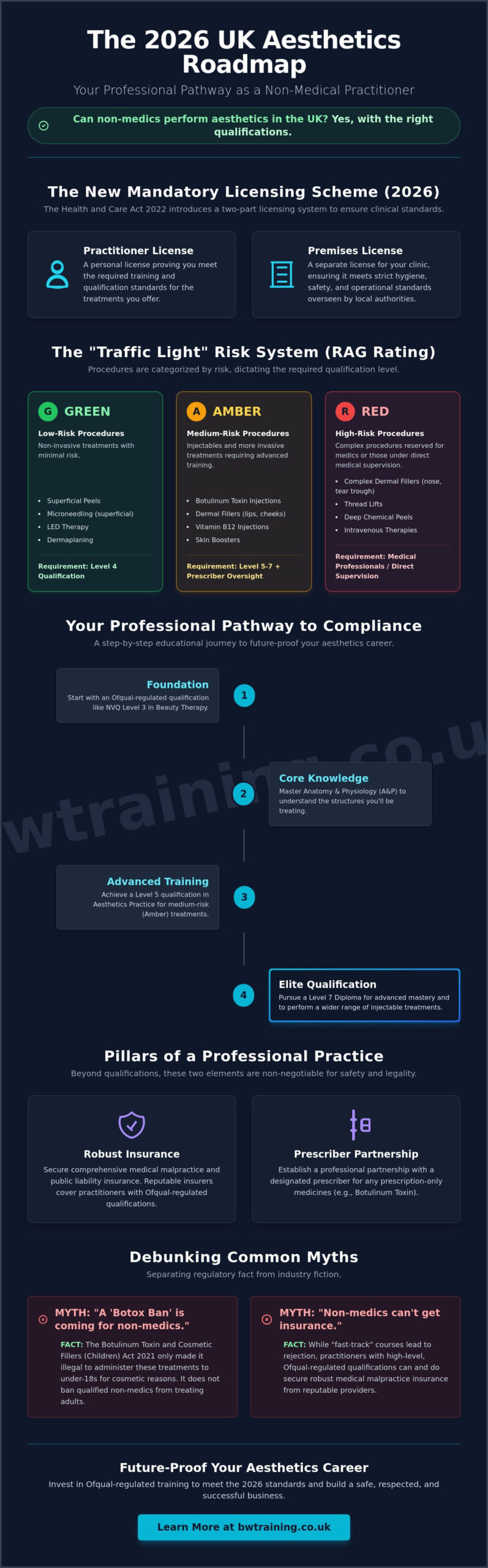
The UK aesthetics industry is currently undergoing its most significant transformation to date. With the 2026 implementation of the Health and Care Act 2022, the transition from a self-regulated market to a mandatory licensing scheme is officially underway. If you are researching can non-medics do aesthetics uk, understanding this new statutory framework is essential. This shift isn’t designed to shut doors. Instead, it ensures every practitioner operates with the same level of accountability and safety as a clinical professional.
The government’s approach centers on the Regulation of non-surgical cosmetic procedures, introducing a two part licensing requirement. You’ll need a personal practitioner license and a separate license for your premises. Local authorities will oversee these applications, conducting inspections to verify that your clinical environment meets strict hygiene and safety standards. This dual layer of protection builds immense trust with your clients, proving that your business prioritizes their well-being above all else.
The RAG Rating Explained for Non-Medics
The new system categorizes procedures based on risk using a “Traffic Light” (RAG) system. This provides a clear roadmap for what you can perform and the level of training required:
- Green (Low Risk): These procedures, such as microneedling and light chemical peels, are accessible to non-medics who hold standard vocational qualifications.
- Amber (Medium Risk): This category includes popular treatments like Botox and dermal fillers. Non-medical practitioners can still perform these, but the 2026 rules mandate oversight by a regulated healthcare professional and a face to face consultation for all prescriptions.
- Red (High Risk): High-complexity procedures like thread lifts and fat transfers will likely be restricted to regulated healthcare professionals working in CQC registered environments.
Preparing for the Practitioner Licence
To secure your license by 2026, you must demonstrate a “minimum standard of education.” The days of unaccredited weekend workshops are over. Local authorities will look for evidence of Ofqual-regulated qualifications from recognized bodies like VTCT. This ensures that every licensed practitioner has undergone rigorous assessment and practical training.
Getting ahead of these changes now isn’t just about compliance; it’s a powerful competitive advantage. Clients are already looking for practitioners who can prove they meet the highest safety standards. By investing in recognized training today, you position yourself as a leader in the new era of professional aesthetics. If you’re starting from scratch, securing your NVQ Level 3 Beauty Therapy is the first essential step toward meeting these future licensing requirements with confidence.
The Professional Pathway: From Beauty Therapist to Aesthetic Practitioner
Building a career in aesthetics is a journey of steady, intentional growth. While the question of can non-medics do aesthetics uk is often met with confusion, the answer lies in a structured ladder of progression. You don’t just jump into injectables; you build a clinical foundation that ensures every treatment you perform is rooted in science and safety. This pathway transforms you from a beauty professional into a highly skilled aesthetic practitioner, respected for your technical expertise and commitment to patient well being.
The backbone of this entire journey is Anatomy and Physiology (A&P). Without a deep understanding of facial muscles, nerves, and blood vessels, you cannot practice safely. We view training as an investment in your personal confidence. When you know exactly what’s happening beneath the skin’s surface, you can navigate complex procedures with the calm authority your clients expect. This technical knowledge is what separates a technician from a true professional.
Step 1: The Foundation (NVQ Levels 2 & 3)
You cannot skip the basics. Every successful practitioner starts by mastering skin biology, hygiene protocols, and professional consultation techniques. Securing an NVQ Level 3 Beauty Therapy qualification is the essential entry requirement for advanced work. It provides the biological grounding and clinical discipline needed to handle medical grade tools and substances. At Beautiful World Training Academy, our fast track vocational approach respects your time while ensuring you meet these rigorous standards without compromise.
Step 2: Advanced Skin & Level 4 Qualifications
Once your foundation is secure, you can move into the world of advanced skin treatments. This stage is about bridging the gap between cosmetic facials and clinical interventions. It allows you to demonstrate that can non-medics do aesthetics uk is a reality achieved through hard work and education. You will focus on:
- Mastering Chemical Peels and Microneedling to understand controlled skin trauma and the body’s healing response.
- Progressing to NVQ Level 4 Laser and IPL to gain experience with high energy devices in a clinical setting.
- Building a diverse portfolio of treatments that prove your manual dexterity and clinical judgment.
Step 3: The Peak: Level 5 and Level 7 Diploma
The final stages of the professional pathway represent true mastery. The Level 7 Aesthetics qualification is designed to provide equivalence with medical postgraduate training. It covers complex injectables, pharmacology, and complication management. Achieving this level is the ultimate way to future proof your career. It demonstrates to licensing bodies and insurers that you have reached the highest possible standard of non-surgical practice. By investing in this level of education, you’re joining an elite group of practitioners dedicated to the highest tier of patient care.
Insurance and Clinical Governance for Non-Medical Practitioners
Clinical governance is the invisible foundation of every successful aesthetics business. While the question of can non-medics do aesthetics uk is legally settled, your professional longevity depends on the safety net you build around your practice. Operating without a robust governance framework doesn’t just put your clients at risk; it leaves your business vulnerable to legal and financial ruin. We view governance as an act of professional self-care that allows you to practice with a clear conscience and total confidence.
Your first priority is securing comprehensive insurance. You’ll need both Medical Malpractice and Public Liability cover. These aren’t just administrative hurdles. They are your professional armor. Most reputable insurers now demand proof of accredited, Ofqual-regulated training before they will provide a quote. By holding a recognized qualification, you demonstrate to insurers that you are a low-risk, high-standard practitioner who takes their responsibilities seriously.
The Prescriber-Practitioner Relationship
If you intend to offer Botulinum Toxin, you must understand the legalities of Prescription Only Medicines (POMs). Non-medics cannot legally purchase or stock Botox without a patient-specific prescription. This requires a formal partnership with a qualified prescriber, such as a GMC-registered doctor or an Independent Nurse Prescriber. The law is very clear: the prescriber must perform a face-to-face consultation with every client before you can administer the treatment. Remote prescribing is strictly prohibited under the 2026 regulations. Building a local network of medical peers in West London or Hounslow isn’t just about compliance; it’s about creating a collaborative environment where safety is the priority.
Clinical Governance: Beyond the Treatment
Professionalism extends far beyond the moment the needle touches the skin. Impeccable record-keeping is essential. You must maintain detailed consent forms, medical histories, and treatment logs that comply with GDPR standards for sensitive health data. Your clinic environment must also mirror clinical standards. This means maintaining a sterile, organized space that is clearly distinguished from a standard beauty room.
Finally, you must be prepared for the unexpected. Emergency protocol training, including the management of complications and anaphylaxis, is a mandatory requirement for insurance and licensing. Staying current with your Continuing Professional Development (CPD) ensures your skills remain sharp and your insurance stays valid. If you’re ready to establish these professional standards, our Foundation Anti-Wrinkle Injections course provides the clinical grounding you need to work safely alongside a prescriber.
Launching Your Aesthetics Career with Beautiful World Training Academy
The journey toward becoming a professional injector is more than just a series of courses; it’s a transformation into a trusted clinical practitioner. When you ask can non-medics do aesthetics uk, you aren’t just looking for a legal loophole. You’re seeking a path that leads to a sustainable, respected career. At Beautiful World Training Academy, we act as the bridge between your current skills and the high standards of the 2026 licensing scheme. Our academies in Hounslow and Whitton have become the central hubs for West London practitioners who want to lead the industry through excellence and safety.
We believe that high-quality training is an investment in your personal reputation. That’s why our Mentor Approach extends far beyond your graduation day. We don’t just hand you a certificate and move on. We remain a steady, supportive partner as you navigate the complexities of setting up your clinic, finding prescribers, and refining your technique. This ongoing relationship provides the emotional security you need to grow your business with confidence.
Our Training Philosophy: Safety Through Excellence
Our primary metric for success is your self-assurance. We know that the transition from beauty therapy to aesthetics can feel daunting, so we’ve created a learning environment that is rigorous yet deeply supportive. You won’t find dry, academic lectures here. Instead, you’ll benefit from small class sizes that prioritize hands-on practice with live models under expert supervision. This participatory approach ensures you develop the manual dexterity and clinical judgment necessary for real world practice.
We’ve designed our curriculum to carry the technical weight of a medical degree program while maintaining the accessibility of a dedicated beauty academy. This balance is crucial. It ensures you meet the strict requirements for Level 5 and Level 7 qualifications without feeling overwhelmed by the transition. By training in a clinical setting that mirrors the 2026 premises requirements, you’re prepared for local authority inspections from day one.
Next Steps for Aspiring Practitioners
Your future in aesthetics starts with a single, decisive step. We invite you to book a career consultation at our Whitton or Hounslow academy to discuss your specific goals and educational needs. Whether you’re just starting your journey or looking to upgrade your existing skills, we have an accredited pathway tailored to you.
If you’re ready to master the most in-demand treatments, our Foundation Dermal Filler Courses provide the perfect entry point into the world of injectables. Don’t wait for the 2026 deadline to catch you off guard. Invest in a future-proof, accredited qualification today and join a community of practitioners who are setting the gold standard for non-medical aesthetics in the UK. We’re ready to help you build a career you can be proud of.
Securing Your Professional Future in Aesthetics
The 2026 regulatory shift marks a new era of integrity for our industry. While the question of can non-medics do aesthetics uk remains a clear yes, the standard for entry has rightly been raised. Success now belongs to those who view training as a lifelong investment in safety rather than a one-off legal hurdle. By mastering the professional pathway from NVQ Level 3 through to Level 7 mastery, you ensure your business is resilient, insured, and deeply respected by your clients. We’ve seen how clinical governance and proper education transform ambitious therapists into industry leaders.
We are here to guide you through every step of this transition. With over 10 years of expert training in London, we specialize in dedicated support for non-medic pathways. Our VTCT and CPD accredited courses provide the clinical weight you need to thrive under the new licensing standards. We believe your state of mind and self-assurance after a course are the true metrics of success. Start your professional aesthetics journey with Beautiful World Training Academy today and build the career you’ve always envisioned. Your commitment to excellence is the foundation of your success, and we’re honored to be your partner in this exciting new chapter.
Frequently Asked Questions
Is it legal for non-medics to do Botox in the UK in 2026?
Yes, it is legal for non-medics to perform Botox treatments in 2026, provided you comply with the mandatory licensing and qualification requirements. Under the Health and Care Act 2022, you must hold a personal practitioner license and operate from a licensed clinical premises. You’ll also need to prove you have achieved the required educational standards and work under the oversight of a regulated healthcare professional for amber-category procedures.
What qualifications does a non-medic need to start aesthetics?
To begin a career in aesthetics, you should ideally start with an NVQ Level 3 in Beauty Therapy. This provides the essential foundation in skin biology, anatomy, and clinical hygiene that most advanced training providers and insurers require. From this base, you can progress through Level 4 and Level 5 qualifications to build the technical expertise and clinical hours necessary for a successful transition into injectables.
Can I get insurance for aesthetics if I am not a nurse?
Yes, you can secure comprehensive medical malpractice and public liability insurance as a non-medic. The key is holding Ofqual-regulated qualifications from recognized awarding bodies like VTCT rather than unaccredited short courses. When you provide evidence of rigorous, regulated training, insurers view you as a professional, low-risk practitioner. This coverage is vital for protecting your business and providing peace of mind for your clients.
Will the new UK licensing scheme ban beauty therapists from doing fillers?
The 2026 licensing scheme does not ban beauty therapists; instead, it introduces a structured framework to ensure everyone asking can non-medics do aesthetics uk meets a high safety standard. Dermal fillers are categorized under the “Amber” risk tier. This means beauty therapists can continue to offer these treatments as long as they hold the mandatory qualifications and adhere to the new rules regarding clinical supervision and premises licensing.
How long does it take for a non-medic to qualify in injectables?
Most practitioners take between 12 and 24 months to fully qualify in injectables, depending on their existing experience. This timeline allows you to move steadily through the necessary levels, from skin fundamentals to advanced clinical practice. We recommend this structured approach because it prioritizes your technical mastery and clinical judgment. Rushing into injectables without a solid foundation can lead to gaps in safety knowledge that the new licensing scheme aims to eliminate.
What is the difference between CPD and NVQ aesthetics courses?
NVQ qualifications are Ofqual-regulated programs that follow a national standard and are highly respected by licensing bodies and insurers. CPD (Continuing Professional Development) refers to shorter training sessions used to update your skills or learn new techniques once you are already qualified. While CPD is excellent for staying current, the 2026 regulations specifically look for regulated qualifications like NVQs to verify your fundamental competence as a practitioner.
Do I need a prescriber if I am a non-medic doing Botox?
Yes, you must have a formal partnership with a qualified prescriber to offer Botox, which is a Prescription-Only Medicine (POM). The law requires your prescriber to conduct a face-to-face consultation with every client before you administer the treatment. You cannot legally stock or buy Botox without a patient-specific prescription. This relationship ensures a high level of clinical oversight and patient safety for every procedure you perform.
Can I do a Level 7 aesthetics course without a degree?
Yes, you can enroll in a Level 7 Diploma in Aesthetics Practice without a prior university degree by following a pathway of equivalent regulated qualifications. By successfully completing Level 4 and Level 5 aesthetics programs, you demonstrate the academic and clinical readiness required for postgraduate-level study. This ensures that the highest level of can non-medics do aesthetics uk training is accessible to dedicated professionals who are committed to reaching the peak of their craft.