What if the single most important decision you make in your aesthetics career isn’t which brand of filler to use, but which certificate hangs on your wall? It’s completely understandable to feel overwhelmed by the sheer number of training options available. You know that proper, hands-on training is non-negotiable for client safety and your professional reputation, but navigating the industry and avoiding unaccredited ‘cowboy’ providers can be a challenge.
This guide is your clear, no-nonsense roadmap to finding accredited lip filler courses in Hounslow and West London that deliver more than just a piece of paper. We will show you exactly how to gain the practical skills, in-depth anatomical knowledge, and the crucial CPD or Ofqual accreditation needed to treat live models, practice confidently, and secure full insurance coverage. We’ll break down the essential components of an expert-led course, giving you the clarity to invest in your future and build a career defined by both artistry and safety.
Key Takeaways
- Clarify the current UK regulations and specific entry requirements for both medics and non-medics to ensure your career path is fully compliant.
- Master essential injection techniques and facial anatomy to deliver safe, precise, and aesthetically pleasing results with confidence.
- Learn the key criteria for selecting accredited lip filler courses, focusing on tutor expertise and the availability of crucial post-course support.
- Gain a practical roadmap for launching your aesthetics business, from meeting hygiene standards in your practice to effectively marketing your new skills.
What to Expect from Professional Lip Filler Courses in Hounslow
Embarking on professional lip filler courses is a decisive step into the world of clinical aesthetics. This isn’t just a beauty workshop; it’s a structured training programme engineered to build your competence from the ground up. A credible course meticulously combines three pillars: an in-depth understanding of facial anatomy, precision-led injection techniques, and uncompromising safety protocols. It’s the essential framework for a safe, ethical, and successful career in aesthetics.
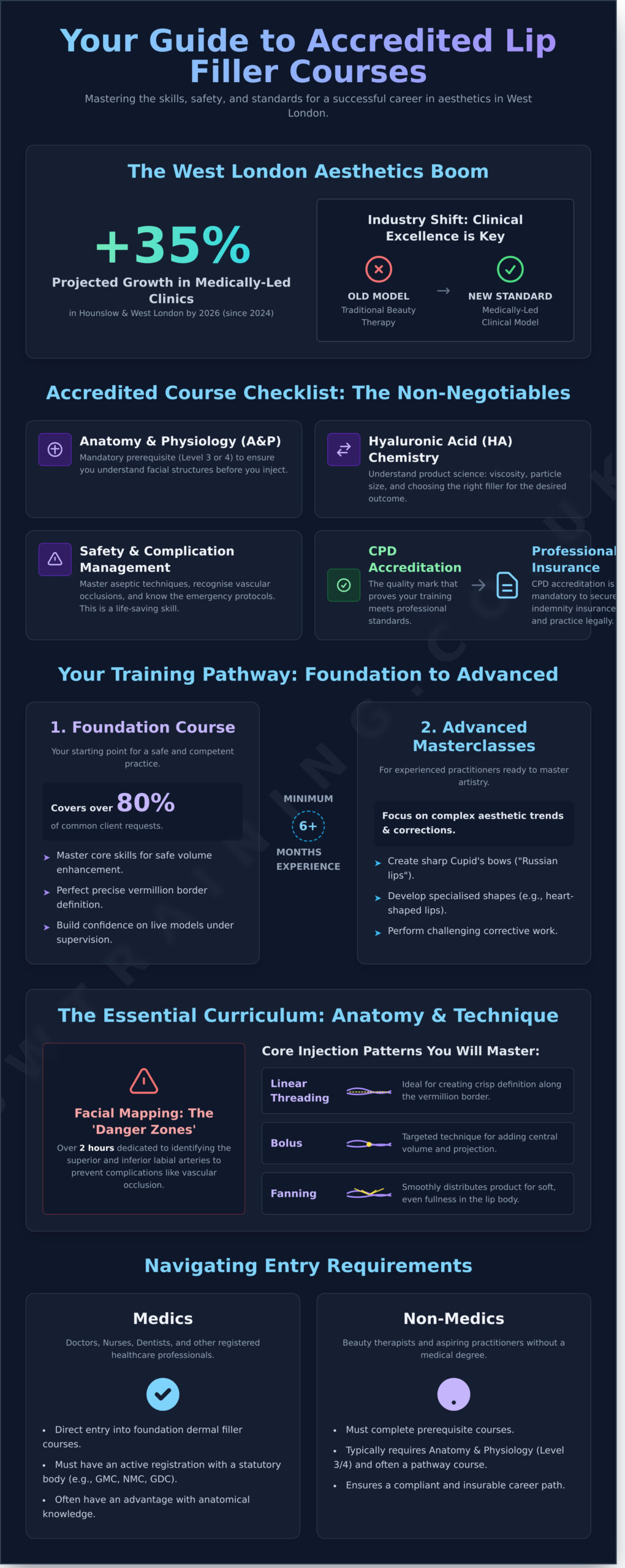
By 2026, West London, with Hounslow at its core, is set to become a recognised hub for aesthetics excellence. Projections show a 35% growth in medically-led aesthetic clinics in the borough since 2024, driven by rising client demand and clearer regulatory pathways. This rapid evolution signifies a critical career shift. The industry is moving decisively away from traditional beauty therapy towards a clinical model, where practitioners are valued for their medical knowledge and procedural skill. This transition means your training must equip you not just with technique, but with the diagnostic and anatomical expertise to practise safely and command professional respect.
A non-negotiable element of this training is hands-on practice. While digital modules have their place, nothing replaces the tactile feedback and real-world experience of working with live models under expert supervision. It’s in these moments that theory becomes skill. You learn to feel tissue resistance, manage client expectations, and build the steady-handed confidence that defines a true professional. An academy that prioritises this practical application is investing directly in your future competence.
The Core Components of an Accredited Course
Your journey begins with a solid educational foundation. Reputable courses mandate prerequisites like Anatomy and Physiology (A&P) at Level 3 or 4, ensuring you understand the structures you’ll be working with. From there, the curriculum must cover:
- Hyaluronic Acid (HA) Chemistry: You’ll learn the science behind the products, from viscosity and particle size to selecting the right filler for specific outcomes, such as Juvéderm for volume or Restylane for definition.
- Safety and Complication Management: This includes everything from aseptic techniques to recognising and managing vascular occlusions, a critical life-saving skill.
- CPD Accreditation: Your certificate must be CPD-accredited. This is not just a quality mark; it’s a mandatory requirement for securing professional indemnity insurance from leading providers like Hamilton Fraser. Without it, you cannot legally practice.
While managing procedure-specific issues is paramount, many practitioners also build broader confidence by completing certified first aid training. This foundational emergency response knowledge enhances client safety and professional credibility, with training partners of major organizations like the Red Cross, such as Aspire First Aid Guide Training Corp, offering comprehensive courses.
Foundation vs. Advanced: Where Do You Sit?
Understanding the training pathway is key to managing your career progression. The two distinct levels ensure you build skills logically and safely.
- Foundation Courses: This is your starting point. Here, you master the core skills that address over 80% of client requests. The focus is on fundamental Lip Augmentation Techniques, including precise vermillion border definition and safe volume enhancement in the lip body.
- Advanced Courses: Once you have at least six months of injecting experience, you can progress to specialised masterclasses. These cover complex aesthetic trends like creating sharp Cupid’s bows with the “Russian lips” technique, developing heart-shaped lips, or performing challenging corrective work.
Mastering the basics at a foundation course, perhaps in a focused setting like Twickenham, is the only responsible way to prepare for advanced artistry. It ensures your confidence is built on a bedrock of proven skill and safety.
The Essential Curriculum: Mastering Lip Augmentation Techniques
True mastery in lip augmentation goes far beyond the needle. It’s a precise blend of anatomical science, artistic vision, and robust safety protocols. The best lip filler courses don’t just teach you how to inject; they empower you to create beautiful, safe, and natural-looking results for every client. This curriculum is built on a foundation of understanding the ‘why’ behind every technique.
A deep dive into facial mapping is your first critical step. We dedicate over two hours to identifying the ‘danger zones,’ primarily the superior and inferior labial arteries. Understanding their depth and location is non-negotiable for preventing complications. From there, we build your technical skill by mastering three core injection patterns:
- Linear Threading: Ideal for creating crisp definition along the vermillion border.
- Bolus: A targeted technique for adding central volume and projection, perfect for a subtle pout.
- Fanning: Used to smoothly distribute product throughout the lip body for soft, even fullness.
Technical skill, however, is only half the equation. The art of the ‘natural’ consultation involves expertly managing client expectations. It’s about guiding them towards a result that enhances their unique features, not one that follows a fleeting trend. For 2026, the Golden Ratio in lip aesthetics is defined by a 1:1.4 vertical height ratio (top to bottom lip) that prioritises a hydrated, well-defined Cupid’s bow over sheer volume. Developing high emotional intelligence is key to mastering these client interactions; to learn more about how these skills can enhance your practice, exploring professional EQ programs can be highly beneficial.
Safety and Complication Management
Your confidence as a practitioner is directly linked to your ability to handle complications. The curriculum prioritises identifying the early signs of vascular compromise, such as immediate blanching, disproportionate pain, or a dusky appearance. We drill the Hyaluronidase protocol, ensuring you know precisely when and how to safely dissolve filler. Understanding these life-saving steps is essential for meeting the standards outlined in emerging UK Government Regulations. Every London practitioner must carry an emergency kit containing, at a minimum, a 1500 IU vial of Hyaluronidase, aspirin, and sterile saline.
Hands-On Clinical Practice
Theory without practice is simply information. Our foundation lip filler courses translate knowledge into competence through supervised injecting on live models. This controlled environment is where you build muscle memory and refine your technique under expert guidance. We also teach you how to build a compelling portfolio by capturing professional ‘before and after’ photos that showcase your skill. At our Richmond training centre, we maintain a strict 3:1 student-to-instructor ratio, guaranteeing you receive the direct, personalised feedback necessary to excel. This direct mentorship is a core component of our foundation dermal filler training, designed to build your confidence from day one.
Navigating the UK Aesthetics Landscape: Medics vs. Non-Medics
The conversation around who can perform aesthetic treatments in the UK is evolving rapidly. For years, the industry operated in a grey area, but that is changing. With the introduction of new guidelines from bodies like the Joint Council for Cosmetic Practitioners (JCCP) and the upcoming licensing scheme detailed in the UK government crackdown on unsafe cosmetic procedures, the path to practice is becoming clearer and more professionalised for everyone. This shift isn’t about creating barriers; it’s about building a universal standard of safety and excellence that protects the public and empowers practitioners.
For aspiring aestheticians without a medical background, the journey begins with a solid foundation. The industry standard entry requirement is an NVQ Level 3 in Beauty Therapy (or an equivalent qualification) combined with at least six months of hands-on experience in advanced skin treatments like microneedling or chemical peels. This isn’t just a box-ticking exercise. This foundational knowledge of anatomy, physiology, and skin health is the bedrock upon which safe and effective injectable skills are built. It ensures every student entering our advanced lip filler courses already speaks the language of skin science.
We believe professional training is the ultimate bridge between the worlds of beauty and medicine. The stigma that once separated these fields is dissolving as clients and regulators alike recognise that competence is defined by the quality of education, not a practitioner’s initial career path. Rigorous, accredited training equips you with the same high standards of safety, ethics, and clinical practice expected of any healthcare professional. At Beautiful World Training Academy, our ‘Fast-Track’ pathway embodies this principle. It’s an intensive, focused curriculum designed for rapid skill acquisition without compromising a single safety protocol. It’s not a short-cut; it’s a direct route to excellence.
Ofqual vs. CPD: Understanding Your Certification
Your qualification is your professional passport. A CPD (Continuing Professional Development) certificate is excellent for demonstrating ongoing learning, but an Ofqual-regulated qualification is a government-recognised credential that proves you have met a national standard. As the industry moves towards tighter regulation, Level 5 and Level 7 diplomas in Aesthetics Practice are becoming the new benchmark. They don’t just teach you technique; they future-proof your career. By 2026, leading insurance brokers like Hamilton Fraser will almost certainly require these higher-level qualifications to provide comprehensive treatment liability insurance.
Building a Legal and Ethical Practice
A successful aesthetics business is built on trust, which starts with impeccable compliance. This is non-negotiable.
- Client Paperwork: Comprehensive consent forms and detailed medical histories are your first line of defence and a core part of client care. They must be completed and reviewed before every single treatment.
- Prescription-Only Medicines (POMs): Dermal fillers themselves are medical devices, but the emergency dissolving agent, Hyaluronidase, is a POM. You must have a working relationship with a qualified prescriber (a doctor, dentist, or prescribing nurse) who can issue a prescription for your client following a consultation.
- Local Council Licensing: Operating a clinic in London requires a Special Treatments Licence from your local borough. For a clinic in Ealing or Chiswick, for example, you would apply through the Ealing or Hounslow councils, with annual fees typically ranging from £200 to £600, depending on the number and type of treatments offered.
Choosing the Right Training Academy in West London
Selecting the right training provider is the single most important decision you’ll make at the start of your aesthetics career. The quality of your foundation training directly impacts your confidence, competence, and patient safety. Your choice should be a calculated investment, not a gamble. To make an informed decision, evaluate every potential academy on three non-negotiable pillars: official accreditation, verifiable tutor experience, and a structured post-course support system.
Look for providers with CPD Certification Service accreditation, which ensures the learning value has been independently scrutinised. Scrutinise the tutors themselves. How long have they been practicing aesthetics, and more critically, how long have they been teaching? Always verify that your tutor maintains significant, active clinical hours; theoretical knowledge alone is insufficient for teaching practical aesthetics. A low student-to-tutor ratio, ideally no more than 4:1, is essential for the hands-on practice needed to master injection techniques.
This principle of independent verification is crucial across all sectors where safety and quality are paramount. For instance, in materials science, independent laboratories play a similar role in ensuring standards are met. If you’re interested in this broader concept of quality assurance, you can learn more about The Testing Lab PLC, a prominent UK-based accredited testing facility.
Proximity is also a powerful, often overlooked, advantage. Being local to a training centre in Hounslow or Twickenham means your mentorship doesn’t end when you receive your certificate. It means you can easily return for refresher days, seek face-to-face advice on a complex case, or build a genuine professional relationship with your mentors. This ongoing access transforms a one-day course into a long-term career partnership.
As you research, be vigilant for common red flags that signal a sub-par training experience. These are clear indicators to avoid an academy:
- Vague or Missing Accreditation: Claims like “fully certified” without naming the official accrediting body (e.g., CPD).
- No Live Models: Training exclusively on mannequins does not prepare you for the reality of treating real patients.
- Unrealistically Large Classes: Any group larger than six students per tutor severely limits your personal injection time and feedback.
- “Get Rich Quick” Marketing: Promises of earning £100k in your first year are misleading and unprofessional. Reputable academies focus on safety and skill, not income claims.
The Beautiful World Training Academy Difference
Since 2012, we’ve built our reputation in Hounslow and Whitton on a foundation of excellence and practitioner success. Our ‘Steady Expert’ approach ensures you build practical skills and unshakable confidence from day one. We don’t just teach; we mentor. Upon graduation from our lip filler courses, you gain access to our exclusive network of over 50 aesthetic clinics across West London, connecting you directly with local vacancies and opportunities.
Post-Course Support and Mentorship
We understand the anxiety of performing your first solo injection. That’s why every graduate gets direct access to our tutors for guidance long after the course ends. We provide a clear pathway for your development, from confidence-building refresher days to advanced conversion masterclasses. You’re not just a past student; you become part of an active and supportive community of practitioners based right here in Greater London.
Your career deserves the strongest possible start. Choose a partner invested in your long-term success. Explore our CPD-accredited foundation courses and build your future with confidence.
Your Roadmap to Success: From Student to Specialist
Completing your foundation training is the first decisive step. Now, it’s time to transform that certification into a thriving aesthetics business. This roadmap provides the practical, actionable steps to move from a newly qualified student to a confident, in-demand specialist. We are here to support you beyond the classroom, ensuring you have the tools to build a successful and compliant practice.
Your first priority is creating a clinical environment that inspires client confidence. This isn’t just about aesthetics; it’s about safety and compliance. Your treatment room must meet rigorous hygiene standards, reflecting the professionalism of your practice. Essential equipment includes:
- A dedicated, wipeable treatment couch.
- Correctly managed clinical waste and sharps disposal contracts.
- An emergency kit, including Hyaluronidase, as covered in your training.
- Adequate lighting and ventilation to ensure precision and client comfort.
With your clinical space established, your focus shifts to marketing. To attract your first clients for lip filler services in Ealing or Brentford, a targeted digital strategy is essential. Start with a professional Google Business Profile, showcasing high-quality before-and-after photos and collecting genuine client reviews. This immediately builds local trust and visibility.
The financial return on your investment can be rapid and significant. Let’s break down the numbers. The initial outlay for one of our comprehensive lip filler courses and a starter kit with insurance is approximately £1,500. A conservative price for a 1ml lip filler treatment in the London area is £200. With product costs around £45 per client, your net profit is about £155 per treatment. You only need to treat 10 clients to fully recoup your initial investment. Securing just five clients per month in your first six months could generate over £4,600 in profit, demonstrating a powerful return.
Launching Your Business in West London
To succeed in a competitive market, you need a smart launch strategy. Focus on local SEO to reach clients searching for “lip fillers in Isleworth” or “aesthetics in Hampton.” Set your initial pricing competitively, around £180-£220, to build a strong portfolio and client base. Your professional branding, from your website to your clinic’s appearance, combined with the clinical excellence you’ve learned, will be the foundation of the trust you build with every client.
While your practice will be local, it’s helpful to draw inspiration from successful UK-based online businesses. For example, niche e-commerce stores like Vape Center demonstrate how strong branding and customer focus can build a loyal following—principles that apply to any new venture.
Enroll Today at Beautiful World Training Academy
Your journey to becoming an aesthetics specialist starts here. We offer our accredited Foundation Dermal Filler training, which includes comprehensive practical experience, at our state-of-the-art Hounslow and Leicester centres. Upcoming course dates are available on our website. Applying is a simple online process designed to get you started quickly and efficiently. Take the next step in your career with confidence. Secure your place on our next Lip Filler Course and begin building your future today.
Once you’ve mastered dermal fillers, the path to expansion is clear. Many of our graduates progress to advanced training in Botox, Skin Boosters, and the revolutionary field of Polynucleotides, allowing you to offer a complete portfolio of sought-after treatments and significantly increase your earning potential.
Begin Your Journey to Aesthetic Mastery
Your path from student to sought-after specialist is clearer than ever. Choosing the right training isn’t just about learning techniques; it’s about building the confidence and credentials to excel safely in the UK’s aesthetics industry. The difference between a good practitioner and a great one comes down to the quality of their foundational training and their commitment to hands-on practice.
At BW Training, we provide that exact foundation. With over 10 years of clinical training experience, our accredited lip filler courses are designed to transform your ambition into expertise. As a recognised NVQ Level 2-7 provider, we ensure you gain essential, practical skills through supervised training on live models in our London and Leicester locations. You won’t just learn the theory; you’ll master the craft.
Ready to build a career defined by skill, safety, and confidence? Empower your career-Browse our Accredited Lip Filler Courses and take your first definitive step today.
Frequently Asked Questions
Can I do a lip filler course without being a nurse or doctor?
Yes, you can enrol in a foundation dermal filler course without a medical degree, provided you meet specific prerequisites. In the UK, entry for non-medics typically requires a qualification like an NVQ Level 3 in Beauty Therapy or a Level 3 in Anatomy & Physiology. This ensures you have the essential foundational knowledge of facial structures and safety protocols, which is non-negotiable for safe and effective practice. Our courses are structured to build upon this essential knowledge.
How much does a lip filler training course cost in London?
A fully accredited foundation dermal filler course in London typically costs between £1,500 and £3,000. The price reflects the quality of the training, the number of live models you work on, and the level of expert supervision provided. A higher investment often corresponds to more hands-on practical experience, which is vital for building the confidence and skill needed to launch a successful career. Think of it as a direct investment in your professional future.
How long does it take to get certified in lip fillers?
You can achieve your foundation certification in dermal fillers, including lip augmentation, over two intensive days of hands-on training. Our programme is designed for maximum impact, blending essential theory on anatomy and complication management with extensive practical work on live models. Upon successful completion, you will be awarded a CPD-accredited certificate, fully equipping you to secure insurance and begin your aesthetics practice with confidence and competence.
Will I be able to get insurance after completing a CPD course?
Absolutely. Our CPD-accredited certification is recognised and accepted by all major aesthetic insurance providers in the UK, including Hamilton Fraser and Insync. We ensure our curriculum meets the stringent standards required by insurers, giving you a clear and direct pathway to obtaining the necessary cover. Graduating from our academy provides you with the credentials and peace of mind needed to practice safely and professionally from day one.
Do I need to find my own models for the practical training?
No, we provide all cosmetic models for your practical training sessions. We believe your focus should be entirely on mastering injection techniques and building your confidence in a controlled environment. Our dedicated team organises a diverse range of models for you, ensuring you gain valuable experience with different facial anatomies and client requirements. This is a core component of our comprehensive lip filler courses, designed to make you a well-rounded practitioner.
What happens if a complication occurs during my training?
In the unlikely event a complication arises, our expert trainers are immediately on hand to manage the situation and guide you through the correct protocol. Our practical sessions are conducted with a low student-to-tutor ratio, ensuring constant, close supervision. Managing adverse events is a critical skill, and experiencing it in a supportive, educational setting is invaluable. This transforms a potential challenge into a powerful learning opportunity that builds real-world confidence.
Is there a difference between basic lip filler and Russian lip training?
Yes, there is a distinct difference in both the injection technique and the final aesthetic outcome. Our foundation course teaches classic linear threading techniques to add volume and define the lip border. The Russian lip technique is an advanced method that involves vertical micro-injections to lift and flatten the lip body, creating a heart-shaped appearance. This advanced skill is taught in our masterclasses after you have perfected your foundational skills.
What qualifications do I need to start aesthetics training?
To enrol in our foundation dermal filler course, you must hold either a medical qualification or a recognised beauty therapy qualification. For non-medic students, the minimum requirement is an NVQ Level 3 in Beauty Therapy or an equivalent, such as 6 months’ experience in SPMU with a Level 3 in Anatomy & Physiology. These prerequisites ensure every student begins with a solid understanding of health and safety standards, which is fundamental to a career in aesthetics.