What if the secret to complication-free injecting isn’t just knowing where the vessels are, but mastering the clinical rhythm that stops a crisis before it starts? Every aesthetic practitioner knows that deep, nagging anxiety that comes with high-risk zones like the glabella or the nose. You’ve likely felt that split-second hesitation when wondering if your aspiration technique is truly reliable or if you’re missing the early signs of a complication. Investing in comprehensive avoiding vascular occlusion training is no longer just a professional recommendation; it’s the foundation of a safe, sustainable practice in 2026.
We understand that you want to provide beautiful results without the constant fear of necrosis or permanent damage. In this guide, you’ll learn the definitive clinical protocols and advanced injection techniques required to prevent, recognize, and manage vascular occlusions with total authority. We’ll break down the latest 1500-unit hyaluronidase dosing standards, the off-label status of HA reversal, and the impact of the 2026 UK licensing requirements. We provide a clear emergency protocol that replaces panic with precision, giving you a structured roadmap to master high-risk areas and ensure your patients remain in the safest possible hands.
Key Takeaways
- Master the layer-based approach to facial anatomy to identify high-risk zones and the unique variations that textbook maps often miss.
- Implement the “Slow and Low” injection philosophy and keep bolus sizes under 0.1ml as a core part of your avoiding vascular occlusion training.
- Learn to use the Capillary Refill Test as your primary diagnostic tool to distinguish immediate occlusions from standard bruising or livedo reticularis.
- Develop a structured emergency protocol for administering hyaluronidase, ensuring you can act with calm precision when every second counts.
- Discover how hands-on coaching in small class settings builds the practical confidence and clinical mindset needed for advanced aesthetics practice.
Understanding Vascular Occlusion: Why Advanced Safety Training is Mandatory
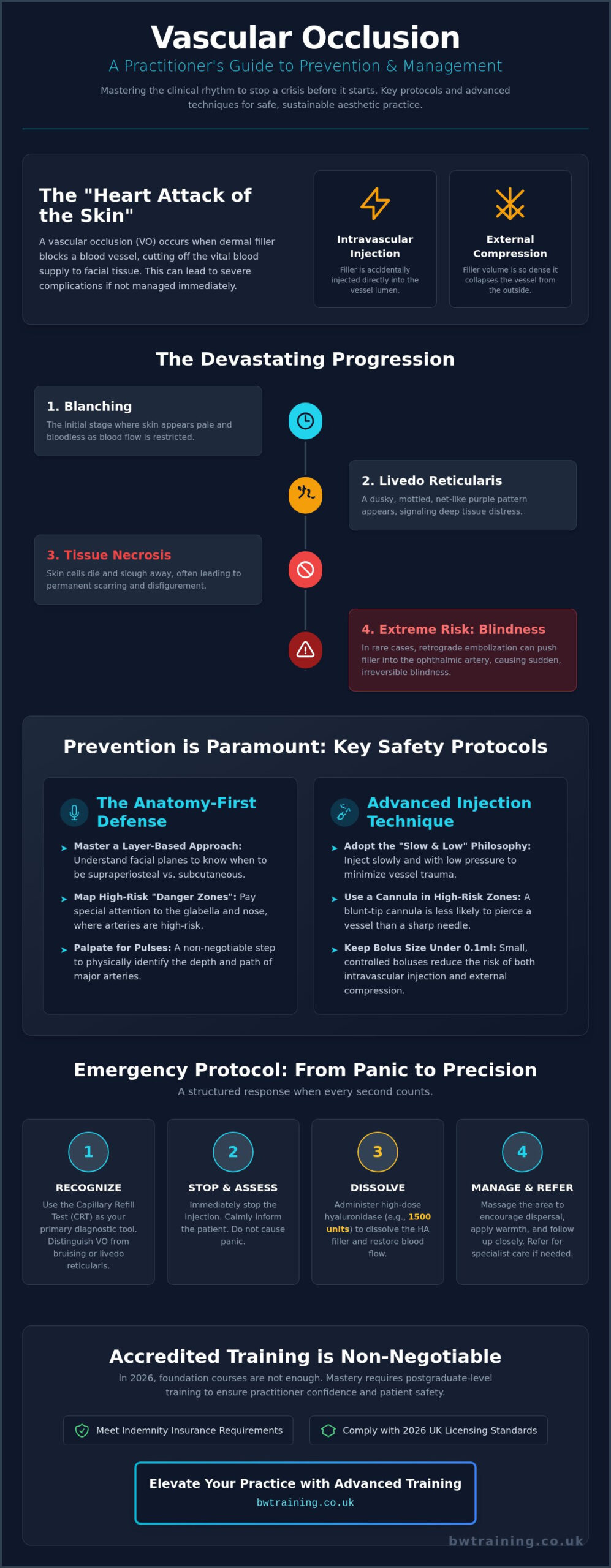
A vascular occlusion (VO) occurs when dermal filler is accidentally injected into a blood vessel or when the filler volume compresses a vessel from the outside. We often describe this as a “heart attack of the skin.” Just as a coronary blockage starves the heart muscle of oxygen, a VO cuts off the vital blood supply to facial tissue. With the massive surge in filler popularity leading into 2026, practitioners face a higher volume of cases and a greater professional responsibility. Maintaining high standards of injectable filler safety isn’t just a clinical preference; it’s a fundamental requirement for anyone holding a syringe.
It’s vital to distinguish between the two primary causes of ischemia. An intravascular injection happens when the product enters the vessel lumen directly, often traveling to distant sites. External compression occurs when filler is placed so densely that it exerts enough pressure to collapse the vessel from the exterior. Both mechanisms lead to the same dangerous end: tissue death. This is why specialized avoiding vascular occlusion training is essential for every injector who wants to practice with true peace of mind.
The Consequences of Unmanaged Occlusions
If you don’t manage an occlusion immediately, the progression is predictable and devastating. It typically starts with blanching, where the skin looks pale and bloodless. This quickly evolves into livedo reticularis, a dusky, mottled purple pattern that signals deep distress. Without intervention, tissue necrosis follows. This is where the skin cells die and slough away, often leaving permanent scarring. In the most severe and rare cases, retrograde embolization can push filler into the ophthalmic artery. This can cause sudden, irreversible blindness. Beyond the human cost, failing to follow a robust complication protocol can end a career and lead to severe legal consequences.
The Role of Accredited Training in Risk Mitigation
Many foundation courses provide the basics of how to inject, but they often gloss over the complex reality of complication management. Real mastery requires a much deeper dive into clinical theory and practical reversal techniques. Our Level 7 Aesthetics Practice qualification is designed to fill these gaps, providing the postgraduate-level knowledge needed for safety mastery. In the UK, professional indemnity insurance providers now strictly require proof of accredited avoiding vascular occlusion training. They need to see that you aren’t just a technician, but a prepared clinician who can act with calm precision during an emergency.
The Anatomy-First Defense: Mapping High-Risk Facial Zones
Relying on textbook diagrams is a dangerous gamble in a clinical setting. While charts provide a baseline, every face you treat possesses unique anatomical variations that can shift the expected position of a vessel by several millimeters. True safety lies in a layer-based approach. We teach our students to visualize the face in distinct planes, knowing exactly when to stay supraperiosteal and when the subcutaneous layer offers a safer harbor. This spatial awareness is the primary goal of high-quality avoiding vascular occlusion training, transforming a nervous injector into a confident clinician.
Before any product leaves the syringe, you must physically engage with the patient’s anatomy. Palpating for pulses is a non-negotiable step that helps identify the depth and path of major arteries. However, even the most experienced hands can become complacent. This is why constant CPD-certified anatomy refreshers are vital for long-term practitioners. Staying updated ensures that your mental map aligns with the latest cadaveric research and clinical findings. If you feel your foundational knowledge needs a boost, enrolling in Level 7 Aesthetics training provides the deep-dive anatomical mastery required for advanced practice.
Navigating the “Danger Zones”
The glabella remains the most treacherous area on the face. Because the supratrochlear and supraorbital arteries provide a direct path to the ophthalmic artery, an accidental injection here carries the highest risk of permanent blindness. Following established Vascular Occlusion Management Guidelines is essential when working in this zone. Similarly, mapping the nasolabial fold requires extreme care; the facial artery often takes a tortuous path and can vary significantly in depth. We also emphasize safe techniques for the pyriform fossa and the dorsal nose, where the angular and dorsal nasal arteries are particularly vulnerable to compression and intravascular trauma.
Visualizing Vasculature with Ultrasound
The standard of care is shifting rapidly as we move through 2026. The use of handheld ultrasound for pre-injection vessel mapping has become a hallmark of the elite practitioner. Advanced avoiding vascular occlusion training now incorporates this technology to move beyond “blind” injecting. By visualizing the exact location, depth, and flow of vessels in real-time, you can create a customized “safe path” for your needle or cannula. Ultrasound guidance allows for real-time visualization that can virtually eliminate intravascular risk by identifying vessel location before the needle ever enters the skin. This marriage of anatomical knowledge and modern technology represents the future of aesthetic safety.
Advanced Injection Techniques to Minimize Vessel Trauma
Safety in aesthetics isn’t just about anatomical knowledge; it’s about the physical mechanics of how you deliver product. Even with a perfect mental map of the facial vasculature, your manual technique determines whether a minor vessel contact becomes a major clinical crisis. Adopting a “Slow and Low” philosophy is the most effective way to reduce risk. By injecting slowly and with minimal pressure, you ensure that if a vessel is breached, the volume of filler remains localized. High-pressure injections are far more likely to cause retrograde embolization, where product is forced backward against the blood flow into larger, more critical arterial branches.
The aspiration debate remains a polarizing topic in the industry. While we include correct aspiration as a core component of avoiding vascular occlusion training, you must understand its limitations. Aspiration is not a 100% guarantee of safety. Factors like the viscosity of the filler, the gauge of the needle, and the potential for a vessel to collapse against the needle tip under negative pressure can lead to “false negatives.” You should aspirate for at least 10 seconds, but never let a negative result lull you into a false sense of security. Clinical observation remains your primary defense.
Mastering the Micro-Bolus
Precision injecting requires keeping bolus sizes exceptionally small, particularly in high-risk zones. We recommend keeping individual aliquots under 0.1ml. Using a retrograde threading technique allows you to deposit product as you withdraw the needle, ensuring you aren’t dumping a large volume into a single point. Maintaining a “moving needle” technique is equally vital; it’s significantly harder to cannulate a vessel if the needle is constantly in motion. To support this, we advise using low-extrusion pressure syringes that allow for a smooth, consistent flow without the need for excessive thumb force.
The Safety Advantages of Blunt Cannulas
Switching from needles to blunt cannulas is one of the most effective ways to enhance patient safety. While needles are sharp enough to pierce vessel walls easily, a blunt cannula is designed to deflect off tubular structures like arteries. However, the gauge matters immensely. A 27G cannula is still thin and sharp enough to penetrate a vessel. For maximum safety, we advocate for 25G or 22G cannulas when working in subcutaneous planes. These larger gauges are significantly more “blunt” and offer better tactile feedback. The process involves:
- Creating a Pilot Hole: Use a needle one gauge larger than your cannula to create an entry point.
- Navigating with Care: Gently wiggle the cannula through the tissue layers, feeling for resistance.
- Knowing the Trade-off: While cannulas are safer for volume replacement, a needle is still the superior choice for supraperiosteal precision, provided it’s used with extreme caution.
By mastering these physical maneuvers, you move beyond theoretical safety and into practical mastery. This technical proficiency is what separates a standard injector from a top-tier clinical professional.
Emergency Preparedness: The Hyaluronidase Protocol
Prevention is the primary goal, but clinical preparedness is what defines a true professional. If a complication occurs, your ability to transition instantly from “injector” to “clinician” is what prevents permanent tissue damage. This level of readiness is a core pillar of our avoiding vascular occlusion training. You must be able to recognize the signs before the patient even leaves your chair. The Capillary Refill Test (CRT) is your most reliable diagnostic tool. By applying pressure to the suspected area for five seconds and watching how quickly the blood returns, you can identify ischemia in real-time. A healthy refill takes less than two seconds. If the skin remains pale or displays a dusky, mottled pattern known as livedo reticularis, you’re likely facing an occlusion.
It’s important not to confuse a vascular event with a standard bruise. Bruising typically develops over several hours and remains localized to the injection site. An occlusion is usually immediate, often accompanied by disproportionate pain, and may follow the anatomical path of a vessel. Your emergency kit must be fully stocked and in-date at all times. This kit should include multiple vials of hyaluronidase, sterile saline for reconstitution, heat packs, and high-dose aspirin. Beyond the physical tools, the psychological aspect of complication management is vital. Your patient will mirror your energy. If you remain calm and lead them through the protocol with steady confidence, you’ll maintain their trust and ensure a much smoother recovery process.
Implementing the High Dose Pulsed Protocol
When an occlusion is confirmed, you must act with speed and precision. The 2026 standard for severe cases often involves the following steps:
- Step 1: Stop treatment immediately. Apply firm, aggressive massage and warm compresses to the area to encourage vasodilation and help disperse the filler.
- Step 2: Reconstitute your hyaluronidase. While 200 units was once the standard starting point, current evidence supports using up to 1500 units for severe or non-responsive cases to ensure total enzymatic saturation.
- Step 3: Perform repeated CRT checks and administer additional pulses of hyaluronidase every 60 minutes until the capillary refill returns to normal and the skin color improves.
Post-Complication Aftercare and Monitoring
The first 24 to 48 hours following a reversal are the most critical for tissue recovery. You must maintain constant communication with your patient, checking in every few hours to monitor their progress. If they report “red flag” symptoms like sudden vision changes, a severe headache, or skin sloughing, you should refer them to A&E or an ophthalmologist immediately. For a standard emergency reversal, hyaluronidase is typically reconstituted to a concentration of 150 units per 1ml of sterile saline to allow for precise delivery into the affected area.
Secure your practice and gain the clinical confidence to handle any complication by enrolling in our Level 7 Aesthetics Practice training today.
Elevating Your Practice with Beautiful World Training Academy
At Beautiful World Training Academy, we believe that clinical excellence is built on a foundation of safety and mutual support. Operating from our specialized training centers in Hounslow and Whitton, we’ve designed our curriculum to bridge the gap between basic theory and expert clinical practice. We know that the transition from a student to a solo practitioner can feel daunting. That’s why our avoiding vascular occlusion training is woven into the very fabric of every course we offer, ensuring that safety isn’t an afterthought, but a core skill.
We maintain a strict commitment to small class sizes. This isn’t just about comfort; it’s a clinical imperative. In a crowded seminar, a student might miss a subtle cue in skin blanching or struggle to feel the correct depth of a supraperiosteal injection. Our instructors provide direct, hands-on coaching for every individual. This allows you to develop the muscle memory and clinical judgment needed to protect your patients. Whether you are just starting with our Foundation Dermal Filler course or advancing to complex facial contouring, safety remains our first priority.
Why Choose Our Accredited Aesthetics Training?
We focus on NVQ and CPD certifications that are fully recognized by major UK insurance providers. This professional recognition is your shield in a regulated industry. You won’t just learn on mannequins; you’ll work with live models under the watchful eyes of expert mentors. This real-world experience is essential for mastering the nuances of avoiding vascular occlusion training and building the confidence to act decisively if a complication arises. Our mentorship model also extends far beyond the classroom. We provide an ongoing support network where you can seek expert advice on complications or refine your techniques as your business grows.
Starting Your Journey in London & Hounslow
Our centers are conveniently located to serve practitioners across Richmond, Twickenham, Ealing, and Chiswick. We offer flexible learning paths that take you from an NVQ Level 3 Beauty Therapy qualification all the way to a Level 7 Diploma in Aesthetics Practice. This structured progression allows you to grow your career with a steady, logical rhythm. We aren’t just a training provider; we’re your partners in professional safety and long-term career growth.
Secure your place on our next Advanced Safety & Fillers course today.
Mastering the Art of Clinical Safety
Mastering clinical safety is a journey that transforms your practice from a series of procedures into a professional clinical service. We’ve explored how a layer-based anatomical defense, combined with “slow and low” injection mechanics, forms your first line of protection. By prioritizing avoiding vascular occlusion training, you ensure that you’re never just reacting to a crisis, but actively preventing one through technical precision and the correct use of tools like blunt cannulas.
True confidence comes from knowing you have a clear, practiced protocol for emergency reversal. At Beautiful World Training Academy, we provide that certainty through our Accredited Level 5 & 7 Aesthetics Qualifications. With over 10 years of expert aesthetics mentorship and dedicated hands-on sessions in Hounslow and Whitton, we help you build a career rooted in patient well-being and professional integrity. It’s an investment in your peace of mind and your patients’ safety.
Book Your Advanced Aesthetics Safety Training at Our London Academy and take the next step toward clinical mastery. You have the talent and the drive; let’s ensure you have the elite safety skills to match.
Frequently Asked Questions
What is the first sign of a vascular occlusion during a filler treatment?
The first sign of a vascular occlusion is typically skin blanching, where the area turns a pale or white color due to restricted blood flow. This is often accompanied by immediate, disproportionate pain that feels different from a standard needle prick. If you notice these symptoms, you must stop injecting immediately to assess the tissue. Early detection is the most critical factor in preventing the progression toward tissue necrosis.
Does aspirating really prevent vascular occlusion?
Aspiration is a useful safety check but it doesn’t offer a 100% guarantee against vascular occlusion. Factors like high filler viscosity or a vessel wall collapsing against the needle tip can produce a false negative result. While we teach correct aspiration as part of avoiding vascular occlusion training, you should never rely on it alone. Clinical observation and a “slow and low” injection technique remain your primary defenses in high-risk zones.
Is a cannula safer than a needle for dermal fillers?
Blunt cannulas are generally considered safer than needles because their rounded tips are more likely to deflect off blood vessels rather than piercing them. However, gauge is a critical factor; thin 27G cannulas can still be sharp enough to enter a vessel. For maximum safety, practitioners should use 25G or 22G cannulas in subcutaneous planes. Needles are still preferred for precision on the bone but require much higher clinical caution.
How much Hyaluronidase should I have in my emergency kit?
Your emergency kit should contain at least 10 to 15 vials of hyaluronidase to ensure you can complete a high-dose pulsed protocol if needed. Recent clinical evidence supports using up to 1500 units for severe or non-responsive cases. Having an insufficient supply can lead to critical delays in treatment. Always check your stock regularly to ensure all vials are well within their expiration dates and ready for immediate reconstitution.
Can a vascular occlusion happen 24 hours after the treatment?
Yes, a vascular occlusion can manifest up to 24 hours or even later after a treatment. While intravascular injections usually show immediate signs, external compression can cause a slower, delayed reduction in blood flow. This is why constant communication with your patient during the first 48 hours is vital. You must instruct them to report any new mottling, increasing pain, or skin temperature changes immediately to prevent long-term damage.
What is the Capillary Refill Test (CRT) and how do I perform it?
The Capillary Refill Test (CRT) is a rapid diagnostic tool used to assess blood flow to the skin’s surface. To perform it, apply firm pressure to the suspected area with your finger for five seconds until the skin blanches. Release the pressure and count how many seconds it takes for the color to return. A healthy refill happens in less than two seconds; anything longer suggests a potential vascular compromise that requires immediate intervention.
Do I need a medical degree to take vascular occlusion training in the UK?
You don’t necessarily need a medical degree to access avoiding vascular occlusion training in the UK. Many non-medical practitioners enter the field through regulated pathways like NVQ Level 3 Beauty Therapy and progress to Level 5 and Level 7 Aesthetics Practice. However, 2026 regulations require that all practitioners working with prescription-only medicines like hyaluronidase have a clear, documented oversight or referral structure with a regulated healthcare professional to ensure patient safety.
Will my insurance cover me if I have a vascular occlusion complication?
Most specialized aesthetic insurance providers will cover you for complications like vascular occlusion, provided you can prove you’ve completed accredited training. Insurers in 2026 are increasingly strict about requiring proof of emergency protocol mastery and up-to-date CPD certifications. If you haven’t documented your safety competence through a recognized academy, you risk having a claim denied. Always verify your specific policy requirements before performing high-risk procedures.