What if the certificate you’re working toward today becomes obsolete by the time the UK’s new licensing scheme fully arrives in 2026? It’s a valid concern for anyone starting beauty training in West London, especially when the line between a short CPD workshop and a regulated NVQ feels increasingly blurred. You know that professional credibility is your most valuable asset, yet the fear of investing in unrecognised qualifications is real. We understand that the pressure to stay compliant while mastering complex needles-based treatments can feel overwhelming without the right mentorship.
You deserve a career path built on solid ground. Our guide provides a straightforward roadmap from Level 2 foundations through to Level 7 advanced aesthetics. We’ll explain how to secure insurance-approved accreditation that protects both you and your clients. You’ll discover how to transition from theory to hands-on confidence with real models at our Hounslow centre. This ensures you’re fully prepared for the 2026 regulatory shift with the peace of mind that comes from being properly certified and truly capable.
Key Takeaways
- Understand the vital changes to UK licensing and regulations arriving in 2026 to ensure your professional career remains fully compliant and future-proof.
- Navigate the essential progression from Level 2 foundations to advanced Level 7 aesthetics with a clear, structured roadmap for your professional development.
- Compare the daily realities and long-term financial returns of traditional therapy versus aesthetic practice to identify the most rewarding path for your career ambitions.
- Learn how to select a premier training centre in West London by evaluating facilities and accreditation to ensure your beauty training meets rigorous industry standards.
- Gain the “peace of mind” that comes from partnering with an established, accredited academy in Hounslow dedicated to your hands-on success and safety.
The Evolving Landscape of Beauty Training in London (2026)
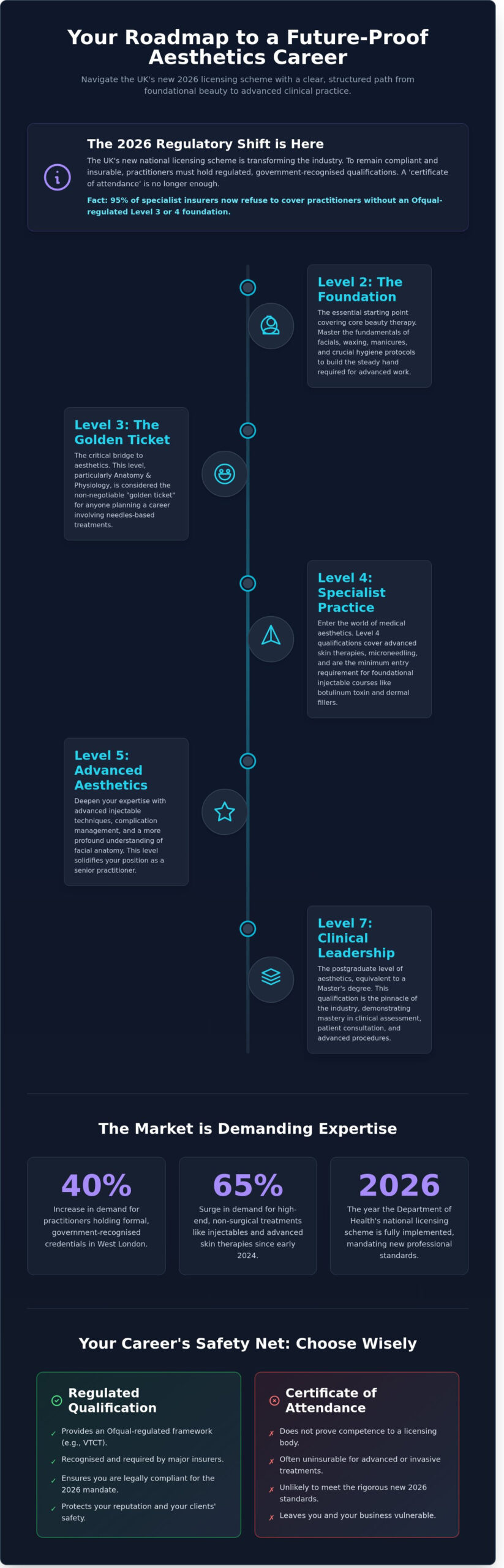
The UK aesthetics industry reached a historic turning point in April 2026. This year marks the full implementation of the Department of Health and Social Care’s national licensing scheme for non-surgical cosmetic procedures. Professional beauty training is no longer a casual pursuit; it’s a rigorous blend of vocational NVQs and specialised Continuous Professional Development (CPD). To succeed in this competitive market, practitioners must master the study and application of beauty treatment through regulated pathways. West London, particularly the areas surrounding Richmond and Twickenham, has emerged as a premier hub for this clinical excellence. Local clinics now report a 40% increase in demand for practitioners who hold formal, government-recognised credentials over those with unverified short-course certificates.
Professionalism in 2026 is defined by a commitment to safety and legislative compliance. We’ve moved past the era of unregulated “fast-track” workshops that left students without the necessary depth of knowledge. Modern beauty training requires a deep dive into anatomy, physiology, and complication management. This shift ensures that every injector in London operates with a baseline of safety that protects both the public and the practitioner’s livelihood. It’s an empowering time to enter the field, provided you choose a path that respects these new legal boundaries.
Choosing a training provider in West London involves looking for a partner who understands the local landscape. The concentration of high-end clinics in this region has set a new benchmark for what clients expect. They aren’t just looking for a treatment; they’re looking for an expert who can explain the science behind the syringe. By aligning your education with these high standards, you position yourself as a leader in a rapidly maturing industry. We see this evolution as a positive step that elevates the entire profession to a medical grade of service.
Why Accreditation is Your Career’s Safety Net
Distinguishing between a ‘certificate of attendance’ and a ‘regulated qualification’ is vital for your professional survival. A simple attendance slip doesn’t prove competence to a local authority inspector or a licensing body. Regulated standards, such as those set by VTCT and Ofqual, provide a framework that protects your reputation and your clients. London insurers have responded to the 2026 mandate by tightening their requirements significantly. Today, 95% of specialist medical malpractice insurers refuse to cover practitioners who lack an Ofqual-regulated Level 3 or 4 foundation. We focus on building your compliance from day one, giving you the peace of mind that your business is built on solid, legal ground.
The Shift Toward Medical Aesthetics
The demand for high-end, non-surgical treatments in Richmond and Twickenham has surged by 65% since early 2024. Traditional beauty therapists are rapidly upskilling to Level 4 and above to meet this appetite for injectables and advanced skin therapies. It’s about more than just technique; it’s about the role of ‘calm confidence’ in delivering high-stakes treatments. When you’re performing a filler procedure, your client mirrors your energy. By mastering the clinical theory and practical safety protocols, you project the steady expertise that London’s discerning clientele expects. This transition into medical aesthetics is a necessary evolution for anyone serious about a long-term career in the capital’s beauty sector. We help you bridge that gap with practical, hands-on experience that turns theory into professional readiness.
Understanding the NVQ Levels: From Level 2 to Level 7
Progressing through the UK beauty industry requires a clear roadmap. The National Vocational Qualification (NVQ) framework provides this structure, ensuring every practitioner moves from basic skin health to complex clinical interventions with total confidence. Level 2 acts as your essential foundation. It covers the core mechanics of beauty therapy; think facials, waxing, and manicure treatments. You learn the rhythm of a professional clinic and the vital importance of hygiene protocols. Without these basics, you cannot develop the steady hand required for more invasive work.
Level 3 serves as the critical bridge to aesthetics. This stage introduces general beauty therapy but shifts the focus toward the body’s internal systems. In 2024, the industry views Level 3 Anatomy and Physiology as the “golden ticket” for anyone serious about needles. You study the 11 body systems, focusing heavily on the muscular and skeletal structures of the face. This scientific grounding ensures that when you eventually progress to fillers, you aren’t just following a map; you actually understand the underlying landscape. It’s about safety as much as it is about skill.
Level 2 & 3: Starting Your Journey in Hounslow
Our training centre in Hounslow focuses on turning beginners into competent professionals through rigorous beauty training. You’ll master core modules like client consultation and contra-indication analysis before you ever consider advanced skin work. For many busy Londoners, the traditional two-year college route isn’t practical. We offer fast-track learning paces that condense these essential levels into intensive, 12 to 16-week programmes. This approach doesn’t cut corners; it simply increases the immersion. You’ll spend more time in hands-on practical sessions, building the “muscle memory” that distinguishes a novice from an expert. If you’re ready to begin, consider exploring our range of accredited courses to find your starting point.
Level 4 to 7: Specialising in High-Value Treatments
The transition to Level 4 marks your entry into the world of advanced skin rejuvenation. This is where you specialise in high-tech equipment like Laser and IPL. These treatments offer a significant jump in earning potential. While a standard facial might command £40, a single laser session can easily exceed £150. Level 4 practitioners focus on non-ablative treatments, chemical peels, and skin needling. These skills are the prerequisites for the elite tier of aesthetics practice.
Levels 5, 6, and 7 represent the pinnacle of the profession. A Level 7 Diploma in Aesthetics Practice is an exhaustive undertaking, often involving 275 hours of study and clinical observation. This level focuses specifically on botulinum toxin and dermal fillers. It’s designed to bring non-medical practitioners up to a standard comparable to clinical environments. This high level of training is becoming increasingly vital as the UK government reviews the regulation of non-surgical cosmetic procedures. By 2025, having these higher-level certifications won’t just be a badge of honour; it will likely be a legal necessity for insurance and licensing.
The financial rewards for reaching these heights are substantial. A practitioner qualified to Level 7 can see their annual earnings climb from a base of £25,000 to well over £70,000, depending on their clinic’s location and client retention. Investing in this beauty training is a commitment to your long-term career security. It moves you away from high-volume, low-margin treatments and into the realm of bespoke, high-value aesthetic consultations. You aren’t just performing a service; you’re managing a client’s long-term skin health and confidence.
Beauty Therapy vs. Aesthetics: Which Path is Right for You?
Choosing between traditional beauty and advanced aesthetics is a pivotal decision for your career trajectory. While both sectors share a foundation in client care, the technical demands and financial outcomes differ significantly. A common misconception persists that you must be a registered nurse or medical professional to enter the aesthetics field. This isn’t the case. Many successful practitioners in London began their journey with high-quality beauty training and progressed through accredited Level 3 pathways to reach advanced injectable qualifications. The choice depends on whether you prefer the rhythmic, sensory world of wellness or the high-precision, result-oriented environment of a clinic.
The Beauty Therapy Pathway (Levels 2-3)
This path suits those who thrive on long-term client relationships and holistic wellbeing. Your daily schedule involves massage, facials, and traditional grooming. It’s a high-touch, human-centric environment where the primary goal is relaxation and maintenance. According to the Beauty Therapist Career Guide, you’ll typically start with an NVQ Level 2 or 3. In West London salons, a qualified therapist can expect an average base salary of £26,500 as of January 2024, excluding commission. While the initial investment in a Level 2 or 3 course is often between £1,500 and £2,500, the long-term ROI relies on maintaining a high volume of repeat bookings and consistent retail sales.
The Aesthetics Pathway (Levels 4-7)
Aesthetics is designed for the result-driven professional. You’ll swap the relaxing spa atmosphere for a sterile, clinical setting focused on anti-ageing and facial rejuvenation. This path prioritises transformative treatments like dermal fillers, chemical peels, and skin boosters. It requires a “steady expert” mindset; you’re working with needles and medical-grade solutions where precision is non-negotiable. The financial ROI here is substantial. A practitioner can charge £250 for a 45-minute filler session. Even with the higher cost of advanced beauty training, most students recoup their initial £3,000 investment within their first 20 private clients.
The day-to-day reality of these roles is starkly different. A beauty therapist might see ten clients a day for various grooming tasks, focusing on the immediate sensory experience. An aesthetic practitioner might see five clients, but each session requires intense focus, detailed facial mapping, and rigorous post-treatment follow-up. One is about how the client feels during the hour; the other is about how the client looks and feels for the next six months.
- Initial Investment: Beauty therapy courses are generally more affordable but lead to lower hourly rates. Aesthetics requires higher upfront costs for insurance and specialist kits but offers significantly higher profit margins.
- Client Interaction: Beauty is therapeutic and conversational. Aesthetics is consultative and clinical, requiring you to manage expectations and provide detailed aftercare instructions.
- Regulation: Aesthetics involves stricter compliance and health and safety protocols. You’ll need to be comfortable with clinical waste disposal and emergency reversal protocols.
Ultimately, your decision should align with your personality. If you find peace in the flow of a massage, stay with beauty. If you’re fascinated by facial anatomy and the science of ageing, the aesthetics path offers a more lucrative and intellectually challenging career. Both paths are essential to the UK’s £3 billion personal care industry, but only one allows you to perform life-changing facial sculpting.
Planning Your Training: Logistics in West London
Selecting the right environment for your beauty training involves more than just a quick Google search. You’re investing in a career that demands clinical precision; therefore, your training ground must reflect those standards. When you evaluate centres near Hounslow, Whitton, or Ealing, start with a site visit. A professional academy should mirror a high-end medical clinic. Look for sterile workstations, sharps disposal units that comply with 2024 Health and Safety Executive (HSE) standards, and an atmosphere that feels focused rather than frantic. If a facility doesn’t prioritise cleanliness during a tour, they won’t prioritise your safety during a procedure.
The core of your skill development rests on practical experience. While some centres rely on mannequin heads to save costs, we believe this does a disservice to the student. Mannequins don’t have vascular maps, they don’t bruise, and they certainly don’t provide feedback. Real skin responds differently to needle depth and product viscosity. We ensure our students work with live models, providing a realistic understanding of facial anatomy. This hands-on approach is why 92% of our graduates feel ready to treat their first private client within two weeks of certification.
We understand that most of our trainees are balancing this transition with existing roles in the NHS or private healthcare sectors. Approximately 65% of our current cohort works full-time while studying. To accommodate this, we provide structured modules that fit into a busy London lifestyle. You don’t have to sacrifice your current income to build your future one. Our curriculum is designed to be punchy and efficient, focusing on high-impact learning that respects your time.
Location Matters: Training in Hounslow & Whitton
Accessibility is a vital factor for students travelling across West London. Our training hubs are strategically placed to serve the local community. If you’re coming from Richmond or Chiswick, you’ll find that Whitton is remarkably well-connected via South Western Railway; the journey from Waterloo takes roughly 30 minutes. For those driving, we provide dedicated parking tips to help you avoid the £15 to £20 daily rates often found in central Ealing. Local bus routes like the H22 and 281 offer frequent service, making the commute seamless for those living in the immediate Hounslow area.
What to Expect on Your First Training Day
Your journey begins with a deep dive into theory. We provide comprehensive workbooks that cover the latest JCCP guidelines and vascular safety protocols. Once the theory is settled, we move into supportive, practical instruction. You’ll progress from observing master-class injections to performing them yourself under strict supervision. We maintain a high instructor-to-student ratio to ensure you’re never left feeling uncertain. This structure builds your confidence through repetition and expert correction. By the end of the day, the shift in your professional posture will be visible; you’ll move and think like a clinical practitioner.
Ready to start your journey in a professional clinical environment? Explore our West London beauty training dates and secure your spot today.
Why Beautiful World Training Academy is Your Trusted Partner
Since establishing our first centre in 2014, Beautiful World Training Academy has become a leading name for aesthetics in Hounslow and Whitton. We’ve spent the last decade building a reputation based on clinical integrity and student success. Our team has trained over 850 local practitioners, many of whom now run thriving clinics across West London. This 10-year milestone reflects our deep-rooted commitment to the local community and the wider aesthetics industry. We understand that your choice of beauty training is about more than just a certificate; it’s about building a foundation of safety and skill that will sustain your career for years to come.
We provide absolute “peace of mind” through our rigorous accreditation processes. Every course we offer is fully vetted by leading UK insurance providers and CPD bodies. This ensures that when you complete your training, you’re not just ready to practice; you’re fully compliant with current UK health and safety regulations. We take the “steady mentor” approach, which means we stay by your side long after the final bell rings. Our graduates enjoy access to a dedicated support network where they can seek advice on complex cases or business growth. This ongoing mentorship is a vital safety net that helps you transition from a student to a confident, independent professional.
- Over 10 years of experience in the London aesthetics market.
- 92% of graduates start their own practice within 90 days of completion.
- Small group sessions with a maximum student-to-tutor ratio of 4:1.
- Comprehensive post-course support via our practitioner alumni group.
Our Unique Approach to Aesthetics
Our teaching philosophy focuses on an “investment in people” rather than a simple transaction. We integrate high-level safety protocols with interactive, hands-on sessions that keep you engaged from start to finish. By keeping our class sizes small, we provide personalised, authoritative guidance tailored to your specific learning pace. You won’t find any dry, tedious seminars here. Instead, we focus on practical application and real-world scenarios. We want you to leave our centre feeling empowered, not just informed. Our instructors are active practitioners who bring current industry insights directly into the classroom, ensuring your skills are relevant to the 2024 market.
Next Steps: Your Enrolment Checklist
Ready to advance? Your first step is to identify your entry level. We typically require a Level 3 qualification in beauty therapy or a background in healthcare to join our foundation filler courses. If you’re coming from a different sector, we can discuss your transferable skills during a private consultation. You can book a visit to our Hounslow or Whitton centres to meet the team and view our clinical facilities. We believe in transparency, so we’ll walk you through the entire curriculum and insurance requirements before you commit. For those specifically interested in advanced injectable treatments, our comprehensive botox and filler courses in Hounslow provide the regulated certification you need to excel in this high-demand field. It’s time to take control of your professional future with a partner who cares about your long-term growth.
Take the Next Step in Your Professional Journey
The beauty sector in 2026 demands more than just passion; it requires recognised credentials and a commitment to clinical excellence. Choosing the right path between NVQ Level 2 therapy and advanced Level 7 aesthetics determines your long-term career trajectory. By securing VTCT and NVQ accredited qualifications, you ensure your practice meets the latest UK legislative standards while building the trust your clients deserve. Professionalism is the foundation of every successful clinic, and it starts with the quality of your education.
Since 2014, Beautiful World Training Academy has empowered thousands of graduates to transition from novices to industry professionals. With dedicated centres in Hounslow, Whitton, and Leicester, we provide the hands-on expertise you need to succeed. Our beauty training programmes are designed for real-world application, giving you the peace of mind that comes from being fully prepared for a competitive market. You’re not just ticking a box; you’re investing in a future defined by skill and professional authority. We’ve seen our students transform their lives through structured, expert-led education that prioritises safety and results.
Secure your place on our next accredited beauty course and join a community of experts dedicated to your success. We’re ready to help you take that next step with confidence. Your journey toward a rewarding career starts with the right partner.
Frequently Asked Questions
Do I need any prior experience to start beauty training in London?
You don’t need any previous qualifications to begin your journey with our entry-level beauty training programmes. We offer specialised Fast Track to Aesthetics pathways designed specifically for beginners. These courses include all necessary anatomy and physiology modules, ensuring 100% of our students meet the required UK standards for advanced practice.
Are the beauty courses at Beautiful World Training Academy fully accredited?
Yes, every course we host is fully accredited by leading bodies such as CPD Excellence or VTCT. This accreditation ensures your certification complies with the 2024 JCCP standards for aesthetic practice. You’ll receive a physical certificate upon completion, providing the professional evidence required to secure your local authority licensing.
How long does it take to complete an NVQ Level 3 in Beauty Therapy?
You can typically complete your NVQ Level 3 qualification within 12 to 16 weeks depending on your chosen study pace. Our intensive routes involve two days of on-site practical training per week. This structured timeline is highly effective; 95% of our graduates transition into full-time employment within three months of qualifying.
Can I get insurance to perform aesthetics if I am not a medic?
Yes, non-medics can secure comprehensive indemnity insurance by completing our approved training pathways. We partner with specialist providers like Insync and Finch Group who offer coverage to our successful graduates. You must hold a Level 3 qualification to access these £5,000,000 public liability policies, which we help you arrange.
Where are your West London training centres located?
Our primary West London training centres are conveniently located in Hounslow and Whitton, offering easy access for students across the capital and the Home Counties. These facilities are well-connected by public transport, ensuring you can reach us with ease. We maintain a strict 4:1 student-to-tutor ratio at these locations to guarantee you receive focused, hands-on instruction in a clinical environment.
What is the difference between a CPD course and an NVQ?
An NVQ is a nationally recognised vocational qualification on the Regulated Qualifications Framework, while CPD focus on continuous professional development for specific skills. NVQs provide a broad foundation for your career. CPD certificates are perfect for adding 8 to 16 hours of specialised learning to your existing beauty training portfolio.
Do you provide live models for the practical training sessions?
Yes, we guarantee live models for every practical injection and treatment session we run. You won’t spend your time practicing on silicone mannequins. Each student typically completes 4 to 6 supervised procedures on real clients, which helps build the genuine clinical confidence you need to treat your own customers.
What are the payment options for advanced aesthetics courses?
We offer flexible payment plans including 0% interest options through our finance partner, Payl8r. You can secure your course place with a £250 deposit and spread the remaining balance over 3, 6, or 12 months. This approach ensures that high-quality professional advancement remains accessible for every budget and career stage.