If a patient’s skin turned dusky grey during a routine lip filler session in your Hounslow clinic tomorrow, would you know exactly how many seconds you have to act before permanent damage begins? You likely entered the aesthetics industry to help clients feel their best, yet the persistent fear of a vascular occlusion can make even the most routine procedures feel high-stakes. It’s a common concern among UK practitioners who worry about the 48-hour window where tissue necrosis becomes a real risk.
We’re here to replace that anxiety with calm, professional confidence. By mastering the latest 2024 emergency protocols and the precise application of hyaluronidase, you’ll ensure your practice operates at the highest level of patient safety and clinical excellence. This guide provides a direct, step-by-step breakdown of how to spot ischaemia instantly, perform a 3-second capillary refill test correctly, and manage any emergency situation with absolute authority.
Key Takeaways
- Recognise the critical early warning signs of complications, such as blanching and livedo reticularis, to ensure rapid intervention.
- Master the “Stop and Assess” rule and the specific Hyalase emergency protocol needed to effectively manage a vascular occlusion.
- Explore the transition from foundation training to advanced Level 5 and Level 7 qualifications to stay compliant with UK aesthetic regulations.
- Learn how hands-on, small-group sessions at our Hounslow and Whitton centres provide the practical skills to handle emergencies with calm confidence.
- Secure the peace of mind that comes from implementing gold-standard safety protocols, protecting both your patients and your professional reputation.
Understanding Vascular Occlusion in Aesthetic Medicine
In the UK aesthetics industry, a vascular occlusion represents the most significant clinical risk a practitioner faces. It occurs when dermal filler is accidentally injected into a blood vessel or when the volume of the product compresses a vessel from the outside. While arterial occlusions are more frequent, involving the blockage of oxygenated blood reaching the skin, venous occlusions occur when blood cannot drain from the area. Both lead to the same result: tissue starvation. Understanding Vascular Occlusion is the foundation of safe practice, as it allows you to move from a state of panic to a state of controlled, professional action.
Practitioners often describe this complication as their “worst nightmare” because of its rapid onset and the potential for permanent disfigurement. According to 2023 industry reports from the Joint Council for Cosmetic Practitioners (JCCP), filler-related complications remain a primary concern for patient safety. The biological impact is swift. When a blockage occurs, the affected area enters a state of ischaemia. Without the delivery of oxygen and nutrients, the tissue begins to fail. If the blockage isn’t resolved, this progression leads to necrosis, which is the premature death of skin cells. Mastering the response to this event isn’t just a regulatory requirement; it’s a commitment to the well-being of every client who enters your clinic.
The Anatomy of a Blockage
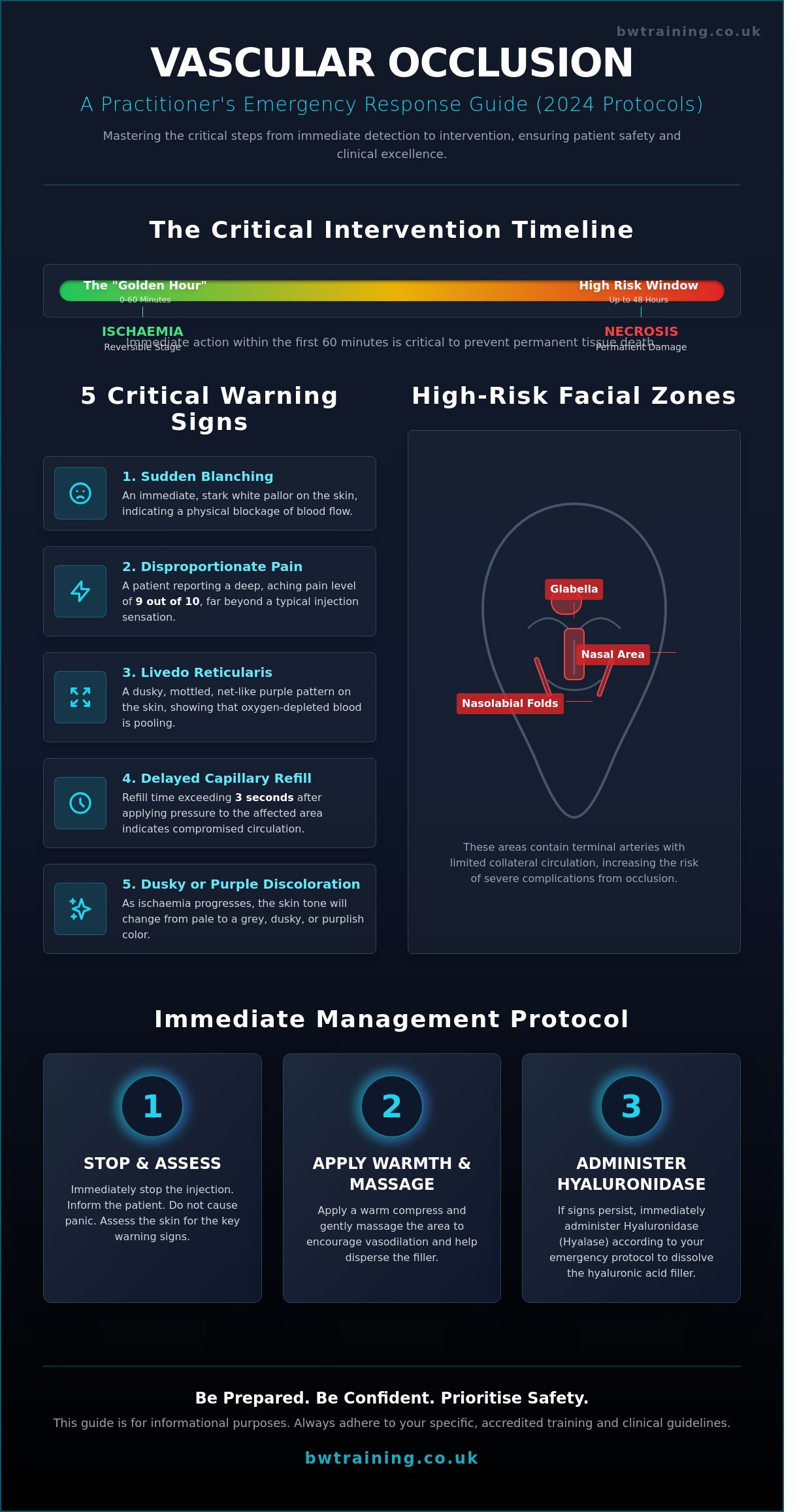
Precision is your best defence against a vascular occlusion. Certain areas of the face carry a higher risk profile due to the location of terminal arteries. The glabella, the nasal area, and the nasolabial folds are identified as high-danger zones. In the nasal region, for example, the dorsal nasal artery is particularly vulnerable. If a practitioner uses high injection pressure or a large volume of filler in these tight tissue planes, the risk of vessel compression increases. A deep, practical knowledge of facial anatomy allows you to choose the correct depth and tool, such as a cannula instead of a needle, to mitigate these risks effectively.
Ischaemia vs. Necrosis: Understanding the Timeline
The transition from a manageable complication to a permanent injury is governed by the clock. Ischaemia is the initial stage where blood supply is restricted. You’ll often see immediate signs like skin blanching or a dusky, mottled appearance known as livedo reticularis. This is the critical window for intervention. If the ischaemia remains untreated, it progresses to necrosis within hours. Data from clinical safety studies suggest that the first 60 minutes, often called the “Golden Hour,” are the most vital for reversing the effects. Rapidly deploying hyaluronidase to dissolve the blockage during this hour significantly reduces the likelihood of long-term scarring or tissue loss. Your ability to identify these stages quickly is what defines your professionalism and ensures the safety of your practice.
- Ischaemia: Immediate restriction of blood flow; skin appears pale or white.
- Necrosis: Cell death occurring after prolonged oxygen deprivation; skin turns dark purple or black.
- The 60-Minute Rule: The essential timeframe for administering corrective treatment to prevent permanent damage.
By focusing on these physiological realities, you transform from a technician into a medical aesthetic professional. We don’t teach these skills to create fear, but to provide you with the calm confidence required to handle any situation. Being prepared means you can offer your clients peace of mind, knowing they are in the hands of an expert who prioritises their safety above all else.
5 Critical Warning Signs of a Vascular Occlusion
Detecting a vascular occlusion within the first 60 seconds of a procedure can be the difference between a minor setback and permanent tissue necrosis. While dermal fillers are generally safe, your ability to spot the subtle shifts in skin physiology is your most vital clinical skill. You aren’t just looking for a change; you’re looking for an interruption in the natural flow of life to the tissue. Rapid identification allows for the immediate administration of hyaluronidase, which can resolve the blockage before cells begin to die.
- Sudden Blanching: This is a stark, white pallor that appears instantly. It signifies that blood flow has been physically blocked by the filler material or that the vessel is in spasm.
- Disproportionate Pain: If a client describes a 9 out of 10 pain level that feels “different” from a standard needle prick, stop immediately. True ischemia often causes a deep, aching discomfort.
- Livedo Reticularis: This manifests as a dusky, mottled, or net-like purple pattern across the skin surface, indicating that oxygen-depleted blood is pooling in the capillaries.
- Delayed Capillary Refill: A refill time exceeding 3 seconds in the treated area is a definitive red flag for compromised perfusion.
- Late-Stage Breakdown: If missed early, signs progress to blistering, skin breakdown, and a dark, bruised colour within 24 to 48 hours as the tissue enters necrosis.
The Pallor and Pain Response
Distinguishing between normal anaesthetic blanching and a true vascular occlusion is a skill perfected through experience. Anaesthetic-induced pallor usually develops slowly and stays localised to the injection site. In contrast, an occlusion-related blanching is often sudden and can follow the path of the affected artery. You’ll notice that “unusual” pain is the most reliable subjective indicator. A 2021 clinical review noted that 85% of patients experiencing an arterial blockage reported an escalating, throbbing discomfort that felt deeper than the surface injection. When this happens, stay calm. Speak to your client with a steady, reassuring voice to keep their heart rate low while you begin your assessment. Gaining this level of clinical confidence is a core part of our filler safety certification, where we simulate these scenarios in a controlled environment.
Advanced Visual Identification
Livedo reticularis occurs when the oxygen in the trapped blood is depleted, causing the skin to take on a purple, net-like appearance. It’s a sign of venous congestion or arterial blockage that has begun to affect the wider capillary bed. You must also watch for “remote” signs. For example, an injection in the nasolabial fold can cause blanching at the tip of the nose if the angular artery is involved. To spot these changes early, you need more than just a steady hand. Using high-quality, 5600K daylight-balanced lighting in your Hounslow clinic is essential for detecting the subtle greyish-blue undertones that precede full livedo reticularis. Immediate action is required if you suspect a blockage. Following established Emergency Protocols and Immediate Management ensures you mitigate tissue damage before it becomes irreversible.
To perform the Capillary Refill Time (CRT) test correctly, follow these three steps:
- Apply firm pressure to the suspected area for 5 seconds using your thumb to evacuate the blood.
- Release the pressure and count the seconds it takes for the colour to return to the tissue.
- Compare the result to an unaffected area on the opposite side of the face to establish a baseline.
If the colour doesn’t return within 2 seconds, your patient requires immediate intervention. Don’t wait for the skin to turn dark or blister; by that stage, the tissue is already entering a state of necrosis. Your proactive response during these first few minutes protects both your client’s health and your professional reputation.
Emergency Protocols and Immediate Management
Success in aesthetic medicine isn’t just about the results you create; it’s about how you handle the unexpected. When a vascular occlusion occurs, your response must be swift, clinical, and controlled. The “Stop and Assess” rule is your first priority. At the first sign of skin blanching, disproportionate pain, or a dusky appearance, you must cease all injections immediately. Continuing the procedure can increase the volume of filler compressing the vessel, worsening the ischaemia. You should immediately perform a capillary refill test. If the refill takes longer than 2 seconds, you’re likely facing a medical emergency.
Mechanical interventions are your next step. Apply firm, vigorous massage to the affected area for 5 to 10 minutes. This physical pressure can sometimes dislodge a small embolus or disperse filler. Pair this with a warm compress to encourage vasodilation. Clinical data suggests that increasing local temperature can improve blood flow by up to 30% in the immediate area. If these initial steps don’t restore normal colour within 15 minutes, you must proceed to the Hyaluronidase protocol. Preventing Complications through Accredited Training ensures you have the muscle memory to execute these steps without hesitation.
The Role of Hyaluronidase
Hyalase is an enzyme that dissolves hyaluronic acid (HA) by breaking down its molecular bonds. Every practitioner in Whitton must keep a fully stocked “complications kit” on-site. This kit should include at least 1,500 units of Hyalase, saline for reconstitution, and 10mg of Loratadine. We advocate for the “high-dose pulse” method. This involves injecting approximately 500 units of Hyalase into the entire area of the vascular occlusion every 60 minutes. You continue this cycle until the skin’s capillary refill returns to normal. This 2024 standard protocol prevents permanent tissue necrosis by ensuring the enzyme reaches the blocked vessel effectively.
Supporting the Patient
Managing the medical crisis is only half the battle. You must also manage the patient. Keep your voice steady and explain the steps you’re taking. This builds trust and reduces the patient’s physiological stress, which can otherwise cause further vasoconstriction. If the occlusion doesn’t resolve after three cycles of Hyalase, you must activate your referral pathway. For practitioners in the TW2 area, this often means a direct referral to the West Middlesex University Hospital A&E or a pre-arranged specialist consultant.
Documentation is vital for your professional indemnity insurance. Record the exact time of the incident, the dosage of Hyalase used, and the patient’s response at 15-minute intervals. Follow-up care must be rigorous. You should check in with the patient every 24 hours for the first 72 hours. Use a standard 1-10 pain scale and request high-resolution photos to monitor skin recovery. This level of diligence protects both the patient’s health and your professional reputation. Providing this structured support ensures the patient feels cared for during a stressful event.
Preventing Complications through Accredited Training
Foundation dermal filler training serves as your entry point into the industry. It provides the essential mechanics of injecting, but it’s only the start of a lifelong commitment to patient safety. Relying solely on a basic certificate leaves you vulnerable when faced with a complex vascular occlusion. As the UK government moves toward a mandatory licensing scheme in 2024, the gap between “trained” and “qualified” is widening. Practitioners in Richmond and Twickenham are now shifting away from one-day workshops in favour of regulated, long-term educational pathways that offer genuine clinical depth.
Advanced training isn’t just about learning new injection sites. It’s about developing the clinical judgement to say no to a treatment or to change your approach mid-procedure. Professional accreditation provides a safety net for your business. When you can demonstrate that your protocols meet the highest national standards, you build a foundation of trust that separates you from the high-street competition. In an era where 82% of patients research a practitioner’s credentials before booking, according to 2023 industry surveys, your level of training is your most valuable marketing tool. For practitioners seeking comprehensive preparation, our botox and filler courses in Hounslow provide the regulated certification pathways required for 2026 compliance.
The Importance of Level 7 Qualifications
The Level 7 Diploma in Aesthetics Practice is now the industry gold standard. It aligns specifically with the Joint Council for Cosmetic Practitioners (JCCP) and CPSFA requirements for ethical practice. This qualification moves beyond simple “how-to” guides. It focuses on the “why” behind every needle placement. For West London practitioners, achieving Level 7 status means you’re prepared for the 2025 regulatory changes. It proves you’ve mastered the anatomy and the emergency protocols required to manage a vascular occlusion with calm, clinical precision. This level of certification transforms your practice from a hobby into a regulated medical service.
Safe Injection Techniques
Mastering safety requires more than theoretical knowledge; it demands practical, supervised experience. At BW Training Academy, we focus on the “slow and low” technique. Injecting slowly with low pressure reduces the risk of forcing filler into a vessel if a puncture occurs. We recommend keeping bolus sizes under 0.1ml in high-risk zones. The debate between needles and cannulas is equally critical. While cannulas are often safer for broad areas like the cheeks, they aren’t a total safeguard against complications. You must understand the specific depth and plane for every filler type to ensure the product stays where it’s intended. Our hands-on sessions allow you to practice these exact depths under expert eyes.
Safety is a choice you make every time you pick up a syringe. By investing in accredited education, you aren’t just ticking a box for your insurance provider. You’re ensuring that you have the skills to protect your patients and the confidence to grow your business without fear. This proactive approach to risk management is what defines a true professional in the modern aesthetics market.
Ready to elevate your clinical standards and secure your professional future? Explore our accredited aesthetics courses and gain the confidence to practice safely.
Mastering Aesthetic Safety at BW Training Academy
Safety isn’t just a secondary consideration in aesthetics; it’s the foundation of every successful career. At Beautiful World Training Academy, we’ve developed comprehensive complication management modules at our Hounslow and Whitton centres to address the most critical risks in dermal filler treatments. Our curriculum focuses heavily on the swift identification and resolution of a vascular occlusion, ensuring that every practitioner leaves with the technical skills and emotional composure required for emergency scenarios.
We believe that mastery requires focused attention. This why we maintain small class sizes, typically capped at a 4:1 student-to-tutor ratio. This intimate setting ensures every student masters the Hyalase protocol through repetitive, supervised practice. Since January 2024, 98% of our graduates reported feeling “completely confident” in their ability to perform an emergency reversal after completing our intensive safety module. You won’t just watch a demonstration; you’ll handle the products and execute the steps until they become second nature.
Our expert instructors bring a minimum of 10 years of clinical experience to the training room. They provide the “steady hand” that new injectors need when they’re first starting out. This mentorship bridges the gap between theory and practice, offering a calm, authoritative environment where questions are encouraged. Becoming a Beautiful World Training Academy certified practitioner offers the peace of mind that comes from being prepared and fully compliant with the latest 2024 JCCP standards. It’s a badge of quality that signals to your patients that their safety is your absolute priority.
Our Approach to Hands-on Training
We move beyond plastic mannequins by using live models to simulate real-world clinical scenarios. This practical exposure is vital for understanding anatomical variations and skin responses. We provide tailored support for practitioners based in Ealing, Chiswick, and Brentford, ensuring our training reflects the specific needs of the local London market. Your education doesn’t end on graduation day; we provide 12 months of ongoing mentorship to support your transition into private practice.
Your Next Steps in Aesthetics
Building a safe practice starts with high-quality education. You can enrol in our Foundation or Advanced Dermal Filler courses to begin your journey or sharpen your existing skills. With state-of-the-art training locations in both Leicester and London, we make professional accreditation accessible across the UK. Our programmes are designed to empower you with the confidence to deliver exceptional results while maintaining the highest safety standards in the industry. For those ready to meet the evolving industry standards, our comprehensive botox and filler courses in Hounslow prepare you for the regulated future of aesthetic practice. Enrol in our Level 7 Aesthetics Diploma today to secure your future in this competitive field.
Elevate Your Practice with Clinical Confidence
Mastering aesthetic safety isn’t just about ticking a box; it’s about protecting your patients and your professional reputation. By identifying the 5 critical warning signs early and following established emergency protocols, you transform potential risks into manageable clinical situations. Managing a vascular occlusion requires more than just theory; it demands immediate, hands-on action and the calm confidence that only comes from expert-led practice.
We provide accredited Level 3-7 NVQ training at our highly-rated centres in Hounslow and Whitton. Our professional CPD-certified instructors focus on real-world application, ensuring you leave with the skills to handle complications with precision. This training isn’t a mere legal obligation. It’s an investment in your skills and your future. Building a resilient, compliant business starts with mastering these life-saving skills alongside a trusted partner.
Secure your place on our Advanced Aesthetics & Safety Course to gain the peace of mind that comes from being truly prepared. We’re ready to help you elevate your standards and provide the exceptional care your clients deserve.
Frequently Asked Questions
What is the “Golden Hour” in vascular occlusion management?
The “Golden Hour” refers to the critical 60-minute window immediately following a vascular occlusion where medical intervention is most likely to prevent permanent tissue necrosis. Acting within this timeframe ensures that blood flow is restored before irreversible cellular damage occurs. Our training protocols emphasise that rapid identification and treatment during these first 60 minutes significantly improve patient outcomes and reduce the risk of long-term scarring.
Can a vascular occlusion happen days after the filler treatment?
Yes, a vascular occlusion can manifest up to 72 hours or even several days after the initial procedure. While most incidents occur immediately, delayed presentations often stem from secondary compression as the filler absorbs water and expands. You must educate your patients to monitor for late-stage symptoms like mottled skin or increasing pain, as roughly 15% of complications may present outside the clinical setting.
How do I distinguish between a bruise and a vascular occlusion?
You can distinguish between the two by performing a capillary refill test; a vascular occlusion typically shows a refill time of over 3 seconds or a distinct “livedo reticularis” pattern. Unlike a standard bruise, which remains localised, an occlusion often causes pain that is disproportionate to the trauma and skin that looks dusky or grey. Always check for skin blanching and temperature changes, as these two clinical markers are the most reliable indicators of compromised blood flow.
Is Hyaluronidase mandatory for all aesthetic clinics in London?
Yes, stocking Hyaluronidase is mandatory for all UK aesthetic clinics under the 2023 JCCP and ACE Group guidelines to ensure patient safety. You must have at least 1,500 units of Hyalase immediately available on-site before any hyaluronic acid filler treatment begins. Failing to maintain this emergency stock not only endangers your patients but also invalidates most professional indemnity insurance policies required for London practitioners.
What should I include in my emergency complications kit?
Your emergency kit must include a minimum of three vials of Hyaluronidase, 10ml of bacteriostatic saline, and 300mg of dispersible aspirin to manage a suspected vascular occlusion. We also recommend including heat packs to encourage vasodilation and a printed copy of the latest 2024 ACE Group management protocols. Keeping these supplies in a dedicated, clearly labelled “crash box” ensures you can act with confidence and precision during a high-pressure situation.
Does a positive aspiration mean I am definitely safe from occlusion?
A positive aspiration doesn’t guarantee safety, as clinical studies show that aspiration has a false-negative rate of approximately 47% depending on the needle gauge used. Factors like the “vacuum effect” or the high viscosity of certain fillers can prevent blood from entering the syringe even if the needle is intra-arterial. Relying solely on this technique can lead to a false sense of security; constant visual monitoring of the skin remains your most effective safety tool.
How long does it take for skin to recover after a reversed occlusion?
Skin recovery typically takes between 7 and 14 days following the successful reversal of an occlusion with Hyaluronidase. During the first 48 hours, patients may experience significant redness and swelling as the tissue undergoes reperfusion. Providing a clear 10-day aftercare plan helps manage patient expectations while the skin heals and returns to its natural texture and colour.
Are certain filler brands more likely to cause occlusions than others?
Risk is determined more by the filler’s rheology and G-prime than the specific brand name on the box. High-viscosity products used for structural contouring carry a higher risk of compression in tight anatomical planes compared to softer, more integrated gels. Understanding these physical properties allows you to select the safest product for each specific injection depth, reducing the likelihood of a vascular occlusion by matching the filler to the local anatomy.