What if the words “Not Yet Competent” weren’t a sign of failure, but a strategic pause on your way to becoming a master therapist? If you are currently spiralling over the question, what if i fail my nvq beauty assessment, please take a deep breath. In the high-stakes environment of London’s £14.6 billion salon service market, the pressure to be perfect from day one is intense. However, a setback during your practical observation or theory paper doesn’t mean your career is over before it’s begun. It’s simply an indication that more evidence is needed to meet the national standards.
We know the anxiety that comes with the thought of wasting hard-earned course fees or feeling the embarrassment of not passing on your first attempt. It’s a heavy weight to carry, especially when you’re eager to start your journey in a thriving industry where 46% of consumers now view beauty treatments as an essential. This guide is here to replace that confusion with a clear, professional roadmap for success. You’ll discover the exact steps to manage a re-sit, understand the nuances of the VTCT and City & Guilds grading systems, and learn how to transform a temporary hurdle into the foundation of a resilient, long-term career.
Key Takeaways
- Reframe “Not Yet Competent” (NYC) as a standard vocational marker that ensures you meet the professional safety requirements for the UK beauty industry.
- Gain clarity on what if i fail my nvq beauty assessment by following a structured 2–4 week roadmap designed to turn feedback into clinical mastery.
- Master the art of managing assessment nerves and technical protocols, including critical hygiene and contra-indication checks.
- Learn how to use your “Record of Assessment” to identify exactly which criteria were missed for a targeted and efficient re-sit.
- Understand why a re-sit can strengthen your technical foundation for advanced pathways like the Level 7 Diploma in Aesthetics Practice.
Understanding the “Not Yet Competent” Result in Beauty Therapy
When you receive your results, the term “fail” rarely appears on the official paperwork. Instead, awarding bodies like VTCT and City & Guilds use the phrase “Not Yet Competent” (NYC). This distinction is vital for your professional mindset. Unlike traditional academic exams where you might scrape by with a 50% mark, National Vocational Qualifications (NVQs) are binary: you are either “Competent” or you have more work to do. If you find yourself asking, what if i fail my nvq beauty assessment, remember that NYC simply means you haven’t provided enough evidence of your skills yet.
The beauty industry is rooted in public health and safety. Every assessment criteria, from how you sanitize your tools to how you drape a client, exists to prevent harm. If an assessor marks you as NYC, they aren’t judging your potential as a therapist. They are protecting your future clients and your professional reputation. In a sector where 46% of UK consumers view beauty services as essential, maintaining these high standards is what allows the industry to thrive. Receiving this result is a common milestone for many successful professionals.
The Difference Between Theory and Practical Failure
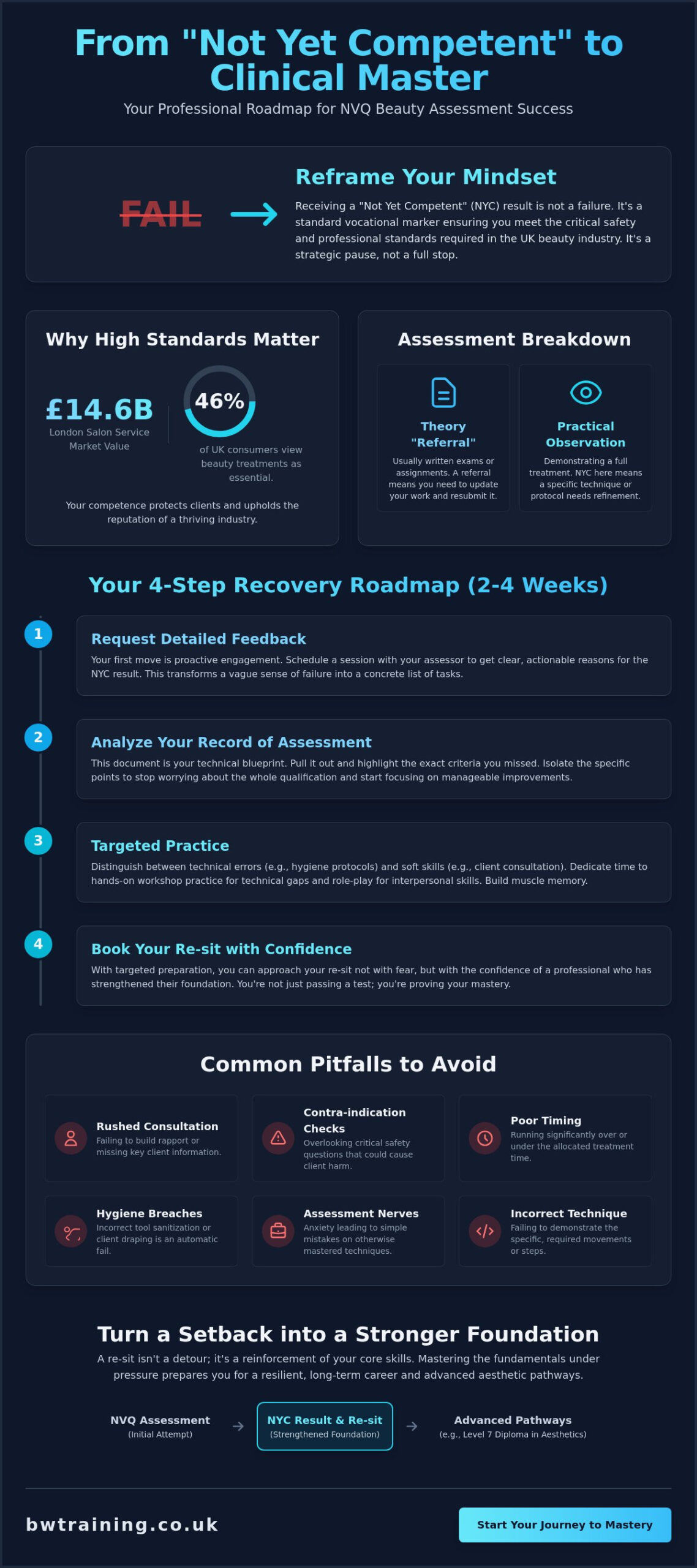
It’s helpful to break down where the gap in evidence occurred. Theory assessments usually involve multiple choice questions or written assignments. If a written piece doesn’t meet the criteria, it’s often called a “Referral.” You simply update the work and resubmit it. Practical observations are different. These require you to demonstrate a full treatment under the watchful eye of an expert. You might pass every written test with flying colors but still need to refine a specific massage movement or a waxing technique. This is why we focus so heavily on hands-on practice; the muscle memory you build now is what carries you through a busy salon day later.
Why “Not Yet” is Not “Never”
We view training as a long-term investment in your personal growth. Mastery isn’t always linear. Even the most successful practitioners currently undergoing Aesthetic Nurse Training likely faced a moment where they had to pause and practice. High precision courses like NVQ Level 3 Beauty Therapy demand a level of detail that often requires more than one attempt to perfect. This pause is your opportunity to move from being someone who just knows the steps to someone who truly understands the science behind the glow. If you’re worried about what if i fail my nvq beauty assessment, look at it as a safety check rather than a final verdict.
The Practical Steps to Take After a Failed Assessment
The moments following an assessment result are critical for your momentum. If you’re wondering, what if i fail my nvq beauty assessment, the answer starts with proactive engagement rather than retreat. Your first move should be to request a detailed feedback session with your assessor. This isn’t a time for defense; it’s a time for discovery. Every accredited center is required to provide clear reasons for an NYC result, identifying exactly where the evidence fell short. This conversation transforms a vague sense of failure into a concrete list of tasks.
Once you have your feedback, pull out your “Record of Assessment” or learner logbook. This document is your technical blueprint. It lists every individual criterion you must meet to be deemed competent. Highlight the specific areas where you didn’t meet the mark. Was it a failure to perform a thorough contra-indication check? Or perhaps your timing for a full-body massage was off? By isolating these points, you stop worrying about the whole qualification and start focusing on manageable, bite-sized improvements. Our instructors at Beautiful World Training Academy prioritize this feedback loop to ensure you feel supported through every correction.
How to Process Assessor Feedback
Success in the beauty industry requires a balance of technical precision and interpersonal grace. When reviewing your feedback, distinguish between technical errors, such as a breach in hygiene protocols, and soft skill errors, like a rushed consultation. Technical errors often require more “hands-on” time in a workshop. Soft skill gaps might be solved through role-play. To keep your progress on track, write a single summary of the assessor’s advice in your learner journal to serve as your primary focus for the next seven days. This keeps the momentum high and prevents the feedback from feeling overwhelming.
The Appeals Process: When You Disagree
There are rare occasions where you might feel a result doesn’t accurately reflect your performance. Every accredited UK training center must have a formal internal appeals procedure. If you choose this route, your work or the observation notes will be reviewed by an Internal Quality Assurer (IQA). The IQA acts as a neutral third party to ensure the assessment was fair, consistent, and followed the awarding body’s guidelines. For a deeper understanding of your rights as a learner, you can refer to Ofqual’s official appeals process for a comprehensive view of how qualifications are regulated. Always maintain professional, written communication with your academy during this time to ensure your case is handled with the seriousness it deserves.
Managing Re-sits: Timeframes, Logistics, and Preparation
The logistics of a re-sit are designed to keep your momentum high. Typically, we schedule re-assessments within 2 to 4 weeks of the initial attempt. This timeframe is strategic. It provides enough space for targeted practice while ensuring your “fresh knowledge” remains sharp. If you wait several months, the subtle technical details of hygiene protocols and contra-indication checks can begin to fade. If you’re currently wondering, what if i fail my nvq beauty assessment, know that a swift return to the clinic is often the best remedy for nerves.
Managing the logistics of a re-take is the first step toward your professional goal. During a practical re-assessment, you’ll need to provide a live model again. This is a non-negotiable requirement for NVQ standards. It ensures you can demonstrate your skills in a real-world environment. At our Hounslow and Whitton centers, we provide tailored re-sit support to help you prepare for this second observation. We focus specifically on the units where you were marked “Not Yet Competent” to ensure you walk into the room with absolute confidence.
Understanding Re-sit Fees and Costs
Assessment fees are a standard part of the UK vocational system. These costs generally cover the awarding body’s registration fees, the professional assessor’s time, and the use of the facility’s specialized equipment. While some centers might include one re-sit within your initial contract, others charge a separate fee for each attempt. If you’re an experienced student who simply missed a minor technical point, “Fast-Track” options may be available to help you secure your qualification quickly. It’s always best to review your learner agreement to understand the specific financial logistics of your training path.
Local Support for London-Based Students
We understand the unique pressures of starting a career in the capital. Our training locations provide hands-on support for students across Richmond, Twickenham, and Ealing. By keeping our class sizes small, we ensure you get the one-to-one attention needed to master complex units. You’re encouraged to use our clinic’s professional-grade equipment during your practice sessions. This level of access is what transforms a temporary setback into a successful career in the London beauty market. When students ask us, what if i fail my nvq beauty assessment, we remind them that the recovery process is highly structured and fully supported.
Common Pitfalls in NVQ Assessments (and How to Avoid Them)
Nerves are the most frequent hurdle during a practical observation. If you’re spiraling with the thought, what if i fail my nvq beauty assessment because my hands are shaking, you aren’t alone. Most students feel the weight of the assessor’s clipboard. The secret to success is reframing the observation as a professional collaboration. Your assessor isn’t looking for a reason to fail you; they’re looking for evidence that you can work safely and effectively. Maintaining a calm confidence is easier when you treat the assessor as a silent salon manager rather than a judge.
Beyond nerves, technical errors often center on three areas: hygiene, contra-indication checks, and timing. In the fast-paced UK beauty market, which is projected to reach £59.28 billion by 2026, efficiency is as vital as the aesthetic result. If your treatment runs over the allotted time, it suggests you aren’t yet ready for the commercial pressure of a busy London clinic. Similarly, missing a contra-indication check, like failing to notice a skin infection before a facial, is an automatic “Not Yet Competent” result because it compromises client safety. Precision in these early steps ensures you don’t have to worry about what if i fail my nvq beauty assessment during the final stages of your practical.
Mastering Health and Safety Protocols
Many learners focus so much on the “beauty” part of the treatment that they neglect the health and safety foundations. Cross-contamination is the transfer of harmful bacteria or viruses from one surface, person, or piece of equipment to another. This is the most common reason for failure. To avoid this, you must set up a sterile trolley with a clear distinction between clean and used tools. Always sanitize your hands in front of the assessor before touching the client. This visible commitment to safety provides the emotional security your assessor needs to mark you as competent.
The Role of Communication Skills
Professional conduct is a graded criteria in both Level 2 and Level 3 qualifications. Your ability to manage a client’s expectations during the consultation phase is just as important as the treatment itself. We recommend talking through the procedure as you perform it. This demonstrates your depth of knowledge and proves you understand the “why” behind every movement. If you can explain the benefits of a specific oil or the reason for a certain massage pressure, you move from being a student to a professional practitioner. If you’re looking to sharpen these professional habits, our NVQ beauty therapy courses provide the rigorous practice environment you need to succeed.
Turning a Setback into a Career in Advanced Aesthetics
A “Not Yet Competent” result is often the catalyst for a much deeper engagement with the science of skin. While the immediate concern is often what if i fail my nvq beauty assessment, the long-term benefit is the technical discipline you develop during the correction process. In the world of advanced aesthetics, there’s no room for “almost” correct. Mastering the NVQ Level 3 foundations now ensures you have the anatomical knowledge and clinical hygiene habits required for high-level progression. This foundational perfection is what separates a standard therapist from a top-tier practitioner.
When you eventually move toward Aesthetic Nurse Training or advanced injectables, you’ll find that the rigour of your early assessments pays off. Complications in treatments like Dermal Fillers are often traced back to a misunderstanding of skin layers or a lapse in sterile protocols. By being held to a high standard during your Level 2 and 3 assessments, you’re building the muscle memory that protects your future clients. We view your journey not as a series of tests to pass, but as a continuous investment in your professional integrity and community responsibility.
The Pathway to Level 4 Laser and IPL
The transition from general beauty therapy to specialized skin rejuvenation requires a massive leap in technical responsibility. If you found a unit like “Skin Analysis” challenging during your initial assessment, consider it a vital lesson for your future as a laser technician. Understanding Fitzpatrick skin typing and tissue response is the core of NVQ Level 4 Laser Training. Taking the extra time now to truly grasp these concepts ensures that when you’re operating powerful IPL or Laser equipment, you’re doing so with absolute self-assurance and safety.
A Final Word of Reassurance
Resilience is the most valuable trait you can possess in the beauty and aesthetics industry. Every expert you admire has likely faced a moment of doubt or a technical hurdle that required a second attempt. The true value of your training isn’t just the certificate on the wall; it’s the calm, capable state of mind you carry into the treatment room after you’ve overcome a challenge. We’re here to act as your steady, professional guide through every stage of your development. If you’re currently feeling stuck and asking what if i fail my nvq beauty assessment, remember that this is just one chapter in a very successful story. Book a consultation with our instructors to get back on track.
Your Roadmap to Professional Mastery
Identifying a “Not Yet Competent” result is simply the first step in a more focused training plan. By analyzing your Record of Assessment and engaging with technical feedback, you turn a brief pause into a long-term career advantage. These standards exist to ensure you enter the UK beauty market with the absolute safety and precision that clients deserve. Mastery takes time, and the resilience you build now will serve as the foundation for your future success in advanced aesthetics.
While the initial worry of what if i fail my nvq beauty assessment can feel heavy, remember that every expert was once a student who refined their skills until they were perfect. As an Accredited VTCT Training Centre, we offer a mentorship-led approach that prioritizes your individual growth. Whether you need to perfect a specific treatment technique or tighten your hygiene protocols, we provide the hands-on support in London and Hounslow needed to secure your qualification with confidence.
Contact our Hounslow Academy for expert re-sit support and guidance today. We are ready to help you transform this milestone into a launchpad for your professional journey. Your career is an investment in your potential, and we are proud to be your partners in reaching that goal.
Frequently Asked Questions
How many times can I re-sit my NVQ beauty assessment?
There is typically no official limit on the number of times you can re-sit, provided you stay within your registration period. If you’re asking what if i fail my nvq beauty assessment multiple times, the focus usually shifts to identifying specific knowledge gaps. Most centers will offer additional tutorial support to ensure you’re fully prepared before your next attempt, helping you build the confidence needed for success.
Is there a time limit for completing my NVQ after failing a unit?
Most NVQ registrations with awarding bodies like VTCT are valid for three years from the date of enrollment. This provides a significant window to complete any outstanding units even if you face a temporary setback. If your registration expires before you finish all components, you may need to pay a re-registration fee to keep your portfolio active and continue your journey toward certification.
What happens if I fail my VTCT theory exam but pass the practical?
If you pass your practical observation but fail the theory exam, your practical success is recorded and remains valid. You only need to re-sit the specific theory paper or online test that you missed. This is a common scenario that allows you to focus your revision entirely on the technical knowledge without the pressure of repeating the hands-on treatment under observation.
Will my certificate show that I had to re-sit an assessment?
Your final NVQ certificate will not indicate whether you passed on your first attempt or required a re-sit. The qualification only confirms that you’ve met the national occupational standards and are “Competent” in your field. Employers are interested in your final certification and your ability to perform treatments safely; they don’t see the number of attempts it took to reach that standard.
Can I move on to Level 3 if I have one unit left to pass in Level 2?
Many training centers allow you to begin your Level 3 studies while you’re finishing the final unit of Level 2. This concurrent learning approach keeps your momentum high and prevents delays in your career progression. However, you won’t receive your full Level 3 certificate until all Level 2 units are officially signed off and verified by the Internal Quality Assurer.
How much do re-sit fees typically cost in London?
Re-sit fees in London vary depending on whether you’re retaking a theory paper or a full practical observation. These costs cover the assessor’s professional time and the administrative fees charged by the awarding body. You should consult your specific training provider’s price list, as some academies include a set number of re-sits within the initial course investment to support their students.
Do I need to find my own models for a practical re-sit?
You’re generally responsible for providing your own live models for a practical re-assessment to ensure the environment is controlled and familiar. Using a model you’ve practiced on previously can help reduce nerves and ensure the treatment flows smoothly. If you’re still worried about what if i fail my nvq beauty assessment, having a reliable model can significantly improve your mental state during the exam.
What should I do if I feel my assessor was unfair?
If you believe an assessment decision was biased or unfair, you should follow your training center’s formal internal appeals procedure. This process involves a neutral review by the Internal Quality Assurer (IQA), who examines the evidence and the assessor’s feedback notes. Maintaining professional, written communication during this time is the best way to ensure your case is handled with the seriousness it deserves.