Choosing between a career in brows or skin isn’t just about the treatments you find interesting; it’s about whether you want to be an architect or a scientist. You’ve likely noticed that the aesthetics industry is shifting rapidly, and the fear of investing in a skill that doesn’t match your natural personality is a valid concern. You might worry if you’re artistic enough for one, or if the other offers the recurring client retention needed to build a stable business. It’s a common crossroads for many aspiring practitioners in the UK.
If you’re asking yourself, “should i do microblading or microneedling course,” this guide is your roadmap to professional clarity. We’ll help you discover which high-demand skill aligns with your unique talents and business goals. We’ll break down the Art vs. Science distinction, the earning potential for both paths, and the exact pathway to accreditation in London. We’ll also simplify the complex UK licensing and NVQ requirements so you can move forward with the calm confidence of a fully prepared professional. With the global microneedling market projected to reach USD 1,588.99 million by 2034, there’s never been a better time to secure your place in this thriving industry.
Key Takeaways
- Identify whether your strengths lie in artistic brow architecture or clinical skin science to select the career path that feels most rewarding.
- Evaluate your natural talents against the specific technical demands of each treatment to decide: “should i do microblading or microneedling course?”
- Compare business metrics like treatment times and client retention rates to ensure your chosen qualification supports your long-term income goals.
- Gain clarity on UK licensing and NVQ requirements to ensure your new aesthetics practice is fully compliant and professionally recognized.
- Discover how personalized instruction and small class sizes in London can accelerate your transition into a confident, high-earning practitioner.
Microblading vs. Microneedling: Defining the Two Paths
Deciding which path to take starts with a clear understanding of what you’ll actually be doing every day. When you ask, “should i do microblading or microneedling course,” you’re really choosing between two distinct professional identities. One treatment is an exercise in meticulous design; the other is a clinical procedure rooted in biological repair. Understanding these foundations ensures you invest in a career that feels like a natural extension of your strengths.
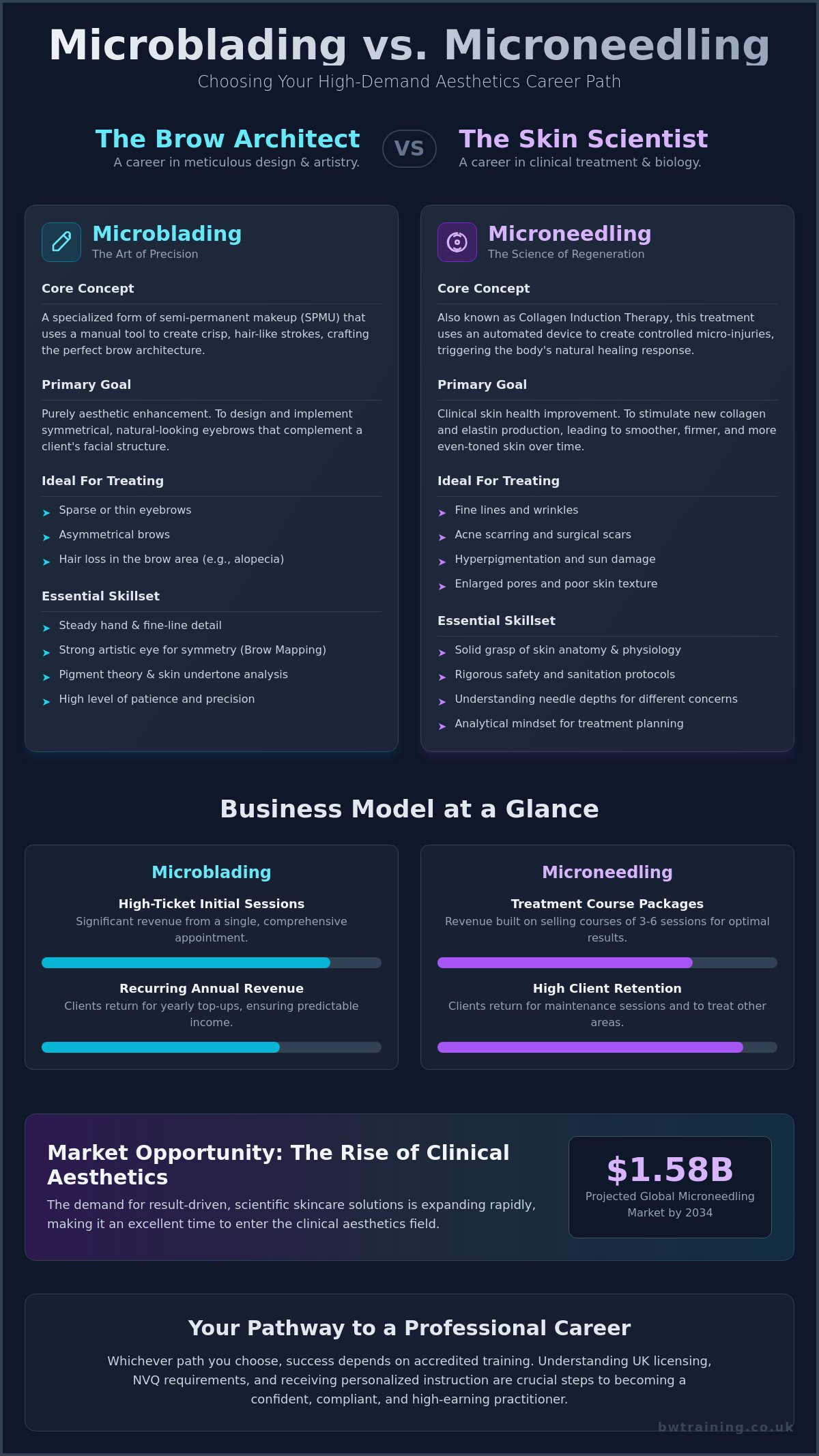
Microblading is a specialized form of semi-permanent makeup (SPMU). We use a manual hand tool equipped with ultra-fine needles to deposit pigment into the upper layers of the skin. The goal is to create crisp, hair-like strokes that mimic the look of natural eyebrows. It is a precise, manual craft that relies heavily on your ability to visualize and execute a design that complements a client’s unique facial structure.
Microneedling takes a very different approach to skin transformation. Often referred to as Collagen induction therapy (microneedling), this treatment uses an automated device to create thousands of controlled micro-injuries in the skin’s surface. This process doesn’t add pigment. Instead, it triggers the body’s natural wound-healing response. This biological “reset” stimulates the production of fresh collagen and elastin, leading to smoother, firmer skin over time.
The primary goal of microblading is purely aesthetic and localized to the brow area. In contrast, microneedling is a versatile skin health treatment that we can apply to the face, neck, and body to improve overall texture. This creates an “Art vs. Science” theme for your career. One requires the eye of a portrait artist, while the other demands the mindset of a clinical technician focused on dermatology.
The Aesthetic Focus of Microblading
Microblading is about design and symmetry. You’ll spend your time mastering brow architecture and pigment theory to ensure results look natural rather than “tattooed.” It’s an ideal service for clients with sparse brows or those experiencing hair loss. Success in this field requires a steady hand and a passion for fine-line detail. You aren’t just performing a treatment; you’re building a look that your client will wear every day, which requires a high level of artistic confidence.
The Clinical Focus of Microneedling
Microneedling shifts the focus from “drawing” to “treating.” This procedure targets broader concerns like acne scarring, fine lines, pigmentation, and enlarged pores. Rather than adding something to the skin, you’re encouraging the skin to repair itself from within. This path requires a solid grasp of skin anatomy and rigorous safety protocols. You’ll learn how to manage different needle depths and understand the inflammatory response to achieve professional, cellular-level results for your clients.
Is the Microblading Path Right for You?
If you find yourself constantly critiquing brow shapes or spending hours perfecting a winged liner, microblading might be your calling. When you’re deciding “should i do microblading or microneedling course,” consider your comfort level with semi-permanent changes. Microblading isn’t a facial that washes away; it’s a commitment to a client’s appearance that lasts for months. This high-stakes environment requires a practitioner who values precision above all else. You’ll need to master the subtle science of skin undertones and pigment theory to ensure that a “dark brown” doesn’t heal into a “cool grey” over time.
The business model for microblading is particularly attractive for those looking for high-ticket sessions. While the initial appointment requires a significant time investment, the annual maintenance appointments provide a steady stream of recurring revenue. It’s important to understand the regulatory landscape too. While microblading is often categorized under tattooing, other devices in your kit might fall under different rules, such as the FDA regulations on microneedling devices, which highlights the need for professional-grade equipment in any aesthetic practice. Our goal is to ensure you feel entirely secure in your technical skills before you ever touch a client’s skin.
The “Brow Architect” Skillset
Successful students transition from being makeup enthusiasts to brow architects. This involves mastering brow mapping, a technique used to find the perfect symmetry based on a client’s bone structure. It takes patience to work stroke-by-stroke, ensuring each line mimics natural hair growth. Precise blade depth is the difference between a crisp hair stroke and a blurred, permanent smudge. We focus heavily on this tactile feedback during our practical sessions to build your confidence and ensure client safety.
Microblading Career Opportunities in London
London remains a global hub for aesthetics, with a high demand for skilled brow specialists in areas like Hounslow and Richmond. Many of our graduates find success by renting a chair in established high-end clinics or launching their own freelance mobile businesses. Taking a Microblading Course provides the foundational skills and accreditation needed to secure insurance and start practicing safely. If you’re ready to invest in your future, exploring our training options is a great first step toward professional independence.
Is a Microneedling Course the Better Choice?
If the idea of freehand drawing hair strokes feels intimidating, you aren’t alone. Many practitioners find their stride in the more clinical, protocol-driven environment of skin rejuvenation. When you’re weighing up “should i do microblading or microneedling course,” think about your interest in dermatology. Microneedling is a technical skill that relies on understanding skin anatomy rather than artistic flair. It’s a science-based approach where success is measured by the biological improvement of the skin’s texture and health.
One of the greatest advantages of this path is its sheer versatility. While microblading is strictly for the brow area, microneedling allows you to treat the face, neck, decolletage, and even the body for concerns like stretch marks or surgical scars. This broader scope makes you a more flexible practitioner. You’ll focus on safety and precision, adhering to strict hygiene standards and device protocols. To ensure you’re operating at the highest professional level, we always recommend staying updated with FDA guidance on microneedling safety, which details the essential risks and benefits of these devices.
Becoming a Skin Rejuvenation Specialist
Modern aesthetics has moved beyond basic manual rollers. You’ll learn to master automated pens that provide consistent, vertical needle penetration for better results and less downtime. We also teach you how to combine treatments. For example, pairing microneedling with chemical peels can accelerate results for clients with deep scarring or stubborn pigmentation. There’s an immense professional satisfaction in watching a client’s skin transform over several months of dedicated treatment.
Recurring Revenue and Client Loyalty
From a business perspective, microneedling offers incredible stability. Unlike microblading, which might only require an annual touch-up, microneedling is typically sold in packages. Most clients need between 3 and 6 sessions, spaced four weeks apart, to achieve their desired outcome. This creates a “sticky” client base and a predictable monthly income for your clinic. You can also increase your session value by upselling specialized skin boosters or post-treatment serums. If you’re ready to build a clinical skin practice, our Microneedling Training Course provides the comprehensive technical foundation you need to succeed in London’s competitive market.
Comparing the Two: ROI, Difficulty, and Regulation
When you’re asking should i do microblading or microneedling course, looking at the return on investment (ROI) is essential. These two paths offer very different business dynamics. Microblading has a steep learning curve because it demands a high level of artistic skill. You’re effectively drawing on someone’s face. A single session can take 2 to 3 hours, but the price point is often higher to reflect that time and skill. In contrast, microneedling is more technical and protocol-based. A treatment usually takes between 45 and 60 minutes. While the individual session price might be lower, your hourly rate can be comparable or even higher due to the speed of the procedure.
Client frequency is another major differentiator. Microblading clients typically return every 12 to 18 months for a colour boost. Microneedling clients need treatments every 4 to 6 weeks to maintain their results and stimulate collagen. This means microneedling offers more predictable, short-term cash flow, while microblading builds a long-term portfolio of premium clients. Your initial investment will vary based on your existing kit, but both require high-quality tools to meet professional standards and ensure client safety.
UK Accreditation and Licensing in 2026
London’s regulatory environment is becoming more structured. In 2026, most boroughs require specific qualifications before they grant a Special Treatment Licence. For many practitioners, an NVQ Level 3 Beauty Therapy qualification acts as the necessary foundation. This level of recognition is vital if you’re operating in West London areas like Hounslow or Richmond. Local councils look for VTCT-accredited training to ensure you understand the risks associated with skin penetration and cross-contamination. Being fully compliant isn’t just about avoiding fines; it’s about the security and peace of mind you provide to your clients.
Which Course Should You Take First?
We often recommend a “stacking” strategy for those who want a truly resilient business. If you already have a beauty background, starting with microneedling is often the faster route to revenue because it builds on your existing knowledge of skin types. If you’re entering the industry specifically because you love the “brow architect” aesthetic, start there. Eventually, offering both treatments allows you to capture a wider market share. You can treat a client’s brows and then transition them into a skin rejuvenation plan. If you’re still unsure which path matches your career goals, you can explore our full range of professional aesthetics courses to see which syllabus resonates with you most.
Training at Beautiful World Training Academy
Deciding which path to follow is a significant career milestone. Whether you choose the artistic precision of brows or the clinical results of skin rejuvenation, the academy you select determines your professional ceiling. At Beautiful World Training Academy, we understand that the question “should i do microblading or microneedling course” is about more than just a certificate. It’s about gaining the self-assurance to treat your first client with total poise. Our centres in Hounslow and Whitton have become the preferred choice for London students because we bridge the gap between academic theory and real-world clinical excellence.
We provide the accredited certifications that local councils and insurers trust. Navigating the legal requirements in West London can feel daunting, but we simplify the process for you. Our instructors are steady experts who prioritize your preparedness. We don’t just teach techniques; we instill a deep understanding of safety, hygiene, and professional integrity. This investment in your growth ensures you leave our doors ready to build a compliant and thriving business. Small class sizes are a non-negotiable part of our philosophy. This structure guarantees you receive the one-on-one instructor time necessary to perfect your technique.
The “Beautiful World” Advantage
Theory is essential, but hands-on experience is where mastery begins. You’ll practice on live models in a controlled, clinical environment under the watchful eye of a reliable mentor. We grant you access to the latest 2026 aesthetic technology and pigments, ensuring your skills are current and competitive. This participatory approach differentiates our sessions from dry, tedious seminars. We focus on the participatory and practical nature of aesthetics, ensuring you understand the tactile feedback of the skin. Our commitment to the safety and well-being of the workforce means you’ll be trained to the highest professional standards from day one.
Your Next Steps to Aesthetic Mastery
Your journey doesn’t end when the course finishes. We offer post-course support and mentorship to help you transition into your new role with confidence. This ongoing partnership helps you navigate the early stages of your career with a dependable guide by your side. If you’re ready to see our facilities for yourself, we invite you to book a tour of our West London training centres. We also provide various financing options for vocational training to make your career transition as smooth as possible. Now is the time to turn your interest into expertise. Explore our full range of Aesthetic Courses and start your journey today to secure your future in the thriving aesthetics industry.
Step Into Your Future in Aesthetics
Choosing your specialty is a pivotal moment in your professional development. Whether you lean toward the artistic precision of brow architecture or the clinical science of skin rejuvenation, your success depends on the quality of your foundation. We’ve explored how microblading offers high-ticket artistry, while microneedling provides versatile, recurring revenue. Both paths require a deep commitment to safety, hygiene, and the specific regulatory standards of London’s boroughs to ensure your business remains resilient and respected.
Deciding should i do microblading or microneedling course is simply the first step toward building the career you’ve imagined. At Beautiful World Training Academy, we’ve spent over 10 years providing training excellence in London. Our expert instructors maintain active clinical practices; they bring real-world insights into every session. We ensure you’re accredited by leading UK awarding bodies, giving you the professional weight needed to secure insurance and licenses with total confidence. Your training is a genuine investment in your own self-assurance and the safety of your future clients.
We’re here to help you transition from an aspiring student to a confident practitioner. View All Accredited Training Courses and discover the perfect fit for your talents. We look forward to welcoming you into our community of highly skilled professionals.
Frequently Asked Questions
Do I need a beauty therapy background to do a microblading course?
You don’t always need a prior beauty background to start your training, but it’s highly beneficial for your long-term career. Many London local authorities require an NVQ Level 2 or 3 qualification before they grant the necessary Special Treatment License for your clinic. We find that students with a foundation in beauty therapy often progress faster because they already understand skin physiology and essential hygiene protocols.
How much can I earn as a microblading technician in London?
Income potential in London is significant for skilled practitioners who build a strong reputation. Your earnings depend on your location, such as Hounslow or Richmond, and your ability to market your unique artistic skills. Most technicians find that their initial investment in training is recovered through a consistent schedule of premium brow sessions and annual colour boosts from a loyal client base.
Is microneedling or microblading easier to learn for a complete beginner?
Microneedling is typically more accessible for a complete beginner because it relies on structured technical device protocols. Microblading requires a natural artistic flair and a very steady hand for manual drawing. If you’re asking “should i do microblading or microneedling course” as a newcomer, consider whether you prefer clinical precision or creative design as your primary focus.
What insurance do I need for microneedling and microblading in the UK?
You must secure specialist medical malpractice and public liability insurance specifically designed for aesthetics. In the UK, reputable insurers require proof of accredited training before they provide coverage for invasive treatments like these. This protection is vital for your professional security; it ensures you can practice with the calm confidence that both you and your clients are fully protected.
Can I do both microblading and microneedling on the same client?
You can certainly offer both treatments to a single client to provide a complete facial refresh. However, you shouldn’t perform them on the same day in the same treatment area. We teach you how to create a structured treatment plan that allows for proper skin healing between sessions, maximizing results for your clients without compromising their safety or skin integrity.
How long do these courses typically take to complete?
Our intensive training courses are designed to get you career-ready efficiently without rushing the learning process. They typically involve a blend of pre-study, practical face-to-face sessions over several days, and post-course case studies. This structured rhythm ensures you gain sufficient hands-on experience with live models while fitting your professional development around your existing life commitments.
Will I get a kit included with my training at Beautiful World?
We include professional starter kits with our training to ensure you have the correct, high-quality tools from day one. Using the same pigments and devices you used during your practical sessions helps maintain consistency as you transition to your own practice. This removes the uncertainty of sourcing equipment and lets you focus entirely on perfecting your technique and client care.
Is microblading still popular in 2026 or are there newer brow trends?
Microblading remains a dominant trend in 2026 because of its unique ability to create hyper-realistic brow hair strokes. While other techniques like ombre brows have emerged, the manual artistry of a microblading course is still the gold standard for clients wanting a bespoke look. It continues to be one of the most requested and high-demand skills in the London aesthetics market.