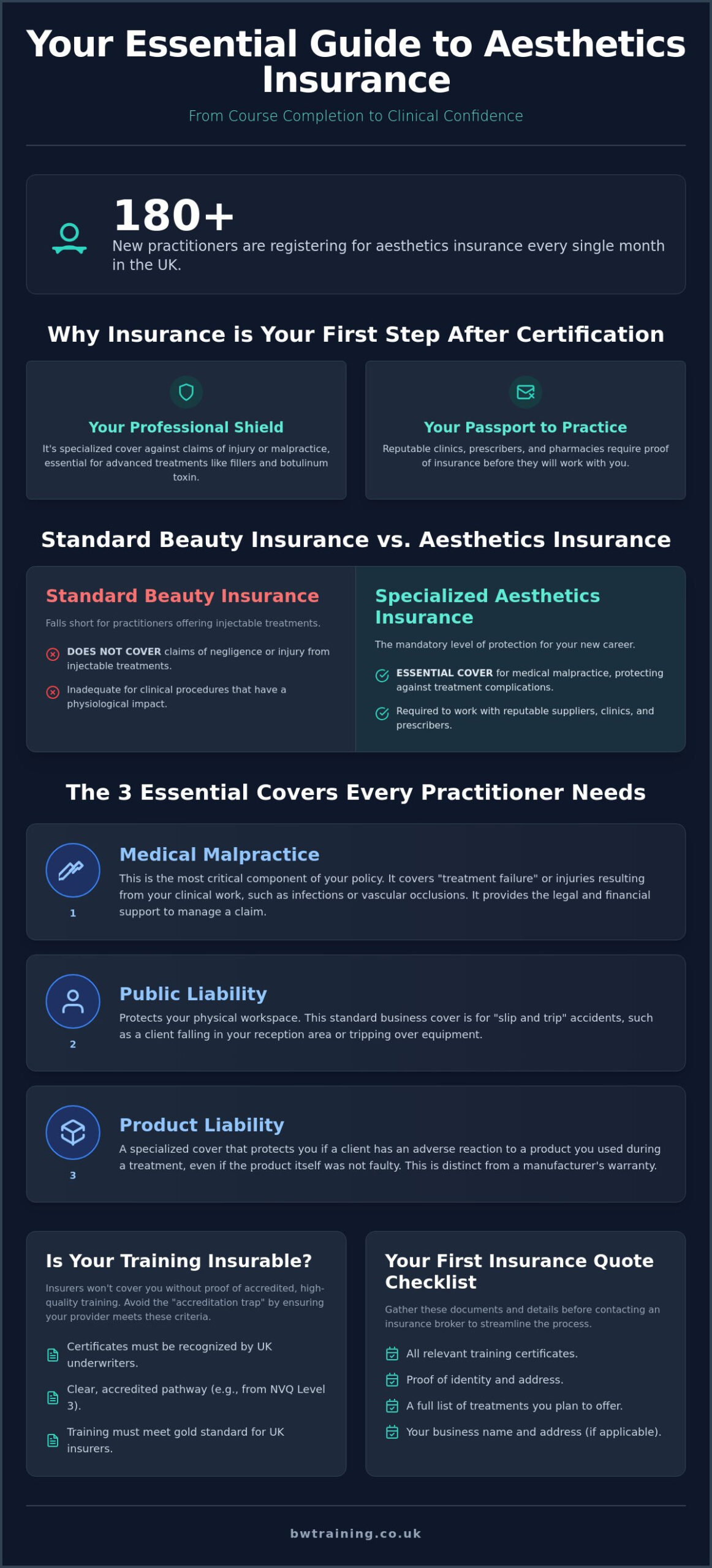
Did you know that over 180 new practitioners are now registering for comprehensive aesthetics insurance every single month? You’ve likely just finished your training, and while the excitement is high, the reality of getting aesthetics insurance uk after course often brings a wave of technical questions. It’s common to worry that a lack of experience might hold you back or that the cost for non-medics will be prohibitive. We understand that the jump from the classroom to a clinical setting feels significant, but being properly covered is the final stamp of approval on your new career.
We want to replace that anxiety with the calm confidence of a professional who knows they’re fully protected. This guide shows you exactly how to secure the right insurance so you can focus on what matters: delivering safe, beautiful results for your clients. We’ll walk through the mandatory requirements of the 2025-2026 licensing scheme, clarify the specific policies you need, and ensure your training meets the gold standard for UK insurers. By the end, you’ll have a clear, actionable path to becoming a fully compliant and successful practitioner.
Key Takeaways
- Understand why standard beauty insurance falls short and why specialized medical malpractice cover is essential for injectable treatments.
- Learn the exact steps for getting aesthetics insurance uk after course completion to ensure your new business is legally protected from day one.
- Identify the three mandatory policy types you need to safeguard your clinical practice and your clients’ safety.
- Discover how to verify if your training certificates meet the strict requirements of UK underwriters to avoid the common accreditation trap.
- Follow a practical checklist of the documents and details you’ll need to gather before requesting your first professional insurance quote.
Why Aesthetics Insurance is Your First Step After Certification
Completing your training is a proud moment, but your journey into clinical practice truly begins with a robust insurance policy. Think of this cover as your professional shield. Aesthetics insurance is a specialized policy designed to protect you against claims of injury, negligence, or malpractice. While you might already have standard beauty insurance, these policies rarely cover the complexities of advanced treatments like dermal fillers or botulinum toxin. Transitioning into the clinical space requires a higher tier of protection that reflects the physiological impact of your work.
Securing this coverage is about more than just ticking a box. It’s a validation of your professional status in the UK market. In this industry, you hold a significant “Duty of Care” toward every person who sits in your chair. Insurance proves you take this responsibility seriously. Without it, you’ll find the industry doors firmly shut. Most reputable clinics, prescribers, and pharmacies will refuse to work with uninsured practitioners. They need to know that you are backed by a policy that meets UK underwriting standards before they provide products or clinical space. Successfully getting aesthetics insurance uk after course completion is essentially your passport to a legitimate, long-term career.
The Reality of Risk in Aesthetic Practice
Even with flawless technique, complications like vascular occlusions or delayed inflammatory responses can happen. Understanding the broader Aesthetic Medicine Overview helps clarify why these specific protections are necessary. Insurance provides the legal defense funds required to protect your personal assets if a claim arises. It also builds immediate trust with your clients, showing them that their safety is your absolute priority from the very first consultation.
Medic vs. Non-Medic: Does the Requirement Change?
The requirement for specific cover is universal, regardless of your background. Whether you are a registered nurse or have progressed from an NVQ Level 3 Beauty Therapy qualification, insurers look for a clear, accredited pathway. The key is choosing a policy that matches your specific entry route. We ensure our students understand that getting aesthetics insurance uk after course graduation depends on having certificates that underwriters recognize and respect, bridging the gap between training and professional practice.
The 3 Essential Covers Every New Aesthetic Practitioner Needs
Securing your first policy is about layering different types of protection to create a comprehensive safety net. While the process of getting aesthetics insurance uk after course completion might seem like a single step, your policy actually bundles several distinct covers. Each one addresses a different risk profile, from the physical environment of your Hounslow clinic to the clinical advice you provide during a consultation. Understanding these layers ensures you don’t leave your career vulnerable to gaps in coverage.
Medical Malpractice: The Safety Net for Injections
Medical malpractice is the most critical component of your premium. It specifically covers “treatment failure” or injuries that occur as a direct result of your clinical work. If a client develops an infection or is genuinely dissatisfied with their aesthetic results, this cover provides the legal and financial support to manage the claim. It’s the bulk of your cost because the risk associated with skin-piercing procedures is naturally higher than standard beauty treatments.
You’ll need to choose between “claims-made” and “claims-occurring” policies. A claims-made policy only covers you if the insurance is active both when the treatment happened and when the claim is filed. Conversely, a claims-occurring policy covers any incident that took place while the policy was active, even if the claim comes years later. Most modern aesthetics policies are claims-made, so maintaining continuous cover is vital for your long-term security.
Public and Product Liability Explained
Public liability protects your physical workspace in West London or your mobile equipment if you travel to clients. It covers “slip and trip” accidents, such as a client falling in your reception area. While this is standard for most businesses, product liability is more specialized. Product liability for aesthetics ensures you’re protected if a CE-marked filler or toxin causes an adverse reaction due to a manufacturing defect rather than your injecting technique.
This cover bridges the gap between the manufacturer and you. If a product fails, you are often the first person a client holds responsible. Having this protection means you aren’t left standing alone if a batch of product is recalled or found to be faulty. It’s an essential part of a professional setup that prioritizes patient safety above all else.
Finally, Professional Indemnity covers the professional advice you give. Whether you’re discussing aftercare or explaining the risks during a consultation, your words carry weight. Following established GMC Professional Standards ensures your advice remains within ethical and legal boundaries. If a client claims your instructions led to a poor outcome, this cover manages the resulting legal dispute. Building this level of professionalism starts with high-quality training; you can explore our accredited aesthetics courses to ensure your foundation meets these rigorous underwriting standards. Getting aesthetics insurance uk after course graduation is far simpler when your training provider is already recognized by leading insurers.
Is Your Training Insurable? Key Requirements for UK Underwriters
Not all certificates carry the same weight in the eyes of an underwriter. One of the most common hurdles new practitioners face is the “Accreditation Trap.” While many short courses offer CPD (Continuing Professional Development) points, these are often insufficient on their own for getting aesthetics insurance uk after course completion. Underwriters are looking for evidence of a deep, structured education rather than just a weekend workshop. They prioritize qualifications that align with national standards to ensure you have the clinical reasoning skills necessary to handle complications.
A solid academic foundation is your strongest asset when applying for cover. Most insurers now require a minimum of Level 3 or 4 Anatomy & Physiology (A&P) before they will even consider covering injectable treatments. This foundational knowledge is non-negotiable; it proves you understand the underlying structures you are treating. For those aiming for the highest tier of professional recognition, pursuing a Level 7 Aesthetics qualification provides the postgraduate mastery that insurers truly respect. Referencing the JCCP’s guide to insurance cover can help you understand why these high standards are becoming the industry baseline.
The Role of Ofqual-Regulated Qualifications
Regulated qualifications from bodies like VTCT or Qualifi are the gold standard for insurance approval. These courses have undergone rigorous external quality checks, which often leads to lower premiums and broader coverage options. If you are transitioning from a beauty background, moving from Level 3 Beauty into Foundation Dermal Fillers through a regulated pathway is the most secure route. Insurers are increasingly wary of “Fast-Track” courses that bypass these essential vocational steps, as they often lack the depth required for safe clinical practice.
Verifying Your Training Provider
Before you invest in any course, you must verify that the academy’s certificates are pre-approved by major UK underwriters. Ask your training provider which specific insurance companies they partner with and whether their practical hours meet the current 2025-2026 requirements. Hands-on experience is vital. Insurers require proof of live model practice because it demonstrates your ability to manage real-world patient interactions and physiological responses under expert supervision. Without documented evidence of supervised practical work, getting aesthetics insurance uk after course graduation can become an uphill struggle.
Step-by-Step: How to Get Your First Aesthetics Insurance Quote
The transition from trainee to insured professional is a structured process that requires attention to detail. While it’s tempting to rush toward your first client, taking the time to prepare your application ensures your cover is valid and comprehensive. The process of getting aesthetics insurance uk after course completion starts with gathering your digital evidence. You’ll need clear, high-resolution copies of your Anatomy & Physiology and Foundation certificates ready for upload. Most specialist brokers won’t offer a firm quote without seeing these first.
Next, you must define your “Scope of Practice.” This is a precise list of every treatment you intend to offer, such as botulinum toxin, dermal fillers, or microneedling. Be specific about the areas you’ll treat. Many standard policies exclude high-risk zones like the tear trough or non-surgical rhinoplasty unless you’ve completed advanced training. Honesty is paramount during this stage. Whether your background is in nursing or beauty therapy, full disclosure ensures that your policy stands up to scrutiny if you ever need to make a claim.
Preparing Your Professional Portfolio
Organizing your credentials into a logical portfolio makes the underwriting process much smoother. Start with your baseline qualifications and layer your specialized certificates, such as those from our Botox courses, on top. An underwriter often looks at your CV to assess your professional journey and commitment to safety. If you are a non-medic, having the details of your lead prescriber or clinical mentor ready can also significantly speed up your approval.
Comparing Quotes and Coverage Limits
When you begin researching specialist brokers like Hamilton Fraser or Insync, you’ll need to decide on a limit of indemnity. While £1 million is often the minimum requirement for local authority licensing, many practitioners opt for £5 million to provide extra security as their business grows. Don’t just look at the annual premium; check the “Excess” amount, which is what you’ll pay out-of-pocket during a claim. The cheapest quote often carries higher risks or more restrictive exclusions, so prioritize long-term career security over the lowest initial cost.
Reviewing the fine print is the final, vital step. Check for specific limits on filler volumes or requirements for face-to-face consultations. If you find the insurance landscape confusing, we are here to help. Our team provides guidance on getting aesthetics insurance uk after course graduation to ensure our students step into the industry with total confidence. You can view our full range of accredited training to find the right path for your professional goals.
Building a Compliant Practice with Beautiful World Training Academy
At Beautiful World Training Academy, we view your certification as the start of a long-term professional partnership. We understand that the process of getting aesthetics insurance uk after course completion can feel like a final, daunting hurdle. Our mission is to remove that friction by providing training that exceeds the rigorous standards set by UK underwriters. By choosing an academy that prioritizes clinical depth over speed, you’re investing in a reputation that insurers recognize and respect from the moment you submit your application.
We’ve spent years cultivating relationships with leading specialist brokers to ensure our graduates have a direct route to coverage. These partnerships mean that when you present a Beautiful World certificate, the insurer already knows the quality of the practical hours and safety protocols you’ve completed. As the industry moves toward the mandatory licensing schemes expected in 2025-2026, we remain committed to keeping our curriculum ahead of the curve. We don’t just teach you how to inject; we guide you through the entire compliance maze, ensuring your business is built on a foundation of total legal security.
Why Our Graduates Stand Out to Insurers
Insurers look for practitioners who minimize risk through meticulous preparation. Our “Safety-First” protocols are designed to meet the exact requirements that underwriters love to see, such as robust complication management and face-to-face consultation standards. For our London-based practitioners, we also provide access to local support networks and help you find reliable prescribers. This community-focused approach ensures you never feel isolated as you establish your Hounslow or West London clinic.
Your Next Steps Toward Aesthetic Mastery
If you’re ready to transition from a student to a fully insured professional, we have the pathways to get you there. Whether you’re starting with our foundation levels or seeking advanced Aesthetic Nurse Training, we provide the Ofqual-regulated certificates you need for insurance approval. Our team in Hounslow is available to discuss your career readiness and help you navigate the specific requirements for getting aesthetics insurance uk after course graduation.
- Book a consultation with our experts to review your current qualifications.
- Explore our advanced pathways to stay compliant with 2026 regulations.
- Join a community of successful practitioners who prioritize patient safety.
Your success is measured by the confidence you feel when you treat your first client. By aligning your training with the highest industry standards, you ensure that your insurance isn’t just a piece of paper, but a genuine shield for your career. We invite you to view our full range of accredited aesthetics courses and take the first step toward building a safe, successful, and fully compliant practice today.
Launch Your Career with Professional Confidence
Securing your professional future starts with the right protection. You’ve learned that specialized medical malpractice cover is the cornerstone of a safe practice and that your training level directly impacts your insurability. By following a structured approach to getting aesthetics insurance uk after course graduation, you move from being a trainee to a trusted professional. This process ensures you are ready for the 2025-2026 licensing changes with a practice built on integrity and clinical excellence.
We provide the exact foundation insurers look for. Our academy is accredited by leading UK bodies and offers hands-on training with live models in Hounslow. You’ll benefit from the direct mentorship of industry experts with over 10 years of experience, giving you the calm confidence needed to excel in your new career. We are here to support you through every step of the compliance journey, from your first injection to your first policy renewal.
Start your journey with an insurable aesthetics course at Beautiful World Training Academy and join a community of safe, successful practitioners. We look forward to seeing you thrive in this exciting industry and watching your business grow with total security.
Frequently Asked Questions
Can I get aesthetics insurance as a non-medic in the UK?
Yes, you can certainly obtain coverage as a non-medic. Insurers offer specific packages for beauty-qualified practitioners, typically requiring an NVQ Level 3 or an equivalent accredited foundation. While premiums and coverage limits may vary compared to medically qualified professionals, both groups have clear paths to securing the necessary protection for their clinical practice.
How much does aesthetics insurance typically cost for a beginner?
For a beginner with beauty qualifications, monthly premiums start from approximately £76.69 for a package that includes both medical malpractice and public liability. If you are focusing on injectables like Botox and fillers, annual premiums generally range between £650 and £1,800. These figures reflect 2026 market standards for practitioners who prioritize comprehensive, high-quality protection.
What training levels do I need to be insured for dermal fillers?
Insurers usually require a solid academic foundation before they will cover injectable treatments. Most underwriters look for a Level 3 or 4 Anatomy and Physiology certificate paired with an accredited Foundation Dermal Fillers course. As the industry moves toward tighter regulation, holding a Level 7 qualification is increasingly viewed as the gold standard for long-term insurability.
Does my insurance cover me if I work as a mobile aesthetician in London?
Yes, mobile coverage is available, but you must explicitly declare this working style to your broker. Annual premiums for mobile aestheticians in London typically fall between £250 and £600. It’s essential that your policy specifically includes “goods in transit” cover to protect your equipment while you move between different clinical environments in the city.
What happens if I perform a treatment that isn’t listed on my policy?
Performing a treatment not listed on your policy leaves you completely unprotected for that specific procedure. If a client makes a claim or a complication occurs, your insurer will reject the case, and you’ll be personally liable for all legal and compensation costs. You must update your “Scope of Practice” with your insurer every time you add a new service.
Do I need a prescriber to get insurance for Botox treatments?
Yes, you must work with a prescriber because botulinum toxin is a prescription-only medicine. Insurers require you to follow strict compliance rules, including a face-to-face consultation between the patient and the prescriber before any treatment. Remote prescribing is no longer compliant in the UK, and ignoring this requirement will likely void your entire insurance policy.
Is my training certificate from Beautiful World Training Academy recognized by insurers?
Yes, certificates from Beautiful World Training Academy are highly respected and recognized by major UK underwriters. We design our curriculum to exceed standard training requirements, which simplifies the process of getting aesthetics insurance uk after course completion. Our focus on safety and practical hours ensures our graduates meet the rigorous criteria that insurers demand.
How long does it take to get an aesthetics insurance policy active?
You can often have your policy active within 24 to 48 hours if you have all your documentation ready. Having digital copies of your training certificates and your prescriber’s details will speed up the underwriting process. Some specialist brokers can even provide same-day activation once they’ve verified that your training provider meets their professional standards.