
True clinical mastery isn’t about the absence of nerves; it’s about the presence of a repeatable, failsafe system. Many practitioners leave their initial training feeling isolated, wondering exactly how to feel confident injecting fillers when the safety net of a tutor is gone. You might find your hands shaking during a lip augmentation or feel a surge of anxiety at the thought of a vascular occlusion. These fears are natural, especially as the July 2026 UK legislation now mandates strict registration and accredited standards for all practitioners. You aren’t alone in feeling that the weight of responsibility is heavy.
We understand that the transition from a student to a solo professional is the most challenging phase of your career. It’s common to worry if you can meet high client expectations or handle a difficult consultation with authority. This guide promises to bridge that gap by sharing the psychological and practical strategies used by expert injectors to deliver flawless results with total self-assurance. You’ll discover how to build a robust safety protocol, master the latest anatomical techniques, and invest in the right clinical pathways, such as the Level 7 Diploma, to ensure your practice is both compliant and courageous.
Key Takeaways
- Reframe injector anxiety as a professional asset that drives clinical safety rather than a hurdle to overcome.
- Anchor your technique in deep anatomical knowledge to eliminate guesswork and protect facial danger zones.
- Learn how to feel confident injecting fillers by building a failsafe emergency response protocol for your clinic.
- Transition from student to professional by structuring your first bookings to prioritise safety and precision over speed.
- Discover why hands-on mentorship provides the clinical security and support that short, isolated courses cannot offer.
Understanding “Injector Anxiety” and Building a Professional Mindset
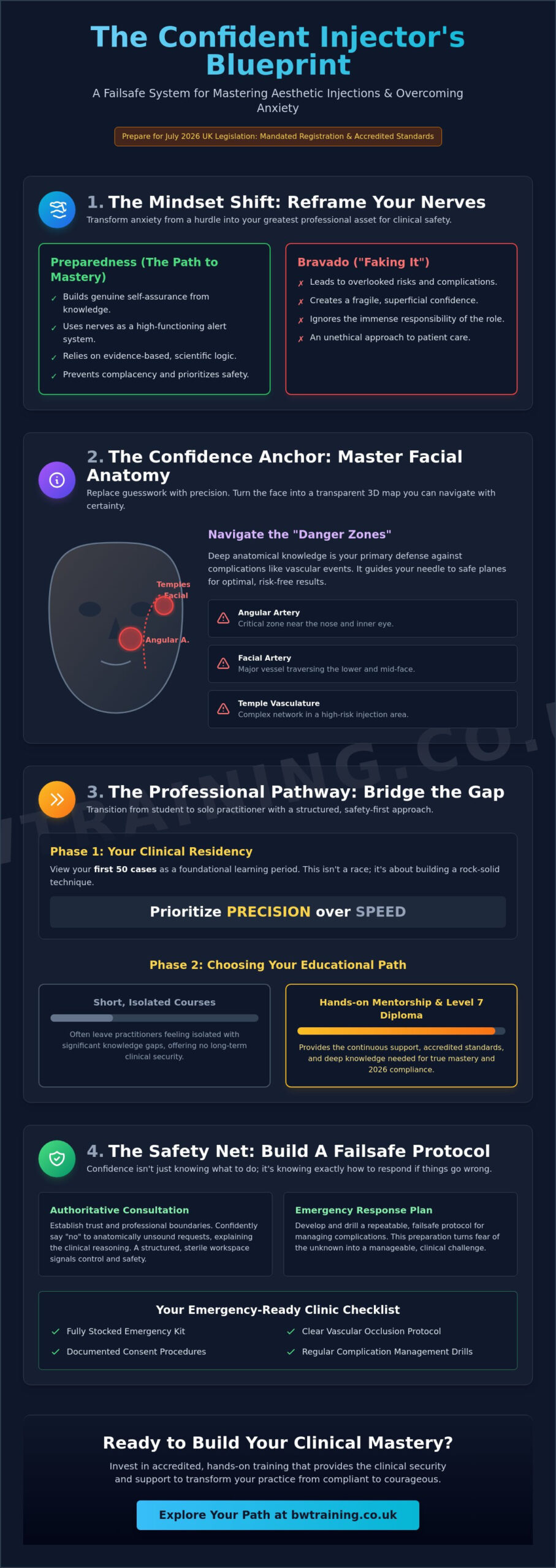
Injector anxiety isn’t a flaw in your character; it’s a physiological response to the immense responsibility of medical aesthetics. When you hold a syringe, you aren’t just performing a beauty treatment. You’re manipulating complex facial structures and altering a person’s appearance. Understanding how to feel confident injecting fillers begins with accepting that these nerves are a sign of respect for your patient’s safety. While some suggest “faking it until you make it,” we believe that “preparedness over bravado” is the only ethical path. Bravado leads to overlooked risks, whereas clinical preparedness creates a foundation of genuine self-assurance.
Mastery is a marathon, not a sprint. You should view your first 50 cases as a clinical residency. During this phase, prioritize precision over the clock. For a comprehensive overview of injectable fillers and their historical development, practitioners can study the evolution of hyaluronic acid technologies to better understand how different gels behave under the skin. This technical depth replaces anxiety with evidence-based logic. When you know why a product behaves the way it does, your hands stop shaking because your mind is occupied with the science of the procedure.
The Psychology of the “Perfect” Result
The internal pressure to deliver perfect symmetry can be paralyzing for new injectors. It’s vital to remember that human faces are naturally asymmetrical. Your goal is harmony and enhancement, not mathematical perfection. Many new practitioners struggle with imposter syndrome, feeling like they’re “playing” the role of an expert. You can overcome this by reframing “nerves” as a high-functioning alert system. This system keeps you focused on patient safety and prevents the complacency that often leads to complications in more experienced practitioners.
Communicating Authority to Your Clients
Your consultation is where you establish professional boundaries and build patient trust. Use precise, industry-specific terminology to explain the “why” behind your injection points. If a client requests a treatment that isn’t anatomically sound, the most confident thing you can do is refuse the treatment. Saying “no” with a clear clinical explanation demonstrates more authority than agreeing to a risky procedure. In the treatment room, keep your body language open. Stand tall, maintain steady breathing, and ensure your workspace is perfectly organized. A sterile, structured environment is a key part of learning how to feel confident injecting fillers because it removes external chaos and signals to the patient that they are in a safe, controlled setting.
Mastering Facial Anatomy: The Ultimate Confidence Anchor
Shaky hands aren’t a sign of weakness; they’re a sign that your brain is correctly identifying a risk but lacks the necessary data to mitigate it. When you can’t visualize exactly what lies beneath the dermis, every injection feels like a high-stakes gamble. Mastering facial anatomy is the single most effective way to learn how to feel confident injecting fillers. By turning the patient’s face into a transparent three-dimensional map, you replace hesitation with clinical precision. You stop guessing and start navigating with the certainty of a seasoned professional.
Understanding the “Danger Zones” is your primary defense against complications. You must know the precise location of the angular artery, the facial artery, and the complex vasculature of the temples. A Clinical Review of Filler Anatomy and Techniques demonstrates that most vascular events are avoidable with proper anatomical awareness and depth control. This knowledge acts as an invisible hand, guiding your needle away from high-risk structures and toward the safe planes where the product can perform optimally. This deep-seated knowledge is the ultimate anchor for anyone wondering how to feel confident injecting fillers in a solo clinic environment.
Investing in accredited Anatomy and Physiology training provides the theoretical safety net you need. It moves your practice beyond skin-deep aesthetics and into the muscular and skeletal layers that define facial structure. When you understand the underlying framework, you stop “chasing lines” and start restoring volume where it truly belongs. This transition from surface-level thinking to structural restoration is what separates a technician from a clinical master.
The 3D Mental Map of the Face
Before any needle touches the skin, you should palpate for bony landmarks and pulse points. This tactile feedback confirms your mental map and ensures you’re injecting at the correct depth. Whether you’re aiming for a supraperiosteal placement on the zygomatic arch or a subcutaneous layer in the lips, your depth must be intentional. Knowing the exact path of the facial nerve prevents anxiety because it ensures you avoid motor nerve damage and preserve the patient’s natural animation.
Continuous Learning Resources for 2026
Anatomy isn’t a subject you learn once; it’s a discipline you maintain. Use cadaver-based apps and 3D software to refresh your vision of the facial layers daily. We recommend re-reading your foundation manuals before every complex case to keep the “Danger Zones” fresh in your mind. Attending advanced workshops is also essential for refining your technique as new clinical data emerges. If you’re looking to elevate your practice, exploring our advanced dermal filler courses can help bridge the gap between theory and clinical excellence.
Overcoming the Fear of Complications with a Safety-First Protocol
The fear of causing a vascular occlusion (VO) is the primary reason many practitioners struggle with clinical anxiety. It’s a heavy responsibility that can lead to hesitation or “shaky hands” during a procedure. However, true clinical mastery isn’t about hoping a complication never happens; it’s about knowing exactly what to do if it does. Understanding how to feel confident injecting fillers means accepting that complications are a statistical possibility and preparing for them with absolute rigor. When you have a clear, battle-tested plan, the “fear of the unknown” disappears, replaced by professional readiness.
Your emergency kit is your psychological safety net. Keeping Hyaluronidase in stock and within reach at all times changes your mental approach to every treatment. It acts as your clinical “eraser,” providing the security of knowing you can reverse a hyaluronic acid filler if necessary. We recommend developing a laminated, step-by-step protocol for suspected VO that sits visibly in your treatment room. This ensures that even in a high-stress moment, you don’t have to rely on memory. You simply follow the steps. This level of preparedness is what allows you to maintain a calm, authoritative presence for your patient.
Your peace of mind extends beyond the treatment room. Implementing a mandatory 24-hour follow-up call or message for every new filler case allows you to catch early signs of issues and provides immense emotional relief. Additionally, with the July 2026 UK legislation mandating practitioner registration and accredited standards, being fully compliant is no longer just a legal hurdle. It’s a source of security. Knowing you’ve met the highest training benchmarks, such as those found in a Level 7 Diploma in Aesthetics Practice, ensures that your insurance is valid and your clinical decisions are backed by the latest evidence-based safety standards.
The “What If” Rehearsal
Top-tier injectors use mental rehearsal to build resilience. Spend time walking through a complication scenario in your mind, from the first sign of blanching to the final injection of the dissolver. Establish a network of prescriber support and peer mentors before you need them. Having a complication protocol acts as a professional insurance policy for your nerves, ensuring you are never truly alone in the clinic.
Patient Selection and Red Flags
Confidence often comes from knowing which patients to avoid. Identifying “high-risk” clients who exhibit signs of body dysmorphic disorder or unrealistic expectations is a vital clinical skill. A thorough medical history and a detailed consent form protect both you and the patient. By screening for red flags early, you ensure that you only perform treatments where you can realistically deliver a positive, safe outcome. This selective approach reinforces your authority and significantly reduces the likelihood of post-treatment stress.
Bridging the Gap: Transitioning from Student to Professional
The leap from a supervised classroom to your first solo booking is a significant professional milestone. Many new practitioners feel an internal pressure to match the speed of established clinics immediately. This is a mistake that often fuels clinical anxiety. On your first day, your primary goal isn’t profit; it’s precision. Booking double the industry average for your first few cases allows you to breathe. It gives you the necessary space to re-verify your anatomical landmarks and cross-reference your safety protocols without the stress of a ticking clock. This intentional slow-down is a practical secret for how to feel confident injecting fillers during those critical early months of independent practice.
We advocate for a structured, natural progression in your clinical career. Mastery isn’t achieved by jumping into complex liquid rhinoplasty or tear trough treatments immediately. Start by perfecting your technique with Foundation Dermal Fillers. Perfecting your approach to lips and nasolabial folds builds the foundational muscle memory required for advanced work. Consider running “Model Days” where you charge only for the cost of products. This strategy removes the commercial pressure of a full-paying client, allowing you to focus entirely on the clinical outcome and your own technique development.
Setting Up Your Clinical Environment
Your clinic should function as a “sterile sanctum” that supports your mental state. If you’re fumbling for gauze or struggling with poor lighting, your cortisol levels will spike. Use the “Checklist Method” to ensure every consumable, from numbing cream to the emergency kit, is laid out before the patient enters the room. Proper ergonomics ensure your hands remain stable and your sightlines are clear. When your physical environment is perfectly controlled, your mind is free to focus entirely on the needle tip, which is essential for how to feel confident injecting fillers.
The Power of Peer Review
Isolation is often the enemy of clinical security. Don’t work in a vacuum; find a “study buddy” from your training cohort to observe your first few independent sessions. Reviewing recordings of your own treatments, provided you have explicit patient consent, reveals subtle habits or posture issues you might not notice in the heat of the moment. Joining professional forums for anonymous case advice keeps you connected to the wider community of experts. This collective support system is vital as you navigate the 2026 regulatory landscape and move toward clinical mastery. Ready to expand your expertise? Explore our Advanced Dermal Filler training to take your skills to the next level.
Why Hands-On Mentorship in London is Your Fastest Path to Mastery
Short, one-day weekend courses often leave practitioners with more questions than answers. While they provide the basic mechanics, they rarely offer the clinical depth required for true self-assurance. If you’re searching for how to feel confident injecting fillers, the answer lies in hands-on mentorship rather than isolated seminars. Having a steady expert guide your hand during those first few procedures transforms abstract theory into concrete skill. For practitioners in Hounslow and West London, local access to experienced tutors means you aren’t just a number in a crowded lecture hall; you’re a protégé in a professional clinical setting.
Confidence is built on a solid foundation. Many successful injectors begin their journey with an NVQ Level 3 Beauty Therapy qualification. This background provides an intimate understanding of skin health and facial physiology before you ever pick up a syringe. When you pair this foundation with the Level 7 Diploma in Aesthetics Practice, you align yourself with the 2026 UK standards for clinical excellence. This progression isn’t just about ticking boxes; it’s about earning the “Expert” status that allows you to practice with total peace of mind.
The Beautiful World Mentorship Approach
We believe in small class sizes that allow for “over-the-shoulder” guidance. This method ensures that every injection you perform under our supervision is corrected and refined in real-time. Unlike large academies, our mentorship doesn’t end when the course finishes. Having a mentor you can call for advice on a complex case provides a safety net that a textbook simply cannot match. We’re proud to support a growing community of practitioners across Richmond, Twickenham, and Ealing, fostering a local network of excellence.
Investing in Your Future Self
Viewing your education as an investment in your mental health is a powerful mindset shift. The more you know, the less you fear. Once you’ve mastered dermal fillers, the natural next step is to integrate Botox courses into your repertoire. Offering a comprehensive, full-face approach allows you to achieve more harmonious results for your clients, further boosting your professional reputation. Remember that learning how to feel confident injecting fillers is a continuous journey. Stay curious, stay compliant, and trust in the steady progress of your clinical mastery.
Elevate Your Clinical Practice with Total Assurance
Clinical mastery is a deliberate journey built on the pillars of anatomical precision and rigorous safety standards. By mastering the 3D map of facial structures and rehearsing your emergency protocols, you transform theoretical knowledge into steady, reliable skill. True professional growth comes from moving beyond isolated study and embracing a structured clinical environment where safety is the priority. Understanding how to feel confident injecting fillers is ultimately about knowing you have the support and training to handle any scenario with authority.
We invite you to take the next step in your aesthetic career by joining a community that prioritizes your success. Our expert mentors in Hounslow and Whitton provide small group sizes for maximum hands-on time, guiding you through accredited Level 5 and 7 pathways. Master your technique and build clinical confidence at our London Academy. You’ve already done the hard work of starting; now it’s time to invest in the clinical security that defines a master practitioner. We look forward to supporting your journey toward clinical excellence and helping you achieve the career you deserve.
Frequently Asked Questions
Is it normal to feel nervous before injecting dermal fillers for the first time?
Yes, feeling nervous is a natural and healthy response for any dedicated practitioner. It indicates that you value patient safety and understand the clinical weight of your actions. This alert state keeps you focused on your protocols and prevents the complacency that can lead to errors. As you gain more experience, this initial anxiety evolves into a state of calm, professional vigilance.
How many filler treatments do I need to perform before I feel confident?
Most practitioners report a significant shift in their self-assurance after completing their first 50 treatments. This volume of work allows you to encounter various facial structures and skin types, building essential muscle memory. To understand how to feel confident injecting fillers, you must prioritize these early cases as learning opportunities, ensuring you have expert supervision to refine your technique during this formative stage.
What is the best way to handle a client if I am feeling unsure during a treatment?
If you feel unsure, the most professional action is to pause and re-evaluate the treatment area. You can explain to the client that you’re taking a moment to ensure perfect placement and symmetry. Never proceed if you’re uncertain about a landmark or depth. This pause actually builds client trust because it demonstrates that you’re a meticulous injector who prioritizes their safety over speed.
Can I practice injecting fillers on mannequins to build my confidence?
Mannequins are excellent for practicing your grip, syringe control, and needle-entry angles, but they cannot replicate the feel of human tissue. While they help build initial motor skills, you should transition to live models as soon as possible. True clinical mastery requires the tactile feedback of real skin layers, which is why we emphasize hands-on time with supervised models in our London academy.
How do I find a mentor in London to help me with my aesthetics career?
Seek out established training centers in West London, specifically in areas like Hounslow or Whitton, that offer accredited Level 5 and Level 7 pathways. A good mentor should provide small group sizes and over-the-shoulder guidance. Many practitioners find that institutions such as the Nadirah London Beauty Clinic & Academy offer the necessary long-term partnership and expert support required to guide your professional growth safely and effectively.
Does having a medical background make you a more confident injector?
A medical background provides a strong start in needle proficiency, but aesthetic mastery requires specific anatomical study. Both healthcare professionals and experienced beauty therapists must learn the nuances of facial mapping and gel rheology. Learning how to feel confident injecting fillers depends more on your commitment to accredited, aesthetics-specific training than your prior clinical history alone.
What should I do if my hands start shaking while I am injecting?
If your hands shake, stop the procedure and anchor your pinky finger against the patient’s face to create a stable base. Take a deep, controlled breath and focus on your anatomical mental map. Shaking is often a physical response to high cortisol or a lack of physical support; anchoring your hand provides the mechanical stability needed to resume the injection with precision.
How can I stay updated on the latest filler safety protocols in 2026?
Staying updated requires active engagement with the latest UK legislative standards and accredited CPD courses. Ensure you’re registered with government-approved bodies and regularly review your Foundation and Advanced Dermal Filler manuals. In 2026, compliance is the foundation of confidence, so staying informed on the latest safety protocols is essential for maintaining your professional registration and clinical peace of mind.