By July 2026, the “wild west” of UK aesthetics ends for good. If you’re planning to perform injectables, you’ll soon need a mandatory practitioner license and an Ofqual-regulated qualification to stay legal. It’s a daunting shift, especially when you’re searching for a fully accredited beauty school ealing that can actually guarantee your future. You don’t want to waste your hard-earned money on unrecognised certificates or endure long commutes when the stakes for your career are this high.
We understand the confusion between NVQ and CPD can feel overwhelming, especially with the anxiety of new licensing regulations looming. It’s natural to worry about whether your training will hold up under the Health and Care Act 2022 requirements. This guide will help you transition from a beginner to a high-earning aesthetics practitioner with a clear, compliant roadmap to Level 7. We’ll explore the essential qualifications you need, from NVQ Level 2 foundations to advanced dermal fillers and anti-wrinkle injections. You’ll discover how to build the confidence and credentials necessary to thrive in a regulated market while securing your place in the growing London beauty industry.
Key Takeaways
- Learn why Ofqual-regulated qualifications are the essential “licence to practice” under the strict 2026 aesthetics licensing requirements.
- Map out your career progression from foundational NVQ Level 2 Beauty Therapy to the advanced Level 7 Diploma in Aesthetics Practice.
- Discover why hands-on training with live models is vital for mastering high-risk treatments like dermal fillers and anti-wrinkle injections.
- Use our checklist to find a fully accredited beauty school ealing professionals can rely on for insurance-compliant certification.
- See how a mentor-led approach and small class sizes ensure you gain the self-assurance needed to launch a successful aesthetics clinic.
What Does a Fully Accredited Beauty School Mean in 2026?
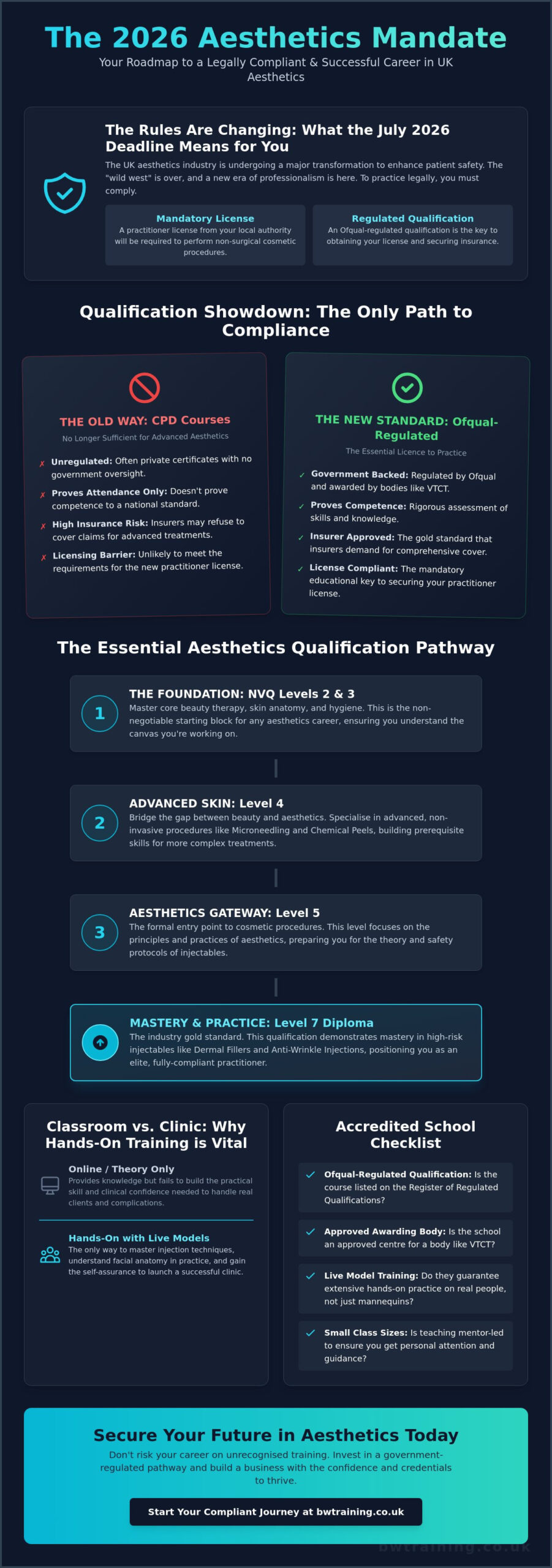
In 2026, the term “accredited” has moved from a marketing buzzword to a strict legal requirement. For anyone looking for a fully accredited beauty school ealing, understanding the difference between a private certificate and a regulated qualification is the first step toward a secure career. A truly accredited institution is one regulated by national awarding bodies like VTCT and mapped directly to Ofqual standards. This ensures that every hour you spend in training meets the rigorous safety and educational benchmarks set by the UK government.
The 2026 market has fundamentally changed how insurers view risk. While Continuing Professional Development (CPD) courses once provided a quick route into the industry, they’re no longer enough for practitioners performing advanced aesthetics. Insurers now look for evidence of structured, regulated learning that follows a clear progression. An attendance certificate proves you were in the room; a nationally recognised qualification proves you’re competent to practice. For Ealing professionals, starting with a clear path to Level 4 and beyond isn’t just about learning. It’s about building a business that can legally operate. You need the peace of mind that your insurance will actually pay out if a complication occurs. That security only comes with regulated training.
Ofqual Regulation vs. Private Accreditation
You can verify a school’s status by checking the Register of Regulated Qualifications. If the course isn’t listed there or linked to an awarding body like VTCT, it likely lacks government oversight. The study of Cosmetology and advanced aesthetics requires a deep understanding of human anatomy and hygiene protocols. VTCT qualifications are the gold standard for London clinics because they provide a universal language of skill that employers trust. They’re your passport to high-end employment in the city’s most prestigious aesthetics hubs. We see many students who’ve wasted thousands on ‘private’ accreditation only to find they can’t get insured for dermal fillers or laser treatments. Don’t make that mistake. Ensure your school is an approved VTCT centre before you sign any enrollment forms.
The Impact of New UK Licensing for Aesthetics
As of July 2026, the new national licensing scheme for non-surgical cosmetic procedures is fully active. Local authority licenses are now mandatory for practitioners offering treatments like Botox and dermal fillers. If you train at a non-accredited facility, you risk being denied a license, effectively shutting down your business before it begins. This legislation was designed to eliminate ‘cowboy’ practitioners and raise the bar for patient safety. Choosing a regulated school now prevents the massive expense and frustration of retraining later. By investing in a regulated environment, you ensure your clinic meets the new local authority standards for safety and compliance. It’s about more than just passing a test; it’s about the emotional security that comes from knowing you’re a legitimate, professional practitioner. If you’re searching for a fully accredited beauty school ealing practitioners can trust, look for one that prepares you specifically for these 2026 standards.
The Essential Beauty and Aesthetics Qualification Pathway
Building a successful career in aesthetics requires more than just a passion for skin; it requires a structured, logical ladder of learning. You can’t jump straight into advanced injectables without first understanding the canvas you’re working on. A fully accredited beauty school ealing students can access should provide this clear progression, ensuring you meet the National Occupational Standards required for professional practice. This pathway isn’t just a series of certificates. It’s a journey that builds your clinical confidence and technical precision at every stage.
Skipping foundational levels is one of the most common mistakes we see. While it might seem faster, it often leads to significant insurance gaps and, more importantly, clinical errors. If you don’t understand the underlying anatomy or how skin tissue responds to trauma, you can’t safely perform advanced treatments. Regulated qualifications ensure you have the prerequisite knowledge to handle complications, which is the hallmark of a true professional. We’re here to guide you through this process, ensuring you’re never out of your depth.
NVQ Level 2 & 3: The Professional Foundation
Your journey begins with NVQ Level 2 Beauty Therapy General. This is where you master the basics of facials, skincare, and client care. It’s the bedrock of your career. Once you’ve secured these skills, an NVQ Level 3 Beauty Therapy qualification becomes your gateway to the aesthetics world. At this level, you move into advanced skin analysis and electrical treatments. We place a heavy emphasis on Anatomy and Physiology (A&P) during these early stages. Understanding the muscular and skeletal systems isn’t just for passing exams; it’s vital for anyone planning to progress to injectables or laser therapy later on.
Advancing to Level 4 Laser and Level 5 Aesthetics
As you move into Level 4 Laser and IPL, the focus shifts from “pampering” to “results-driven” clinical procedures. You’ll learn to handle high-demand treatments like permanent hair reduction and skin rejuvenation with precision. This stage requires a higher level of academic rigour and practical assessment. By the time you reach Level 5 Aesthetics Practice and eventually the Level 7 Diploma in Aesthetics Practice, you’re performing complex non-surgical treatments. These higher-level courses are designed to mirror the standards of healthcare professionals, ensuring you’re fully prepared for the 2026 licensing requirements. If you’re looking to start this journey, we recommend viewing our accredited course list to see where your skills can take you.
Classroom vs. Online: Why Hands-On Training Wins
Choosing where to train is a decision that defines your clinical reputation. While the convenience of online learning is tempting, it simply cannot prepare you for the physical reality of aesthetics. When you’re searching for a fully accredited beauty school ealing students can reach easily, the priority must be physical, supervised practice. Needle work and laser safety require a tactile understanding that a screen won’t provide. A 20-minute journey from Ealing to our Hounslow or Whitton centres is a small price to pay for the clinical safety of your future patients.
The British Beauty Council consistently advocates for higher standards and professional recognition across the sector. This industry-wide push for excellence highlights why “attendance-only” or “video-only” courses fall short. You need an environment where a mentor can physically correct your hand positioning or adjust your depth of injection in real-time. This immediate feedback loop prevents bad habits from forming and ensures you develop the steady hand required for advanced treatments like fat dissolving injections or microneedling.
The Role of Live Models in Clinical Training
Training heads are useful for initial theory, but they’re no substitute for human skin. They don’t bruise, they don’t have unique facial symmetries, and they don’t provide the psychological pressure of working on a real person. We source and supervise all live models to ensure a safe, controlled environment for both student and client. Performing your first injection under expert guidance is a transformative moment. It replaces anxiety with a sense of preparedness. You’ll learn to navigate different skin textures and anatomical variations that are impossible to replicate with plastic or silicone.
Supervised Practice and Clinical Hours
Meeting the mandatory practical hours required for Level 7 Aesthetics is a cornerstone of our curriculum. These hours aren’t just a box-ticking exercise; they’re an investment in your competence. In a classroom setting, peer-learning also accelerates your growth. Watching a classmate handle a specific skin concern or discussing a potential complication with your tutor builds a collective intelligence. This repetitive, supervised practice is how you cultivate “calm confidence.” By the time you open your own clinic near Ealing, you won’t be guessing. You’ll have the muscle memory and the technical depth to deliver safe, results-driven care every single time.
How to Choose a Beauty School Near Ealing
Selecting the right fully accredited beauty school ealing professionals choose is a decision that impacts your entire career trajectory. It isn’t just about finding the closest classroom; it’s about verifying that the institution operates with the integrity and clinical rigour your future patients deserve. You should start by confirming the school’s registration with regulated awarding bodies like VTCT or Qualifi. Without this, your qualification may hold no weight with insurers or the new licensing boards that will govern the industry by July 2026.
Beyond the paperwork, look at the environment. A high tutor-to-student ratio is essential for safety, especially when you’re first handling needles or lasers. You need an instructor who can be by your side, providing immediate correction and support. Inspect the clinical facilities during a visit if possible. Are they using modern, medical-grade equipment, or are you learning on outdated machines? Your training should mirror the high standards of a professional clinic. Accessibility also matters for your work-life balance. For those in Ealing, Brentford, and Chiswick, our locations in Hounslow and Whitton offer a perfect balance of professional clinical settings and an easy commute.
Evaluating Tutor Expertise and Clinical Background
You should always learn from active practitioners. There’s a profound difference between a full-time academic and someone who manages a busy clinic daily. Ask specific questions about your instructor’s background in Botox courses and dermal fillers. You want a mentor who has navigated real-world complications and can teach you the nuances of patient safety. This practical wisdom is what builds your own “calm confidence” when you begin treating your own clients. We focus on teaching you how to think like a clinician, not just how to follow a manual.
Insurance and Career Support Post-Graduation
Choosing a fully accredited beauty school ealing students can rely on means looking at the support system provided after the course ends. A regulated certificate is your strongest asset when applying for professional insurance. We maintain strong partnerships with major aesthetic insurance providers to ensure our graduates can practice legally and safely from day one. For non-medics, we provide essential guidance on finding prescribers and building a clinical network. Our commitment to your success doesn’t end when you receive your certificate; we view our training as a long-term investment in your professional standing. If you’re ready to take the next step, explore our full range of accredited aesthetics courses and start your journey with a team that prioritises your safety and growth.
Why Beautiful World Training Academy is the Choice for Ealing Professionals
Choosing a fully accredited beauty school ealing students can trust means finding a partner that values your long-term success over simple enrollment numbers. At Beautiful World Training Academy, we operate on an “Investment in People” philosophy. We don’t just aim for administrative completion; we aim for clinical excellence. Our goal is to ensure you leave our doors with the self-assurance needed to treat patients safely and effectively. This focus on your professional state of mind is what sets us apart from high-volume training centres.
Our strategic locations in Hounslow and Whitton are perfectly positioned to serve the Ealing, Chiswick, and Richmond communities. We provide a seamless, structured pathway that takes you from beginner NVQ Level 2 and 3 Beauty Therapy all the way to postgraduate Level 7 Aesthetics Practice. By keeping our class sizes small, we ensure every student receives the clarity and momentum they need to master complex techniques. You won’t get lost in the back of a crowded room here. You’ll be at the forefront of every demonstration, with a mentor by your side at all times.
A Supportive Mentor-Led Environment
We’ve moved beyond the stereotype of dry, tedious seminars. Our training is participatory and deeply practical. We adopt a “Steady Expert” approach, where our instructors act as reliable mentors who are passionate about their craft. This ensures you feel empowered rather than just informed. As we head toward the 2026 licensing changes, our vision remains clear; we lead the way in compliant, high-standard education. We focus on the safety of the workforce and the well-being of your future clients, ensuring every protocol is grounded in real-world application rather than abstract theory.
Ready to Start Your Journey?
If you’re living in Ealing and ready to elevate your career, the next step is simple. We invite you to book a tour of our Hounslow or Whitton centres to see our clinical facilities firsthand. Our team provides tailored career advice to help you decide which level is right for your current experience, whether you’re starting with NVQ Level 2 or looking to advance to Foundation Dermal Fillers. We’re here to help you navigate the requirements of the 2026 landscape with confidence. Don’t leave your professional future to chance. View our upcoming course dates and secure your place today to join a community of elite aesthetics practitioners. Finding a fully accredited beauty school ealing professionals recommend starts with a conversation about your goals, and we’re ready to help you reach them.
Secure Your Future in the 2026 Aesthetics Industry
The transition toward a regulated aesthetics market by July 2026 is a positive evolution for practitioners and patients alike. It prioritizes safety, integrity, and clinical excellence. By choosing a fully accredited beauty school ealing students can reach, you ensure your training meets the highest national standards. We’ve explored how a clear pathway from NVQ Level 2 through to the Level 7 Diploma builds a career that’s both legally compliant and rewarding. This journey requires more than just attendance; it demands high-quality, hands-on practice.
Since 2014, we’ve served Ealing and West London as a VTCT and CPD accredited academy. Our focus remains on expert-led clinical training using live models to ensure you’re ready for real-world practice. We believe your success is measured by the self-assurance you feel when you perform your first solo treatment. This isn’t just about getting a certificate; it’s about investing in a professional identity that lasts. You have the drive to succeed, and we have the steady expertise to help you get there.
Start your journey to becoming a fully accredited practitioner today. We’re ready to help you take the next step toward clinical mastery with confidence and pride.
Frequently Asked Questions
Is a Level 3 Beauty Therapy qualification required for aesthetics?
Yes, an NVQ Level 3 is the standard prerequisite for moving into clinical aesthetics. It provides the essential knowledge of Anatomy and Physiology needed to understand how advanced treatments affect the body’s systems. Starting with this foundation ensures you meet the entry requirements for higher-level qualifications like Level 4 Laser or Level 5 Aesthetics Practice. We recommend securing this bedrock of knowledge before attempting any injectable training.
How long does it take to travel from Ealing to your training centres?
Traveling from Ealing to our training centres in Hounslow or Whitton typically takes about 20 minutes by car or public transport. This short commute allows you to access high-quality, clinical training without the stress of a long journey. It’s a practical choice for anyone looking for a fully accredited beauty school ealing that offers a professional, mentor-led environment close to home. You’ll find our locations are easily accessible for students across West London.
Are your aesthetics courses open to non-medics in 2026?
Non-medics can certainly enter the aesthetics field in 2026 by following the regulated qualification ladder. You’ll need to progress through NVQ Levels 2 and 3 before specializing in advanced procedures like injectables or chemical peels. This structured approach ensures you meet the new national licensing requirements and possess the technical depth required for safe clinical practice. We provide a clear roadmap to help you navigate these professional standards with confidence.
Will I be able to get insurance immediately after completing my course?
You’ll be eligible to apply for professional insurance as soon as you receive your accredited qualification. Since our courses are regulated by recognized awarding bodies, insurers recognize your training as meeting the necessary safety and competency benchmarks. We often provide guidance on the best insurance providers for our graduates to help you start your clinic with full peace of mind. Your regulated certificate is your strongest asset during the application process.
What awarding bodies are your courses accredited by?
Our courses are primarily accredited by VTCT, which is a government-regulated awarding body under Ofqual. This status means your certificate is a nationally recognized qualification, not just a private attendance award. Choosing a fully accredited beauty school ealing ensures your education is mapped to the highest UK standards, protecting your professional reputation and your career’s longevity. We take pride in maintaining these rigorous educational benchmarks for all our students.
Do you provide live models for the practical training sessions?
We source and provide live models for all our practical sessions to ensure you get authentic clinical experience. This supervised practice allows you to work on real skin textures and anatomical variations under the watchful eye of an expert tutor. It’s a vital part of our philosophy, focusing on your readiness and self-assurance before you treat your own clients. You won’t be practicing on plastic heads when it’s time to master advanced techniques.
What is the difference between a CPD certificate and a VTCT qualification?
A VTCT qualification is an Ofqual-regulated credential that proves your competence to a national standard, whereas CPD focuses on continuing professional development for existing skills. While CPD is valuable for learning new techniques, the 2026 licensing scheme often requires the structural rigour of a VTCT or equivalent qualification. Regulated training is the most secure way to ensure your business remains compliant and insurable in the long term.
Can I pay for my beauty and aesthetics training in instalments?
You should contact our admissions team directly to discuss the current options for managing your course fees. While payment structures can vary depending on the specific qualification, we prioritize making our professional training as accessible as possible for our students. We’re happy to provide a transparent breakdown of the enrollment process and any administrative requirements during your initial career consultation. Our goal is to help you invest in your future without unnecessary stress.