The most daunting moment in an aesthetician’s career isn’t the final exam. It’s the first time they stand alone with a syringe and a paying client. Securing comprehensive hands-on filler training london is the most effective way to silence the anxiety that comes with complex facial anatomy and the fear of causing complications. We understand the weight of that responsibility. You might feel overwhelmed by the technical demands of the job or fear the isolation that follows a one-day course when real-world questions finally arise.
We believe that clinical mastery is a product of mentored haptic experience, not just reading a manual. We’ll help you transition from nervous theory to clinical certainty, ensuring you leave with the insurance-recognised certification and the practical skills to handle both needles and cannulas. With the July 2026 legislation mandating accredited training and practitioner registration for amber risk procedures, there’s never been a more vital time to invest in your skills. This article explores how expert-led practice prepares you for these new regulatory standards while giving you the confidence to provide exceptional, safe results for every client.
Key Takeaways
- Understand the importance of haptic feedback and why supervised practice on live models is the only way to master skin resistance and needle depth.
- Identify the critical differences between training pathways to find the right hands-on filler training london that meets the new 2026 regulatory standards.
- Learn the exact clinical steps required before the needle touches the skin, including precise facial mapping and aseptic non-touch techniques.
- Prepare for your first injection with a checklist of essential pre-course studies covering vascular anatomy and product science.
- Discover how professional mentorship in West London can provide the long-term support you need to transition from a student to a confident practitioner.
What is Hands-On Filler Training and Why Is It Essential?
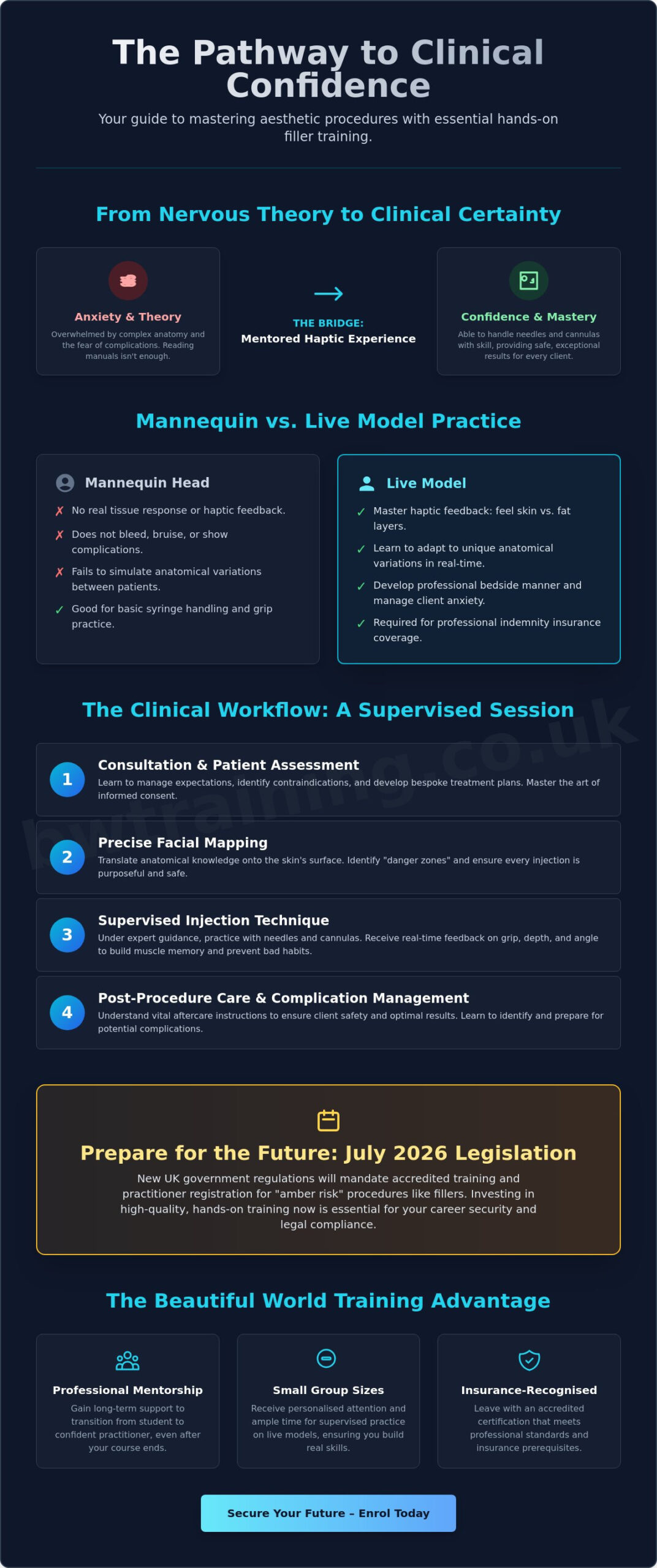
Mastering aesthetics requires more than a certificate; it demands muscle memory. Hands-on training is the vital phase where textbook theory meets clinical reality. It isn’t just watching a demonstration or practicing on a silicone head. It is the supervised clinical practice on live models under the watchful eye of an expert. While diagrams provide the map, our hands-on filler training london provides the actual driving experience you need to practice safely.
You must understand what are injectable fillers and how they interact with living tissue before you ever treat a paying client. This involves mastering haptic feedback. Haptic feedback is the physical sensation of the needle or cannula passing through different anatomical layers. You’ll learn to feel the distinct resistance of the dermis compared to the “give” of subcutaneous fat. Classroom theory can’t teach your hands how to recognize these subtle shifts in pressure and depth.
Anatomical variations make every treatment unique. No two faces are identical. Textbooks show “average” anatomy, but real patients have unique vascular patterns, varying skin thicknesses, and different tissue densities. Practical experience allows you to adapt your technique to these variations in real-time. This exposure is also a prerequisite for professional indemnity insurance. Most insurers won’t cover practitioners who haven’t completed a verified number of supervised hours on live models, making this practical stage a non-negotiable step for your career security.
The Difference Between Mannequin and Live Model Practice
Mannequins are helpful for learning how to hold a syringe, but they have significant limitations. Synthetic skins don’t simulate real tissue response. They don’t bleed, they don’t bruise, and they don’t provide the physiological feedback that a human body does. Working with live models helps you develop a professional bedside manner. You’ll learn how to talk a client through the procedure while maintaining a steady hand. Managing a patient’s natural anxiety or a physical flinch is a skill that only comes from working with real people in a clinical setting.
Why Safety Starts with Supervised Injections
A mentor’s role is to act as your safety net. During hands-on filler training london, an instructor monitors your grip, the depth of your needle, and your angle of entry in real-time. They provide immediate corrections that prevent you from developing bad habits that could lead to complications in your own practice. This direct intervention builds your internal clinical compass and ensures you’re injecting with precision. Hands-on training is the bridge between anatomical theory and safe clinical results.
The Clinical Framework: What to Expect from a Practical Session
A typical day in our hands-on filler training london follows a logical, clinical rhythm. We don’t just hand you a syringe; we guide you through a professional workflow that mirrors a real-world clinic. This starts with a patient assessment and moves through mapping, the procedure itself, and vital post-procedure care. This structure isn’t just for organization; it’s a safety protocol that protects both you and your client.
Facial mapping is the foundation of every successful treatment. You’ll learn to use marking pencils to translate your knowledge of the anatomy of facial structures onto the skin’s surface. This step identifies danger zones and ensures every injection is purposeful. As the UK government regulation of cosmetic procedures moves toward stricter mandatory licensing in 2026, these meticulous habits will define your professional reputation and legal compliance.
Consultation and Patient Assessment Mastery
Great results start with a great conversation. During the session, you’ll learn to manage client expectations and identify contraindications like active infections or previous filler complications. We’ll help you develop a bespoke treatment plan tailored to a patient’s unique bone structure. This section also covers the legal necessity of informed consent. You’ll learn how to explain risks clearly, ensuring your patients feel secure and well-informed before any treatment begins.
Injection Techniques: Needle vs. Cannula
You need to master different tools for different tasks. We teach you when a sharp needle provides the precision needed for fine lines and when a blunt cannula offers a safer alternative for volumizing high-risk areas. You’ll practice three core techniques:
- Bolus: Placing small amounts of product deep against the bone for structural support.
- Linear Threading: Depositing a continuous line of product as the needle is withdrawn.
- Fanning: Using a single entry point to distribute filler across a wider area.
You’ll also learn about product rheology. Choosing a filler with the right thickness and elasticity is vital for achieving natural-looking results. This progression from simple line filling to complex contouring ensures you build clinical confidence in a supportive environment. If you’re ready to transition from theory to practice, our hands-on filler training london provides the expert mentorship you need. You can explore our full range of professional aesthetics courses to find the right path for your career.
Comparing London Aesthetic Courses: Accreditation and Group Sizes
Choosing the right training provider is a significant investment in your professional future. You aren’t just purchasing a certificate; you’re building the foundation of a clinical career. While many providers offer “All-in-One” courses that promise to cover everything in a single weekend, these can often leave beginners feeling overwhelmed. We find that tiered pathways, moving from Foundation Dermal Fillers to Advanced techniques, allow for better retention of safety protocols and technical precision. This staged approach ensures that Dermal filler safety guidelines become second nature before you attempt more complex procedures.
The quality of your hands-on filler training london is often reflected in the ratio of trainers to students. We maintain a 1:4 ratio because it is the gold standard for participant safety and educational depth. In larger seminar-style groups, you risk becoming a spectator rather than a practitioner. Small groups guarantee that a mentor is always within arm’s reach to monitor your needle placement and product flow. This intimate environment fosters the calm confidence needed to transition from a student mindset to a professional one.
CPD vs. Vocational Qualifications (NVQ)
It’s vital to distinguish between short-term skill updates and long-term career frameworks. CPD (Continuing Professional Development) points are excellent for staying current with industry trends, but they don’t offer the same regulatory weight as a vocational qualification. For those looking to future-proof their practice, an NVQ Level 7 Aesthetics diploma provides the highest level of regulated training in the UK. These higher-level qualifications align with JCCP standards, protecting you against the legislative shifts coming in July 2026. Investing in a regulated path shows a genuine commitment to the safety and well-being of your future workforce.
The Importance of Small Group Learning
Intimate, clinic-based mentorship is vastly superior to large-scale demonstrations. Small groups allow for significantly more “needle time” per delegate, which is the only way to build the haptic memory we discussed earlier. In a low-pressure, supportive environment, you can ask the “what if” questions that might feel intimidating in a crowded room. This personalized attention ensures that every student leaves the session with a clear, practical understanding of how to manage real patient reactions and physiological responses. We believe that your state of mind after a course is the truest metric of our success as educators.
Your First Injection: Step-by-Step Preparation for Practitioners
The transition from observer to practitioner is a pivotal moment in your career. Preparation is what separates a nervous beginner from a composed professional. Before you step into your hands-on filler training london, your foundation must be built on a rigorous understanding of vascular anatomy and product science. You aren’t just learning where to inject; you’re learning the “why” behind every movement of the needle. This deep dive into theory ensures that when you finally pick up the syringe, your focus remains on the patient’s safety and the aesthetic outcome.
Your pre-course study should include a comprehensive checklist. You need to master the locations of major facial arteries and understand the rheology of the products you’ll be using. Different fillers have different G-prime ratings, affecting how they lift and integrate into the tissue. Clinical excellence also requires a flawless “clean-field” setup. We teach the Aseptic Non-Touch Technique (ANTT), a protocol designed to eliminate the risk of infection and biofilm formation. Mastering these sterile procedures early on prevents the development of poor clinical habits.
Psychological readiness is just as vital as technical skill. Your patient looks to you for reassurance and authority. If you appear hesitant, they’ll feel anxious. We help you develop a calm, professional presence that puts clients at ease. This mental state allows you to think clearly, follow your mapping, and respond effectively to the physical feedback you feel during the injection. If you’re ready to start this journey, you can enrol in our foundation dermal fillers course to build your clinical base.
Vascular Mapping and Danger Zones
Identifying high-risk areas is the most critical part of your mapping process. You must be hyper-aware of the glabella and the piriform fossa, as these are known danger zones where vascular complications are more likely to occur. We advocate for the use of aspiration as a routine safety check, though it is never a substitute for anatomical knowledge. Always identify the location of the facial artery before performing any lip filler courses or mid-face treatments.
Complication Management Protocols
True mastery in aesthetics is defined by your ability to fix a problem, not just your ability to inject. You must be fully briefed on the role of Hyaluronidase (Hyalase) and know exactly how to use it to dissolve fillers in an emergency. Every practitioner’s clinic must be equipped with a complete emergency kit, including high-dose Hyalase, aspirin, and clear protocols for suspected vascular occlusions. Knowing you have the tools and the knowledge to manage a complication provides the emotional security needed to practice with confidence.
The Beautiful World Advantage: Professional Mentorship in West London
Beautiful World Training Academy doesn’t just teach techniques; we cultivate practitioners. With dedicated centers in Hounslow and Whitton, we provide a localized hub for excellence in West London. Our academy was founded in 2014. This gives us a 10-year heritage of nurturing the city’s aesthetic talent. We’ve seen the industry evolve and we’ve adapted our curriculum to ensure our students remain at the forefront of safety and innovation. Our “mentor-first” philosophy means we invest in your long-term confidence. We believe the true value of our work is your state of mind when you return to your own clinic.
Our curriculum is designed to be comprehensive and adaptive. We offer everything from accredited Botox courses to advanced fat dissolving injections. This variety allows you to build a diverse treatment menu under a single, trusted educational roof. When you choose our hands-on filler training london, you’re joining a community that prioritizes integrity and real-world application over abstract theory. We focus on the emotional security that comes from being fully compliant with 2026 standards.
Accessible Training for Richmond, Ealing, and Beyond
Many practitioners feel they must travel to Central London or Harley Street for high-quality education. We’ve changed that by bringing elite standards to West London. Our locations are highly convenient for professionals in Richmond, Ealing, and surrounding boroughs. This local focus creates a unique networking benefit. You’ll meet and collaborate with other practitioners in your immediate area, fostering a supportive local community that lasts long after the course ends. For experienced therapists looking to upskill quickly, we also offer flexible fast-track options that respect your existing clinical background.
Post-Training Support and Career Pathways
Our relationship with you doesn’t end when you receive your certificate. We provide lifetime after-course support and access to a vibrant alumni community. This safety net is essential for those moments when you need a second opinion or professional advice on a complex case. We’re committed to your long-term growth, helping students progress seamlessly from NVQ Level 2 Beauty Therapy through to the prestigious Level 7 Diploma in Aesthetics Practice. This structured career path ensures you’re always prepared for the next step in your professional journey. If you’re ready to master clinical skills with a team that truly cares about your success, secure your place on our next hands-on filler course today.
Step Into Your Future as a Confident Practitioner
Mastering dermal fillers is a journey that requires more than study; it demands the haptic feedback and clinical precision only found in supervised practice. By prioritizing small group sizes and direct 1-on-1 mentor time, you ensure every injection you perform is backed by anatomical certainty. This level of preparation is vital for meeting the legislative standards arriving in July 2026 and for building a professional reputation rooted in safety.
Since 2014, we’ve focused on nurturing London’s aesthetic talent with courses fully accredited by VTCT and CPD. Choosing our hands-on filler training london means you’re investing in a heritage of expertise that spans over 10 years. We’re committed to your personal growth, providing the emotional security and technical skills required to excel in this competitive field. We don’t just aim for administrative completion; we aim for your total self-assurance.
View Our 2026 Hands-On Filler Course Dates in London
Your path to clinical mastery starts with a single, confident step. We’re ready to guide you there and welcome you into our professional community.
Frequently Asked Questions
Do I need to be a nurse or doctor to take hands-on filler training in London?
You don’t necessarily need to be a nurse or doctor, but you must meet specific entry requirements. We welcome healthcare professionals and experienced therapists who hold an NVQ Level 3 in Beauty Therapy. Under the July 2026 legislation, non-healthcare professionals performing dermal fillers will work under the supervision of a regulated professional. This ensures every practitioner meets the highest safety standards while maintaining full legal compliance.
How many live models will I actually inject during the foundation course?
We prioritize quality over quantity to ensure you develop genuine clinical confidence. During your hands-on filler training london, you’ll work in small groups with a maximum of four delegates. This intimate setting guarantees significant 1-on-1 time with your mentor. You’ll perform multiple injections across different facial zones on live models, allowing you to master haptic feedback and depth control under direct expert supervision.
Is the filler training at Beautiful World Academy CPD accredited?
Yes, our dermal filler training is fully accredited by both VTCT and CPD. We’ve spent over 10 years building a reputation for excellence and regulatory integrity. These certifications are recognized by major UK insurance providers, ensuring you can practice legally and safely. Our focus is on providing a regulated career framework that protects both the practitioner and the public.
What happens if I don’t feel confident after my first day of training?
We offer lifetime after-course support to ensure no student feels “left alone” after their session. If you need extra reassurance, our alumni community and mentors are available to provide guidance on complex cases. We believe clinical mastery is a journey. Our supportive environment allows you to return for further guidance or progress through our tiered pathways until you feel completely self-assured.
Can I get insurance immediately after completing the hands-on filler course?
You can typically secure professional indemnity insurance immediately upon receiving your accredited certificate. Because our courses meet the strict standards set by VTCT and CPD, they are recognized by the UK’s leading aesthetic insurance providers. We provide all the necessary documentation to help you transition from the classroom to your own clinical practice without unnecessary delays.
What is the difference between a one-day masterclass and a Level 7 Diploma?
A Level 7 Diploma is a comprehensive, OFQUAL-regulated postgraduate qualification, whereas a foundation course focuses on core injection skills. The Level 7 Diploma in Aesthetics Practice provides the highest level of regulatory protection and follows JCCP standards. It’s an investment in long-term career security. Foundation courses are excellent entry points for learning the essential haptic skills and safety protocols.
Are models provided by the academy, or do I need to bring my own?
We provide live models for all our practical sessions to ensure you gain experience with diverse anatomical types. You won’t need to worry about sourcing your own patients for the training day. This allows you to focus entirely on your injection technique and consultation skills. Our mentors select models that offer the best educational value for each specific training module.
Do you offer advanced training for tear troughs and non-surgical rhinoplasty?
We provide Advanced Dermal Fillers training that covers complex facial contouring and sophisticated injection techniques. These modules are designed for practitioners who have mastered the foundation level and wish to expand their treatment menu. While we focus on high-demand zones, we always prioritize safety and complication management. This ensures you can deliver transformative results while maintaining the highest clinical standards in the industry.