
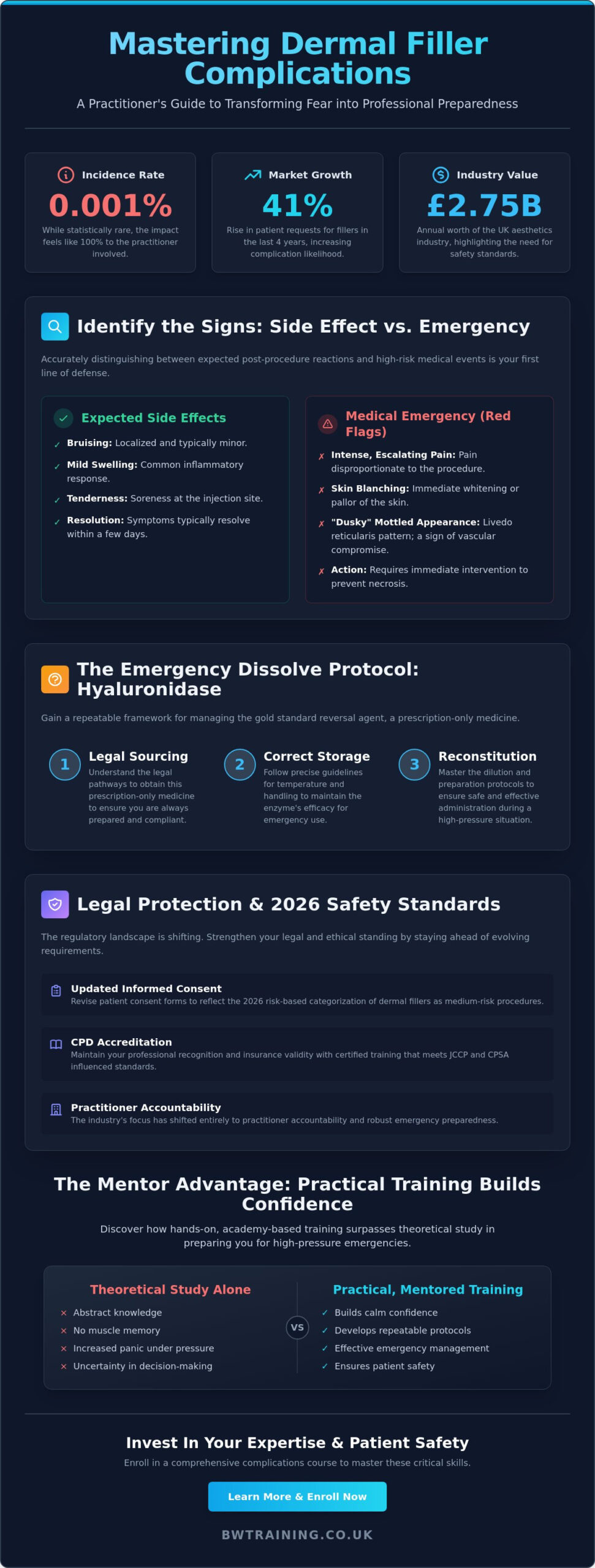
While the incidence of impending necrosis is estimated at just 0.001%, that statistic feels like 100% when you’re the one holding the syringe. You’ve likely felt that flicker of anxiety when a patient’s skin doesn’t blanch quite right or worried about the legal weight of a potential insurance claim. Enrolling in a comprehensive complications from fillers training course is the most effective way to transform that underlying fear into professional preparedness.
We believe that true expertise is defined by how you handle the unexpected. This guide will help you master the critical skills needed to identify, manage, and prevent dermal filler complications through a structured, expert-led approach. It’s a genuine investment in your personal growth and the safety of every patient who walks through your door. By focusing on practical application rather than abstract theory, we help you build the self-assurance required for a successful practice.
We’ll walk you through the 2026 safety standards, providing a clear and repeatable emergency protocol for vascular occlusions. You’ll also gain total clarity on hyaluronidase protocols to ensure you stay compliant with the latest UK licensing requirements and maintain your CPD accreditation with confidence.
Key Takeaways
- Learn to accurately distinguish between expected side effects like bruising and high-risk clinical complications that require immediate intervention.
- Gain a repeatable framework for the legal sourcing, storage, and reconstitution of hyaluronidase for emergency use.
- Strengthen your legal and ethical standing by updating informed consent forms to reflect the 2026 risk-based categorization of procedures.
- Discover how a dedicated complications from fillers training course builds the calm confidence needed to handle high-pressure aesthetic emergencies.
- Understand the “Mentor Advantage” of practical, academy-based training in Hounslow compared to purely theoretical study.
What are Dermal Filler Complications? Defining Risks in 2026
Mastering aesthetics is about more than just a steady hand; it requires a deep understanding of what happens when the body reacts unexpectedly. While the UK aesthetics industry is worth over £2.75 billion annually, this surge in popularity brings a heightened responsibility for safety. With patient requests for filler rising by 41% in the last four years, the statistical likelihood of encountering a clinical issue naturally increases. Every practitioner, regardless of their experience level, must be equipped with a robust emergency plan. Investing in a comprehensive complications from fillers training course is the most reliable way to ensure you’re never caught off guard during a procedure.
A critical part of this preparation involves understanding Injectable filler risks through a clinical lens. While side effects are a normal part of the healing process, true complications are medical events that demand swift, decisive action. Hyaluronidase, commonly known as Hyalase, remains the gold standard for reversing hyaluronic acid fillers in these scenarios. Because it’s a prescription only medicine, knowing how to source, store, and administer it correctly is vital for patient safety. The industry’s “wild west” era is rapidly closing, and as we move through 2026, the focus has shifted entirely toward practitioner accountability and emergency preparedness.
Minor Side Effects vs. Medical Emergencies
It’s essential to manage client expectations from the very first consultation. Normal inflammatory responses like bruising, mild swelling, or tenderness are common and usually resolve within a few days. You should always prepare your clients for these outcomes to prevent unnecessary anxiety. However, you must be able to spot red flag symptoms immediately. Intense, escalating pain, skin blanching, or a “dusky” mottled appearance are signs of a medical emergency like vascular occlusion. The psychological impact of a complication can be heavy for both the client and the injector. Having a clear, repeatable protocol reduces panic and fosters the calm confidence required to manage these high-pressure moments effectively.
The Evolution of Aesthetic Safety Standards
The regulatory landscape in 2026 is defined by a commitment to public protection. The Joint Council for Cosmetic Practitioners (JCCP) and the Cosmetic Practice Standards Authority (CPSA) have influenced new licensing schemes that categorize dermal fillers as medium-risk procedures. This evolution means that staying updated with a CPD-certified complications from fillers training course is now a core requirement for insurance and professional recognition. We believe that safety should be foundational rather than an afterthought. That’s why our Foundation Dermal Fillers training integrates these safety protocols from day one, ensuring that new practitioners enter the field with a high level of risk awareness and the ability to protect their clients’ well-being.
Identifying High-Risk Filler Complications: A Practitioner Guide
Identification is your first line of defense. In a clinical setting, the ability to distinguish between a harmless bruise and a medical emergency is what separates a novice from an expert. While most procedures proceed without incident, certain high-risk complications require immediate action to prevent permanent damage. Enrolling in a complications from fillers training course provides the clinical framework needed to recognize these signs instantly, allowing you to act with the steady hand of a prepared professional.
Beyond immediate emergencies, practitioners must also manage long-term issues like Delayed Onset Nodules (DONs) and biofilms. These inflammatory responses can appear weeks or even months after a procedure, often presenting as firm, sometimes tender lumps at the injection site. Similarly, the Tyndall effect, which manifests as a blueish hue under the skin, signals that the filler was placed too superficially. For a comprehensive overview of approved uses and potential adverse events, you can consult the FDA information on dermal fillers. Understanding these nuances ensures you can offer your clients clear, honest guidance and effective corrective treatments.
Vascular Occlusion: The Stages of Ischemia
Vascular Occlusion (VO) is the “ticking clock” of aesthetic medicine. It occurs when filler is accidentally injected into a vessel or compresses it, starving the surrounding tissue of oxygen. You must monitor for immediate blanching, where the skin turns ghost-white, followed by livedo reticularis, a dusky, net-like mottling. The Capillary Refill Test is considered abnormal if the skin takes longer than 2 seconds to return to its original color after pressure is released. While arterial occlusions often present with sudden, intense pain and immediate blanching, venous occlusions can be more deceptive, showing slower onset swelling and darker discoloration. Recognizing these stages early is the only way to prevent tissue necrosis.
Rare but Severe: Vision Loss and Stroke
Certain “danger zones” on the face carry a higher risk of catastrophic complications due to the complex network of communicating vessels. The glabella, nose, and temples are particularly sensitive areas where retrograde embolization can lead to ophthalmic emergencies or even stroke. If a patient reports sudden vision changes or ocular pain, you must follow an immediate referral pathway to a specialist eye hospital. We believe that a deep understanding of the “why” behind the “where” is essential for safety. This is why a strong foundation in Anatomy and Physiology Level 3/4 is the best investment you can make to prevent vascular compromise before it starts. If you’re looking to sharpen your diagnostic skills, our complications from fillers training course offers the hands-on mentorship required to navigate these high-stakes scenarios with total confidence.
The Emergency Dissolve Protocol: Managing Hyaluronidase
Having a vial of hyaluronidase in your kit isn’t just a recommendation; it’s a fundamental requirement for safe practice. As we’ve established, identifying a vascular event is only half the battle. You must be prepared to act with immediate, clinical precision. In our complications from fillers training course, we emphasize that hyaluronidase (Hyalase) is a prescription only medicine (POM). This means you must have a valid prescribing pathway and store the product according to manufacturer guidelines, typically in a temperature controlled environment to maintain its enzymatic potency. We help you navigate these legal requirements so your clinic remains fully compliant and ready for any eventuality.
The reconstitution process requires a steady hand and a clear mind. You’ll typically mix the lyophilised powder with sterile saline, ensuring the solution is completely clear before administration. In an emergency scenario, the debate between patch testing and immediate injection becomes a critical risk vs. benefit analysis. While patch testing is the standard for elective dissolving, the imminent threat of tissue necrosis in a vascular occlusion usually justifies immediate administration. We teach you how to navigate this ethical and clinical crossroads, prioritizing the preservation of tissue while managing the rare risk of an allergic reaction. Following any dissolve procedure, you must monitor the patient for at least 60 minutes to ensure their safety and provide peace of mind.
Mixing and Dosage Calculations
Precision in dosing is vital for a successful outcome. For elective corrections, a higher dilution with lower units often suffices to refine a result. However, emergency protocols demand a more aggressive approach to break down modern, highly cross-linked hyaluronic acid quickly. High-dose pulsed protocols are the current 2026 standard because they ensure a constant saturation of the enzyme to overcome the mechanical obstruction of the filler. You’ll need to calculate units based on the specific filler volume and the area’s anatomy, a skill we refine through practical, hands-on drills in our complications from fillers training course.
The “Flood” Technique for Vascular Occlusion
When a VO is confirmed, the “flood” technique is your primary tool for resolution. This involves injecting high volumes of hyaluronidase into and around the suspected area of occlusion. You aren’t just aiming for the vessel; you’re saturating the entire anatomical plane to ensure the enzyme reaches the blockage. Vigorous massage must follow every injection to help the enzyme penetrate the filler material and encourage blood flow. We use the 15-minute assessment rule: if capillary refill hasn’t improved within 15 minutes of the first round, you repeat the cycle. This repeatable protocol replaces panic with a structured, life-saving workflow.
Legal Protection, Ethics, and Patient Management
Overconfidence is a quiet threat in the aesthetics room. Many practitioners believe that their precise technique makes them immune to issues, but the “it won’t happen to me” myth is a dangerous mindset that can lead to clinical complacency. The reality is that the human body is anatomically unique and unpredictable. Even the most seasoned injectors will eventually encounter an adverse event. Acknowledging this statistical reality isn’t an admission of failure; it’s the mark of a responsible professional. Enrolling in a complications from fillers training course is a vital investment in your integrity. It ensures that when a crisis occurs, you aren’t relying on luck, but on a foundation of expert training and calm confidence.
Your legal safety depends on the strength of your paperwork and your adherence to 2026 standards. Informed consent forms must be more than a formality; they need to explicitly detail high-risk events like vascular occlusion and the specific steps you’ll take to resolve them, including the emergency use of hyaluronidase. You should also audit your insurance policy immediately to verify that your coverage includes emergency dissolving and the off-label use of Hyalase. Without this alignment, you risk facing devastating legal and financial claims. We recommend building a strong referral network with medical specialists in London and Hounslow, ensuring you have a clear pathway for support before a need arises.
Documentation and the Paper Trail
In a clinical audit or insurance dispute, your records are your only defense. You must implement photography standards that capture suspected complications from multiple angles with consistent lighting to provide a clear visual timeline of the event. We also advise maintaining a dedicated “Complications Log” for every incident, no matter how minor. This isn’t just for insurance protection; it’s a tool for professional growth and clinical accountability. When sharing patient data during an emergency referral, always use secure, encrypted channels to remain GDPR-compliant while acting with the necessary speed to protect the patient’s health.
Managing the Panicked Patient
Technical skill means very little if you can’t manage the “panic factor” in a high-pressure scenario. Your client will naturally mirror your emotional state; if you appear flustered, their anxiety will escalate, making clinical intervention much more difficult. We teach you to use steady, reassuring communication to keep the patient calm and cooperative while you work. There’s also an ethical weight to “corrective work” when a patient arrives with a complication caused by another injector. You must decide if the situation is a medical emergency or an elective correction. Your structured follow-up protocol is what eventually restores the client’s journey to aesthetic confidence. Ready to secure your practice? Secure your place on our complications from fillers training course today at Beautiful World Training Academy.
Why Choose Beautiful World Training Academy for Your Complications Training?
Choosing where to refine your clinical skills is a decision that shapes your professional reputation. At Beautiful World Training Academy, we provide a supportive, high-standards environment where West London practitioners transition from basic knowledge to true clinical mastery. While we’ve discussed the theoretical risks and protocols in previous sections, a complications from fillers training course requires the “Mentor Advantage” that only face-to-face guidance can offer. We believe that the ability to manage a vascular event or an acute inflammatory response isn’t just a certificate on the wall; it’s a skill forged through practical drills and expert oversight in a controlled, professional setting.
Our curriculum is designed to be a cohesive journey rather than a series of isolated workshops. We ensure that the safety foundations you’ve learned are reinforced and expanded upon as you progress through more complex aesthetic procedures. For example, our Advanced Dermal Fillers training builds directly on these emergency protocols, allowing you to master sophisticated injection techniques with the absolute certainty that you can protect your patients. This integrated approach satisfies major UK aesthetic insurers and provides the accredited CPD certification required to maintain a leading practice in 2026.
Expert Tutors with Real-World Experience
We pride ourselves on the clinical depth of our instructors. You’ll learn from practitioners who have personally managed the medical emergencies we’ve detailed, sharing the subtle nuances of patient psychology that aren’t found in online modules. We keep our class sizes strictly limited to ensure every student receives dedicated attention while mastering the precise mixing and injection techniques required for hyaluronidase administration. This focus on individual growth allows us to act as your long-term partners in safety. We don’t just provide a seminar; we invest in your state of mind and your ability to remain calm under pressure.
Your Career Path in West London
High-end clinics in 2026 prioritize safety-first professionals who can protect both their patients and the business’s legal standing. Becoming “Complications Ready” at Beautiful World Training Academy significantly increases your employability and professional authority. Our academy is perfectly situated for practitioners in Richmond, Twickenham, and Ealing, offering a convenient, professional hub for West London’s aesthetic community. By training with us, you’re choosing a steady, reliable guide dedicated to your long-term clinical success. Secure your place on our next Complications Management Course at Beautiful World Training Academy and take the final step toward total clinical confidence.
Elevate Your Practice with Clinical Certainty
Aesthetic mastery is ultimately defined by the expert management of the unexpected. By internalizing the clinical markers of ischemia and the precise mechanics of the pulsed dissolve protocols we have discussed, you transition from an injector to a true clinical specialist. This complications from fillers training course is more than just a regulatory requirement; it is a genuine investment in your professional integrity and the longevity of your business. The true value of this training is the state of mind you carry into every appointment, knowing that your self-assurance is backed by a repeatable, life-saving emergency workflow.
We are dedicated to providing a grounded, practical guide to aesthetic safety that moves beyond abstract theory. As a specialist in NVQ Level 2-7 qualifications, Beautiful World Training Academy offers the structured environment needed to master these critical skills under expert supervision. Our tutors in Hounslow and Whitton are ready to partner with you to ensure your practice remains at the forefront of the 2026 licensing standards. Invest in your clinical safety: Book your Complications Management Course today at Beautiful World Training Academy. We look forward to supporting your journey toward becoming a fully compliant and empowered practitioner.
Frequently Asked Questions
Is a complications course mandatory for aesthetics practitioners in the UK?
Demonstrating competence in complications management is a core requirement under the 2026 licensing scheme for non-surgical cosmetic procedures. While the industry was once less regulated, the current framework categorizes dermal fillers as medium-risk procedures. This means you must have evidence of formal training to meet the standards set by local authorities for both practitioner and premises licensing. Completing a complications from fillers training course ensures you stay compliant with these essential safety regulations.
Can I take a complications from fillers training course online?
You can complete the theoretical portion of a complications from fillers training course online, but we strongly advise hands-on training for the practical elements. Mastering the reconstitution of hyaluronidase and the specific “flood” injection technique requires tactile experience that a screen simply cannot provide. Most UK insurers and the JCCP now prioritize practitioners who have undergone face-to-face clinical assessments to ensure they can act effectively in a real-world emergency.
What is the most common filler complication practitioners face?
Bruising and swelling are the most frequent minor side effects, but vascular occlusion remains the most critical clinical complication that requires immediate intervention. While the incidence of necrosis is statistically low at 0.001%, the rise in patient volume means practitioners are more likely to encounter it than in previous years. Other issues like Delayed Onset Nodules (DONs) and the Tyndall effect are also common and require specific corrective protocols to resolve.
Do I need to be a medical professional to administer Hyalase in an emergency?
Administering Hyalase in a life-saving emergency is permitted for trained practitioners, but the product itself is a prescription-only medicine (POM). If you aren’t a prescribing medic, you must have a formal oversight arrangement with a named healthcare professional. This ensures you can legally source and store the enzyme in your clinic. The 2026 licensing standards emphasize that having a clear prescribing pathway is essential for professional and legal safety.
How long does a filler complications certificate stay valid?
Most complications management certificates are valid for one to two years before a refresher is required. Because aesthetic protocols and hyaluronidase dosages evolve, annual training is the industry gold standard for maintaining your clinical edge. Staying up to date ensures you’re using the most current evidence-based techniques, which is vital for your professional development and satisfies the ongoing CPD requirements of your aesthetic insurance policy.
What should I include in my emergency complications kit?
Your emergency kit should be organized, accessible, and fully stocked with unexpired products at all times. It must include at least ten vials of hyaluronidase, sterile saline for reconstitution, a variety of syringes and needles, and high-dose aspirin. You should also include a printed copy of your emergency protocol and an adrenaline auto-injector to manage rare but severe acute allergic reactions. Regular audits of this kit are essential for clinic safety.
Will my insurance cover me if I haven’t taken a dedicated complications course?
It’s highly unlikely that your insurance will provide full indemnity cover if you haven’t completed a dedicated complications course. Most specialist aesthetic insurers now mandate this specific training as a condition of your policy. Without a valid certificate, you risk being personally liable for legal claims or medical costs arising from a complication. We always recommend checking your specific policy wording to ensure your training meets their current 2026 requirements.
How much does a complications management course typically cost in London?
The cost of complications training in London varies depending on whether the course is a standalone module or part of a larger qualification. While e-learning options are available at a lower price point, comprehensive clinical courses with hands-on mentoring typically reflect the value of the expert oversight and facility use provided. We recommend viewing this cost as a vital investment in your practice’s longevity and your personal professional security rather than a mere administrative expense.