You might save a few hundred pounds on a home-learning kit, but can you afford the lifelong cost of a legal claim or a permanent injury to a client? When weighing up diy beauty training vs professional course options, it’s easy to feel overwhelmed by the maze of NVQ levels and accreditation standards. You want to turn your passion into a career, but the fear of causing harm or being denied professional insurance is a heavy burden for many beginners. We understand that you need more than just a certificate; you need the confidence that comes from expert, hands-on mentorship.
This article shows you why accredited training is the only viable path to a safe and successful career in the UK. We’ll help you understand the latest 2026 legal requirements and how to gain the emotional security that comes from being fully compliant. You’ll discover exactly how to get insured and find a clear, structured roadmap to progress from basic beauty therapy to advanced aesthetics like dermal fillers and laser treatments. By the end of this guide, you will have a professional blueprint for a career built on safety, integrity, and clinical excellence.
Key Takeaways
- Understand why professional insurance providers require accredited certificates and how this protects your future business from legal risks.
- Compare the risks and rewards of diy beauty training vs professional course options to ensure your education meets 2026 UK regulatory standards.
- Map out a clear progression from foundational NVQ Level 2 entry points to advanced aesthetics like Laser and IPL.
- Decipher the differences between VTCT, NVQ, and CPD to choose the qualifications that industry employers actually value.
- Learn how small class sizes and direct mentor support bridge the gap between theoretical knowledge and practical, life-saving skills.
What is DIY Beauty Training and Why is it Trending?
DIY beauty training refers to self-taught methods where individuals attempt to learn complex procedures through social media, YouTube, or unaccredited “home kits” purchased online. The primary appeal is obvious. It’s inexpensive, convenient, and allows you to learn at your own pace. In a world where influencers make advanced techniques look effortless, it’s easy to believe that a professional career is just a few video tutorials away. However, there’s a vital distinction between learning how to create a specific “look” and mastering the scientific principles of Cosmetology. We believe that true expertise is built on a foundation of safety and biological understanding, not just aesthetic mimicry.
As we move through 2026, the UK beauty landscape is changing rapidly. Authorities are increasingly focusing on practitioner accountability and public safety. This shift means that the debate between a diy beauty training vs professional course isn’t just about cost anymore; it’s about your legal right to practice. While a DIY approach might help you understand the basics of a trend, it doesn’t provide the biological knowledge or safety protocols required to protect your clients and your reputation. Choosing the right path early on ensures you don’t waste time on methods that won’t allow you to grow a legitimate business.
The Rise of Social Media Tutorials
TikTok and Instagram have undoubtedly democratised beauty techniques. They provide a window into the industry that didn’t exist a decade ago. But this has birthed the era of “fast beauty,” where the focus is on the final result rather than the essential process. These platforms often skip the boring but essential fundamentals of anatomy and physiology. You might see a perfect dermaplaning result in a 60-second video, but that video won’t teach you how to assess different skin types or prevent cross-contamination. Supervised practice under a qualified instructor is the only way to build the muscle memory and clinical judgment needed for a successful career. We see training as an investment in your future self-assurance, giving you the readiness to handle any situation.
The Limitations of Self-Taught Methods
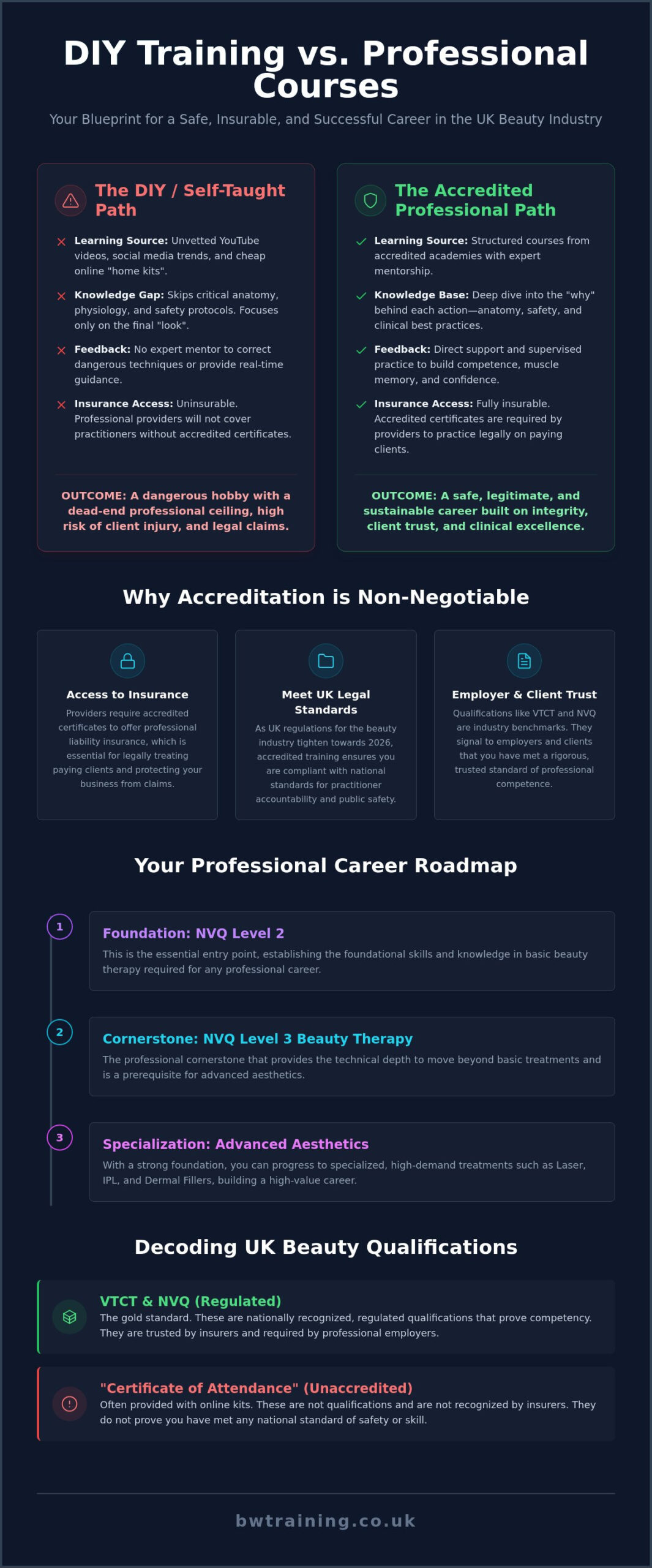
One of the biggest risks of learning alone is the lack of real-time feedback. When you’re teaching yourself, there’s no mentor to correct your technique or point out a potential safety hazard. This creates a dangerous “blind spot” regarding complications. DIY tutorials rarely show what happens when a treatment goes wrong or how to manage a medical emergency. Beyond the safety risks, there’s a clear professional ceiling. Without accredited certification, you can’t access professional insurance. This means you can’t legally treat paying clients, effectively ending your career before it has even begun. When comparing a diy beauty training vs professional course, remember that professional training isn’t just a hurdle to clear. It’s a genuine investment in the safety and well-being of your future clients.
The Anatomy of a Professional Beauty Course
A professional course is far more than a sequence of lessons; it’s a structured educational journey designed to transform a beginner into a competent practitioner. While a DIY approach focuses on the visual outcome, a regulated course prioritises the “why” behind every action. This involves a deep dive into anatomy, physiology, and the chemical composition of products. When you evaluate diy beauty training vs professional course options, you’re essentially choosing between a hobby and a career. A professional path provides the emotional security of knowing you’re fully prepared for the responsibilities of the job.
The curriculum of an accredited course is comprehensive. It covers everything from the basics of health and safety to advanced client consultation techniques. For many, the NVQ Level 3 Beauty Therapy qualification serves as the essential professional cornerstone. It provides the technical depth required to move beyond basic treatments and into advanced aesthetics. This level of training ensures you aren’t just following a trend, but building a sustainable business on a foundation of clinical excellence.
Accreditation and Vocational Standards
In the UK, VTCT and NVQ are the recognised benchmarks for excellence. These aren’t just acronyms; they represent a rigorous standard of assessment that employers and insurers trust. Unlike a simple “certificate of attendance” often found with unaccredited kits, these regulated qualifications prove you’ve met national standards. This alignment is crucial as the industry moves toward stricter oversight, mirrored by global shifts like the Modernization of Cosmetics Regulation Act of 2022 (MoCRA). By choosing a regulated path, you ensure your skills remain relevant and legally compliant as 2026 regulations evolve. If you’re just starting, our NVQ Level 2 Beauty Therapy General course is the perfect first step toward these professional standards.
Hands-On Mentorship vs. Passive Watching
The most significant advantage of a professional course is supervised clinical practice. Watching a video is passive; performing a treatment under the watchful eye of an expert is active learning. Our instructors provide immediate feedback, correcting your posture, pressure, and technique in real time. This mentorship helps you build the muscle memory needed to handle professional-grade equipment safely. Beyond the technical skills, you’ll also learn the “soft skills” of client management. You’ll practice how to conduct thorough consultations and manage client expectations, which are vital components of a successful practice that DIY methods simply cannot replicate.
DIY vs. Professional: The Safety and Legal Comparison
The difference between a hobbyist and a professional is often defined by how they handle a crisis. In the ongoing debate of diy beauty training vs professional course, the legal and safety stakes are remarkably high. If you choose to practice without a regulated certificate, you’re essentially operating without a safety net. In London, most local authorities require a Special Treatment License for services ranging from manicures to advanced aesthetics. These licenses are typically only granted to practitioners who can prove they’ve completed accredited, face-to-face training. Without this legal compliance, your business can be shut down before it even gains momentum.
Beyond the legal hurdles, there’s the vital element of client trust. In 2026, clients are more educated and cautious than ever before. They aren’t just looking for a good price; they’re looking for the emotional security of a practitioner who is “fully insured and accredited.” This phrase is your most powerful marketing tool. It tells your clients that you’ve invested in your skills and that their safety is your primary concern. We believe that professional training is a genuine investment in people, ensuring you have the self-assurance to provide excellent care every single time.
The Insurance Gap
Reputable UK insurers simply won’t cover a self-taught practitioner. Without professional indemnity and public liability insurance, you’re personally liable for any injury or dissatisfaction a client might experience. This represents a massive personal financial risk that could lead to bankruptcy if a legal claim is made. Even when you move toward advanced treatments, such as botox courses or dermal fillers, insurers require specific pre-requisite qualifications. You cannot skip the foundational steps and expect to find a policy that protects your career.
Health, Safety, and Anatomy
Safety in beauty isn’t just about clean tools; it’s about deep biological knowledge. DIY aesthetics carry severe risks, including infection, necrosis, and permanent scarring. Professional courses mitigate these risks by including mandatory Anatomy and Physiology training. This education helps you understand the underlying structures of the skin and face, which is critical for avoiding complications. It also teaches you about contraindications, giving you the confidence to know when you shouldn’t treat a client for their own safety. The FDA Dermal Filler Warnings highlight the dangers of using unapproved products or devices, a common pitfall for those who learn via unaccredited methods. When comparing a diy beauty training vs professional course, remember that professional education teaches you how to fix mistakes, while DIY methods often cause them.
Transitioning from Hobbyist to Professional Practitioner
Turning a personal interest into a profitable career is an exciting journey, but it requires a structured roadmap. While the diy beauty training vs professional course debate often focuses on immediate costs, the real value lies in the long-term career path. Mastery takes time. It’s a commitment to your craft that begins with a solid foundation and evolves into clinical authority. We believe in building your career brick by brick, ensuring you have the self-assurance to succeed at every stage.
Your professional progression should follow a logical sequence to ensure both safety and competence:
- Step 1: The Foundation. Start with NVQ Level 2 Beauty Therapy General. This entry point covers the essential skills every practitioner needs.
- Step 2: Specialisation. Advance to NVQ Level 3 and then move into high-demand areas like NVQ Level 4 Laser and IPL.
- Step 3: Aesthetics Entry. Once your foundations are secure, you can enter the world of injectables with CPD-certified lip filler courses and skin boosters.
- Step 4: Clinical Mastery. For those seeking the highest level of recognition, pursuing a Level 5 or Level 7 Diploma in Aesthetics Practice establishes you as a leading expert in the field.
Ready to start your journey? Explore our full range of accredited beauty and aesthetics courses today and take the first step toward your new career.
Choosing Your Specialism
Identifying your niche is vital for success in the competitive London market. You might prefer the holistic approach of general beauty therapy or the technical precision of focused aesthetic practice. High-demand treatments in Hounslow and West London often include advanced skin rejuvenation and laser hair removal. While fast-track certifications can be tempting, we recommend balancing them with long-term vocational goals. This approach ensures your business remains resilient as 2026 industry standards continue to rise.
Building Your Professional Portfolio
A professional portfolio is more than just a collection of certificates; it’s a record of your clinical growth. During your training, it’s essential to work on diverse skin types and ages to broaden your expertise. This hands-on experience is what truly separates a diy beauty training vs professional course graduate. Beyond the treatments, you must also master the administrative side of the industry. This includes understanding licensing, proper clinical waste disposal, and maintaining high professional ethics. Documenting this journey from student to certified practitioner builds the trust your future clients will rely on.
Why Train with Beautiful World Training Academy?
Since 2014, Beautiful World Training Academy has served Hounslow, Whitton, and the wider West London area. We’ve seen the industry evolve, and we’ve helped thousands of students navigate the choice between a diy beauty training vs professional course. Our mission is to provide more than just a certificate. We provide the emotional security and clinical preparedness you need to thrive in a high-stakes industry. We don’t just certify you; we help you launch your career with the backing of a community that values safety and integrity above all else.
Small class sizes are our standard. This ensures you receive direct, one-on-one mentor support during every practical session. In a crowded classroom or a lonely DIY setting, it’s easy to miss subtle technique errors that could lead to client dissatisfaction or safety risks. Our instructors are there to catch those moments, ensuring your practice is safe and effective from day one. We offer a comprehensive pathway from Level 2 foundational skills through to Level 7 Aesthetics practice, allowing you to grow with us throughout your professional life. This steady, logical progression ensures you never feel rushed or unprepared as you take on more advanced treatments.
Our Hounslow and Whitton Training Centres
Our Hounslow and Whitton training centres are designed to mimic real-world clinical environments. This isn’t just a classroom; it’s a simulation of the professional space you’ll eventually own or manage. For students in Richmond, Twickenham, and Ealing, our locations offer easy access to high-tier education. We understand that your time is valuable. We provide flexible learning options, including intensive and fast-track programmes that fit your schedule without compromising on the depth of your education. This practical environment helps you transition seamlessly from the training room to the treatment room with absolute confidence.
The Beautiful World Advantage
The Beautiful World advantage lies in our commitment to practical reality. You’ll have access to live models and high-end aesthetic technology, bridging the gap between theory and professional application. This is where the diy beauty training vs professional course debate truly ends. You cannot learn to manage skin reactions or handle professional-grade lasers through a screen. Our safety-first training exceeds standard regulatory requirements, giving you the self-assurance that only comes from expert-led, supervised practice. We view your training as a genuine investment in your future, prioritizing your growth as a safe, ethical practitioner. View our upcoming beauty and aesthetics courses in London and join a community dedicated to clinical excellence.
Take the First Step Toward Professional Excellence
Choosing your educational path is the most significant decision you’ll make for your career. While social media makes self-teaching look simple, the reality of diy beauty training vs professional course options comes down to one thing: your ability to practice safely and legally. By choosing a regulated route, you gain the insurance coverage, clinical knowledge, and client trust that are essential for success in 2026. You aren’t just learning a technique; you’re investing in a professional identity that commands respect.
At Beautiful World Training Academy, we bring over 10 years of training excellence to every session. Our courses are fully accredited by VTCT and CPD, ensuring your qualifications meet national standards. With our small class sizes, you’ll receive the personalised mentoring needed to master complex aesthetic skills with confidence. We’re here to support your transition from a passionate beginner to a leading practitioner in West London.
Explore Our Accredited Beauty & Aesthetics Courses and build a career you can be proud of. We look forward to welcoming you into our professional community and helping you achieve your goals.
Frequently Asked Questions
Can I get insured if I am self-taught in beauty therapy?
No. Reputable UK insurance providers require proof of an accredited certificate from a recognised awarding body to grant professional indemnity and public liability insurance. Practising without this cover puts you at immense personal financial risk. This lack of protection is a primary reason why the choice between a diy beauty training vs professional course is so critical for anyone serious about a career.
What is the difference between an accredited course and a certificate of attendance?
An accredited course is regulated by an external awarding body, such as VTCT, ensuring it meets national vocational standards for safety and skill. A certificate of attendance only proves you were present during a session. It doesn’t verify your technical competency or allow you to gain professional insurance or a local council license to practice.
How long does it take to become a professional beauty therapist?
The timeline depends on your chosen specialism and the intensity of the programme. An NVQ Level 2 foundational course can often be completed in a few months through intensive, fast-track training. However, reaching an advanced level in aesthetics typically requires a commitment of one to two years as you progress through higher NVQ levels and gain clinical experience.
Is it illegal to perform beauty treatments without a qualification in the UK?
Most local authorities in the UK, particularly across London, require practitioners to hold a Special Treatment License. To obtain this license, you must usually provide evidence of accredited training. Operating without the necessary council license or professional insurance can result in significant fines and the immediate closure of your business by local enforcement officers.
Do I need NVQ Level 3 to start aesthetics training?
Yes, most high-quality aesthetics programmes require an NVQ Level 3 in Beauty Therapy or an equivalent qualification in Anatomy and Physiology. This foundation is essential for understanding the biological structures you’ll be treating. Without this prerequisite, you’ll likely find it impossible to secure the insurance needed for advanced procedures like dermal fillers or anti-wrinkle injections.
Can I learn aesthetics like dermal fillers through online-only courses?
No, online-only courses are insufficient for mastering complex injectable treatments. While you can study theory and anatomy remotely, you must undergo hands-on clinical practice on live models under the direct supervision of an expert mentor. This practical experience is the only way to safely develop the precision and complication management skills required for professional practice.
What qualifications do I need to open a beauty salon in London?
You generally need a minimum of an NVQ Level 2 or 3 qualification in the treatments your salon will offer to satisfy local authority licensing requirements. You must also have valid public liability insurance and a premises license. Because each London borough has its own specific bylaws, you should always consult your local council’s licensing department before signing a lease.
Are DIY beauty kits safe for professional use?
No, DIY beauty kits sold to the general public often lack the medical-grade standards and regulated ingredients required for professional clinical use. Using unverified products on clients significantly increases the risk of infections, allergic reactions, and poor results. Professional courses provide access to high-end, regulated technology and products that ensure both client safety and your professional reputation.