Did you know that botulinum toxin and dermal fillers now account for 9 out of 10 cosmetic procedures in the UK? While the market is worth an estimated £3.6 billion, the regulatory landscape in the capital has shifted permanently. Learning how to start an aesthetics business london can feel overwhelming when you’re faced with the mandatory licensing scheme arriving in July 2026. We understand the pressure of choosing the right path, especially when you’re navigating the confusion between medic and non-medic pathways or worrying about borough-specific requirements like the Special Treatment Licence.
It’s natural to feel a sense of urgency about compliance, but we’re here to provide the steady guidance you need. This guide offers a comprehensive blueprint to help you transition from uncertainty to a fully accredited, profitable practice. We’ll walk you through the essential NVQ levels, the expected Level 7 benchmark for injectables, and the two-licence model required for both practitioners and premises. By the end of this article, you’ll have the roadmap and the confidence to launch your career in London’s thriving aesthetics industry with total peace of mind.
What you’ll learn in this guide:
- Understand the 2026 mandatory licensing scheme and how the London Local Authorities Act 1991 impacts your specific borough.
- Map a clear educational journey from NVQ Level 3 Beauty Therapy through to a Level 7 Diploma in Aesthetics Practice to meet new benchmarks.
- Master the logistics of how to start an aesthetics business london, from securing compliant premises to managing clinical waste contracts.
- Develop a strategic business plan that defines your unique selling proposition and sets profitable rates for the London market.
- Gain the professional confidence to launch your practice with the support of accredited, industry-leading training.
Navigating the London Aesthetics Landscape in 2026
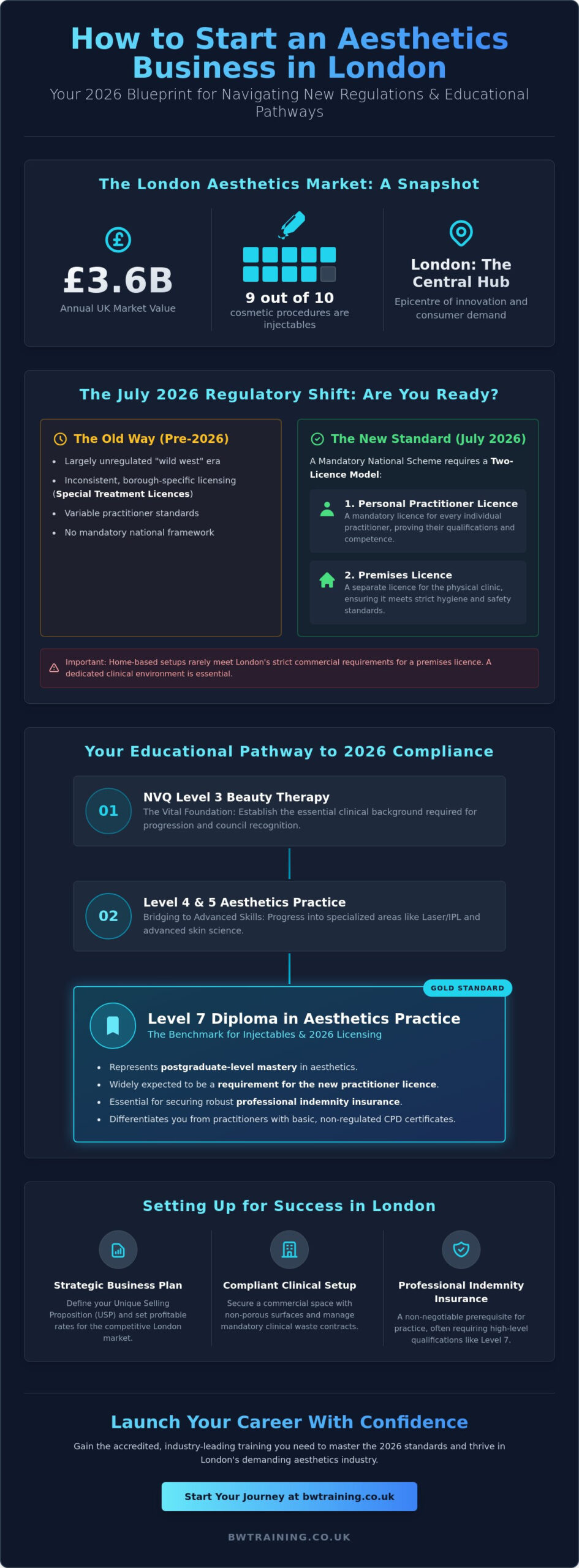
London’s aesthetics market is currently experiencing a period of significant growth. While the UK market is valued at approximately £3.6 billion annually, the capital remains the central hub for innovation and consumer demand. If you are researching how to start an aesthetics business london, you’ll find particularly strong opportunities in West London hubs like Hounslow and Richmond. The broader field of Aesthetic medicine has evolved from a niche luxury to a mainstream expectation. With 9 out of 10 cosmetic procedures now involving injectables, the potential for new practitioners is vast.
However, entering this market requires more than clinical skill; it demands a deep understanding of the London Local Authorities Act 1991. This specific legislation governs ‘Special Treatment’ licenses, which are mandatory for procedures involving the piercing of the skin. Unlike other parts of the UK, London practitioners must navigate these borough-specific rules before they even open their doors. July 2026 marks a turning point for the industry with the introduction of a mandatory national licensing scheme. This new framework requires both a personal practitioner license and a separate premises license, ending the era of the unregulated ‘wild west.’
London Council Licensing vs. National Regulations
Licensing isn’t uniform across the city. Hounslow, Richmond, and Ealing councils each have distinct application processes and fee structures for their Special Treatment Licenses. You’ll work closely with Environmental Health officers who conduct rigorous clinic inspections to ensure hygiene and safety standards are met. Many aspiring business owners assume they can start from a spare bedroom, but home-based setups rarely meet London’s strict commercial requirements. Most councils demand dedicated clinical environments with non-porous surfaces and specific ventilation to grant a license. We always advise our students to secure a commercial space that aligns with these high expectations from day one.
The 2026 Practitioner Standard: Why Mediocrity is No Longer an Option
The shift toward the JCCP (Joint Council for Cosmetic Practitioners) register has changed consumer behavior. London clients are more educated than ever; they actively seek out practitioners who hold a Level 7 qualification. This postgraduate standard is becoming the industry benchmark for administering anti-wrinkle injections and dermal fillers. To how to start an aesthetics business london successfully, you must differentiate yourself through accredited, high-level training. This commitment to excellence doesn’t just build client trust; it’s often a prerequisite for securing professional indemnity insurance. In a competitive city, being fully compliant and highly qualified is your greatest professional asset.
Educational Pathways: From Beginner to Level 7 Mastery
Understanding how to start an aesthetics business london requires a clear-eyed look at the educational ladder. For many, the journey doesn’t start with a medical degree, but with a solid foundation in beauty therapy. If you’re following the non-medic pathway, beginning with an NVQ Level 3 Beauty Therapy qualification is the first vital step toward professional recognition. This regulated course provides the clinical background necessary to progress through advanced levels safely while meeting the specific requirements of London’s local councils.
Once you’ve mastered Level 3, the bridge to advanced practice involves moving into Level 4 Laser and IPL, followed by Level 5 Aesthetics Practice. This structured progression ensures you aren’t just performing treatments; you’re understanding the complex science behind them. The British Beauty Council on aesthetics regulation emphasizes that the industry is moving away from short, unregulated workshops toward comprehensive, Ofqual-regulated qualifications. This shift is designed to protect both the practitioner and the public.
By 2026, the Level 7 Aesthetics diploma will be the industry gold standard. It represents postgraduate-level mastery and is widely expected to be a requirement for the new licensing scheme. Unlike basic CPD (Continuing Professional Development) certificates, which may not be recognized by future licensing boards, an Ofqual-regulated Level 7 qualification provides the long-term security your business needs. Learning how to start an aesthetics business london means investing in your education early to stay ahead of the July 2026 mandate.
Foundation Training: Botox and Dermal Fillers
Your practical journey often begins with Accredited Botox Courses and Accredited Lip Filler Courses. These aren’t just about injection techniques. They’re about facial mapping, skin health, and patient selection. We prioritize hands-on practice with live models in a clinical setting. This real-world experience builds the muscle memory and calm confidence required to treat your own clients safely once your clinic doors open.
Anatomy, Physiology, and Complications Management
A deep understanding of Anatomy and Physiology at Level 3 and 4 is non-negotiable. You can’t safely inject what you don’t fully understand. Ethical practice also requires being prepared for the unexpected. Complications management training is what separates a professional from an amateur. This knowledge protects your London business from litigation and, more importantly, ensures the safety of your clients. If you’re ready to begin your journey, explore our accredited pathway options today.
Clinical Setup: Compliance, Insurance, and London Logistics
Once you’ve secured your qualifications, your focus must shift to the physical environment where you’ll practice. Learning how to start an aesthetics business london requires a deep dive into the logistics of clinical compliance and premises management. You’ll need to decide between a full commercial lease or renting a room within an established salon. While room rentals offer lower initial overheads, you must verify that the host premises already holds a valid license that covers your specific treatments. If they don’t, you’ll need to apply for your own to remain legal.
Clinical waste management is another non-negotiable factor. You must have a formal contract with a registered waste carrier to dispose of sharps and clinical materials. This isn’t just a safety protocol; it’s a legal requirement under London-wide environmental disposal regulations. We also recommend establishing a partnership with a prescriber early on if you’re a non-medic. Since toxins are prescription-only medicines (POMs), you’ll need a face-to-face consultation for every patient before treatment can proceed. This collaborative approach ensures your business stays aligned with the UK government’s licensing scheme and prioritizes patient safety.
The ‘Special Treatment License’ Application Process
The Special Treatment License (STL) is the backbone of London compliance. In boroughs like Hounslow or Twickenham, the process is precise and requires thorough preparation. You’ll typically need to submit the following documentation:
- Detailed floor plans showing treatment areas and hand-washing facilities.
- Qualification certificates for every practitioner working at the premises.
- PAT testing records for all electrical equipment, including lasers or centrifuges.
- Calibration certificates for any medical-grade devices.
Expect a visit from a council inspector. They’ll check for non-porous surfaces, adequate lighting, and proper sterilization protocols. We find that practitioners who treat this inspection as a professional audit rather than a hurdle often build more resilient businesses.
Pharmacy and Stock Management
Establishing relationships with reputable UK aesthetic pharmacies is vital for your clinical integrity. It’s tempting to look for cheaper options, but the ‘grey market’ for fillers is rife with counterfeit products that carry significant legal and health risks. To how to start an aesthetics business london with a reputation for excellence, only source products from regulated suppliers. You must also ensure you have correct storage for toxins and emergency reversal agents like Hyaluronidase. Having an emergency kit on-site isn’t just best practice; it’s a cornerstone of the professional standard London clients expect.
Strategic Business Planning for the London Market
Success in the capital requires more than just clinical excellence; it demands a sharp business mind. When you’re figuring out how to start an aesthetics business london, your Unique Selling Proposition (USP) is your most powerful tool. In a city where clients have endless choices, positioning yourself as a “Compliance-First” practitioner provides the emotional security patients crave. This isn’t just about marketing; it’s about weaving professional authority into every touchpoint of your brand, from your logo to the way you answer the phone.
Pricing your services in London is a delicate balancing act. You have to account for higher than average commercial rents and specialized insurance premiums while remaining competitive. We suggest avoiding a “race to the bottom” on price. Instead, focus on the value of your expertise and the safety of your clinical environment. A ‘Patient-First’ consultation process is essential here. By prioritizing a thorough assessment over a quick sale, you build the long-term loyalty that sustains a business through its early years. This approach transforms a one-time visitor into a lifelong advocate for your practice.
Marketing Your London Aesthetics Business
While many practitioners rely solely on social media, smart business owners focus on local SEO. Ranking for specific neighborhood terms like ‘Botox Hounslow’ or ‘Fillers Richmond’ helps you capture high-intent clients in your immediate area. Social proof is equally vital. Actively managing your Google Reviews and maintaining a professional portfolio of before and after images provides the evidence clients need to trust you. You must also stay within the Advertising Standards Authority (ASA) rules. In the UK, it’s illegal to advertise prescription-only medicines like anti-wrinkle injections to the public. Focus your marketing on your skills, your qualifications, and the consultation process instead.
Financial Management and Growth
Managing your finances effectively means knowing your exact break-even point. This includes your rent, clinical waste contracts, and the cost of your professional indemnity cover. Once you’ve established a steady client base, reinvesting in your skills is the best way to grow. Adding services like Advanced Dermal Fillers or Microneedling Training allows you to offer more comprehensive treatment plans to your existing patients. While every business varies, a well-managed London aesthetics startup typically aims to reach its initial break-even point within the first 12 to 18 months of consistent operation. If you’re ready to build a business founded on accredited excellence, explore our Level 7 Diploma options to secure your professional future.
Launch Your Career with Beautiful World Training Academy
Embarking on a new professional journey requires more than just a certificate; it requires a partnership with mentors who understand the stakes. When you’re researching how to start an aesthetics business london, the sheer volume of regulatory changes can feel daunting. At Beautiful World Training Academy, we provide the steady guidance and authoritative expertise you need to navigate this transition with calm confidence. We don’t just teach techniques. We empower you with the clinical readiness and regulatory knowledge to launch a practice that is safe, compliant, and respected from day one.
Our West London training centres in Hounslow and Whitton serve as hubs for excellence, designed to mirror the clinical environments you’ll eventually manage. We’ve structured our programmes to offer a ‘Fast-Track’ to professional success that never compromises on safety. This efficiency comes from our highly organized, logical curriculum that distills complex standards into manageable, practical steps. We’re deeply invested in the well-being of the workforce we help create, offering ongoing mentorship that extends far beyond your final assessment.
Our Accredited Course Pathways
We provide a seamless educational ladder tailored to the evolving London market. Whether you’re starting with NVQ Level 2 or NVQ Level 3 Beauty Therapy General, or you’re ready to master the Level 7 Diploma in Aesthetics Practice, our pathways are fully accredited and recognized by local authorities. Our approach focuses on:
- Intensive Practical Sessions: We prioritize hands-on experience with expert instructors to build your muscle memory.
- Small Group Sizes: We limit our intake to ensure you receive the personalized attention necessary for mastering life-saving skills.
- Local Authority Alignment: Our curriculum is specifically designed to meet the rigorous licensing requirements of London boroughs like Hounslow and Richmond.
Take the First Step Toward Your London Clinic
Your transition into the aesthetics industry should feel like a well-planned investment rather than a stressful obligation. We offer flexible payment plans to ensure your business goals remain manageable and within reach. Our career advisors in West London are ready to help you map out a bespoke training schedule that aligns with your specific ambitions. We’ll help you gain the self-assurance needed to stand out in a competitive city. Start your journey with Beautiful World Training Academy today and take the first definitive step toward learning how to start an aesthetics business london with total professional security.
Secure Your Professional Future in London Aesthetics
The shift toward mandatory licensing in July 2026 represents a landmark moment for patient safety and practitioner standards. By aligning your practice with these new regulations now, you’re not just opening a clinic; you’re building a reputation founded on trust. Success in this competitive market requires a clear understanding of how to start an aesthetics business london, from mastering local council licenses to achieving the Level 7 benchmark. We’ve seen that practitioners who prioritize compliance early on are the ones who achieve long-term stability.
We’re here to guide you through every step of this journey with over 10 years of vocational training excellence. Our Ofqual-regulated Level 7 qualifications and expert mentorship in Hounslow and Whitton provide the clinical security you need to thrive. Take the next step toward your professional goals with a team that’s as invested in your safety as you are. Your path to a successful practice starts with the right preparation, and we’re ready to help you launch with confidence.
Explore Our Accredited London Aesthetics Courses
Frequently Asked Questions
Do I need to be a nurse or doctor to start an aesthetics business in London?
No, you don’t need a medical degree to enter the industry, but you must follow a regulated educational pathway. Non-medics often start with an NVQ Level 3 in Beauty Therapy before progressing to Level 4 Laser and Level 5 Aesthetics. By July 2026, the Level 7 Diploma will be the expected benchmark for everyone. This ensures you have the clinical depth to treat patients safely while complying with the new licensing framework.
What is a Special Treatment License and do I need one for my London borough?
A Special Treatment License is a mandatory permit required by most London boroughs for treatments that involve piercing the skin. Under the London Local Authorities Act 1991, you must apply to your local council before offering services like microneedling or injectables. Fees vary by borough. For example, Waltham Forest fees start at £590, while Newham’s license costs £770 for the 2026-2027 period.
How much does it typically cost to start an aesthetics business in London?
Startup costs vary based on your location and business model. You’ll need to budget for borough-specific licensing, which can range from £590 to over £770 depending on the area. Other essential costs include specialist indemnity insurance, clinical waste contracts, and high-quality stock. When planning how to start an aesthetics business london, focusing on a compliance-first budget helps you avoid unexpected legal fees or council fines later.
Can I run an aesthetics business from my home in London?
It’s very difficult to run a compliant aesthetics business from a residential home in London. Most local councils require your premises to have specific clinical features, such as non-porous flooring, dedicated hand-wash basins, and professional ventilation. Environmental Health officers conduct strict inspections to ensure the space is safe. We always recommend securing a dedicated commercial space or a room in a licensed salon to meet these standards.
What insurance do I need as a new aesthetics practitioner in the UK?
You must have specialist medical malpractice and public liability insurance. These policies protect you against claims of negligence or accidental injury during treatments. Premiums are often tiered based on your qualifications and the risk level of the procedures you offer. For example, annual premiums for high-risk treatments like dermal fillers can start from £371.40 for £1 million in treatment liability cover as of early 2026.
How long does it take to get qualified to perform Botox and fillers?
The timeline depends on your starting point and the level of mastery you want to achieve. Foundation courses for anti-wrinkle injections usually take a few days of intensive training, but reaching the Level 7 benchmark is a longer commitment. We focus on a steady, logical progression that allows you to build clinical confidence through hands-on practice. This approach ensures you’re prepared for the long-term demands of the 2026 regulatory environment.
What are the new aesthetics regulations coming in 2026?
The July 2026 regulations introduce a mandatory licensing scheme for all practitioners performing cosmetic injectables. This framework uses a traffic light system to categorize procedures by risk level. You’ll need both a personal practitioner license and a premises license to operate legally. This professionalization of the industry ends the unregulated environment of the past and prioritizes patient safety through higher training standards like the Level 7 qualification.
How do I find a prescriber if I am a non-medic practitioner?
Non-medics can find prescribers through dedicated prescribing networks or by building partnerships with local doctors, dentists, or nurses. Since toxins are prescription-only medicines, a face-to-face consultation is required for every patient. Many practitioners also use aesthetic pharmacies that offer prescriber services. This collaborative model is a key part of how to start an aesthetics business london while maintaining the highest ethical and legal standards.